Planning Guides, Style Guide
Ceremony Examples: Sample Ideas & Examples
Apr
Okay So Ceremony Structure Basics
Look, the biggest thing people get wrong is thinking every ceremony has to follow the exact same formula. Like there’s this one “right” way to do things and honestly that drives me crazy because I’ve planned over 300 weddings at this point and literally no two have been identical. You’re gonna want to think about what actually matters to you versus what you think you’re “supposed” to do.
The traditional processional usually goes: officiant enters first, then groom with parents or just walks in himself, then wedding party (groomsmen, bridesmaids), then flower girl and ring bearer, and finally the bride with whoever’s walking her down. But here’s the thing – you can totally flip this. I had a couple in spring 2023 who did a “all at once” entrance where literally everyone walked in together as a group and it was actually kinda beautiful and way less stressful for the bride who hated being the center of attention.
Sample Processional Orders You Can Actually Use
Traditional Religious:
- Officiant takes position
- Groom enters with parents (or solo)
- Groomsmen walk in (solo or paired)
- Bridesmaids walk in (solo or paired)
- Maid/Matron of Honor
- Ring bearer and flower girl
- Bride with parent(s)
Modern Paired Walk:
- Wedding party enters in pairs (one bridesmaid, one groomsman together)
- Best man and Maid of Honor together
- Ring bearer/flower girl
- Both partners walk in together OR each with their own parents
Casual Reverse:
- Groom walks bride down the aisle (yeah this is a thing now)
- Or both sets of parents walk them both in
- Wedding party is already standing up there
The Actual Ceremony Content
So once everyone’s up there, you need actual words to say. This is where I see people freeze up because they think it has to be super formal or… I don’t know, sound like Shakespeare? But it doesn’t.
Opening Words Example:
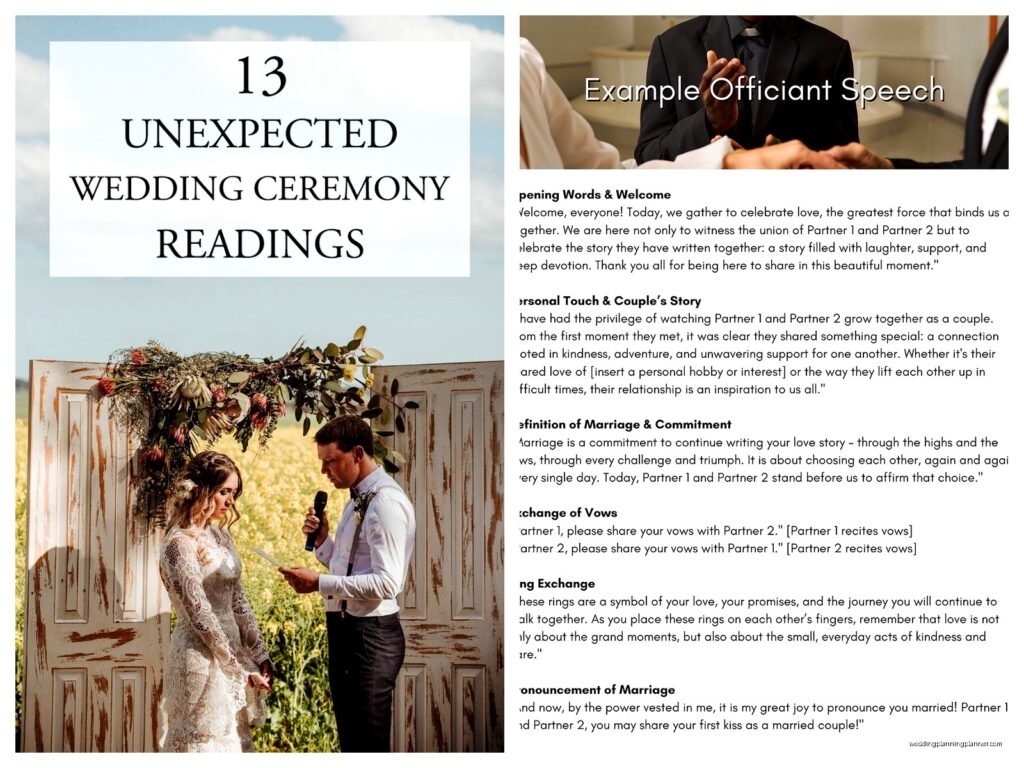
Welcome everyone. We’re here because [Partner A] and [Partner B] decided they wanted to spend their lives together, and they wanted you specifically to be here for this moment. No pressure or anything.
That’s it. You can add more but honestly keeping it simple works. The officiant can acknowledge why everyone’s gathered, maybe crack one joke (just one, not like a comedy routine which I’ve seen go horribly wrong), and then move into the actual ceremony.
Sample Ceremony Script Sections
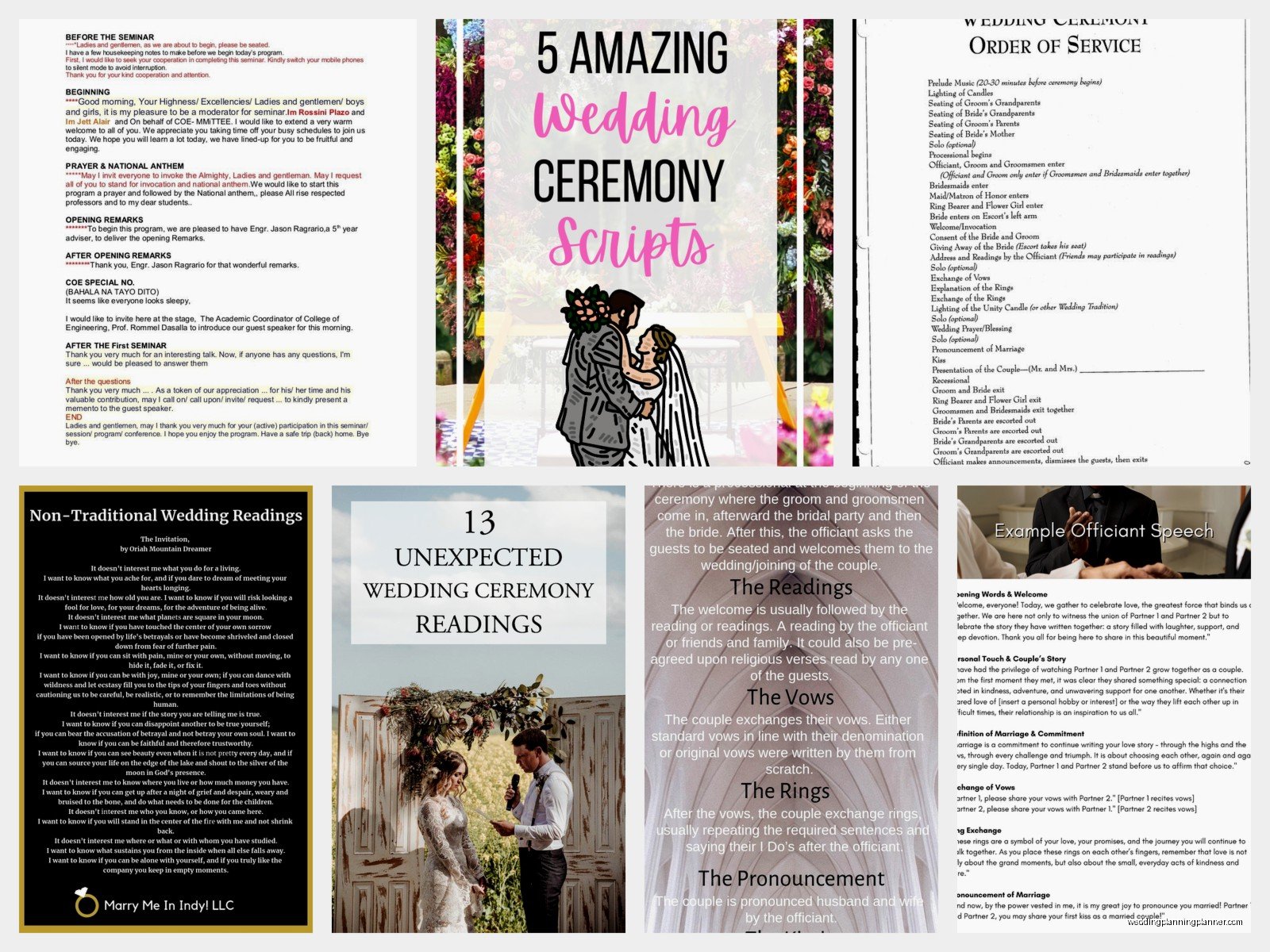
Okay so here’s a breakdown of the chunks you’re gonna need:
Welcome/Opening (2-3 minutes): Officiant welcomes guests, maybe mentions the weather or the location or how far people traveled. Keep it under 3 minutes because people are standing and also my cat once knocked over a unity candle during this part at a home wedding and it was chaos.
Readings or Rituals (5-10 minutes): This is where you’d put any poems, religious texts, or cultural traditions. You don’t need this section at all if you don’t want it. Some couples do like three readings and honestly it drags, but if the readings matter to you then absolutely include them.
Sample reading sources that aren’t cringey:
- Pablo Neruda poems (Sonnet XVII is popular for a reason)
- Excerpts from favorite books (I’ve seen Harry Potter, Captain Corelli’s Mandolin, even Dr. Seuss work)
- Song lyrics if they’re meaningful
- Personal letters written to each other
The Declaration of Intent (2 minutes): This is the “do you take this person” part. You can word it however you want.
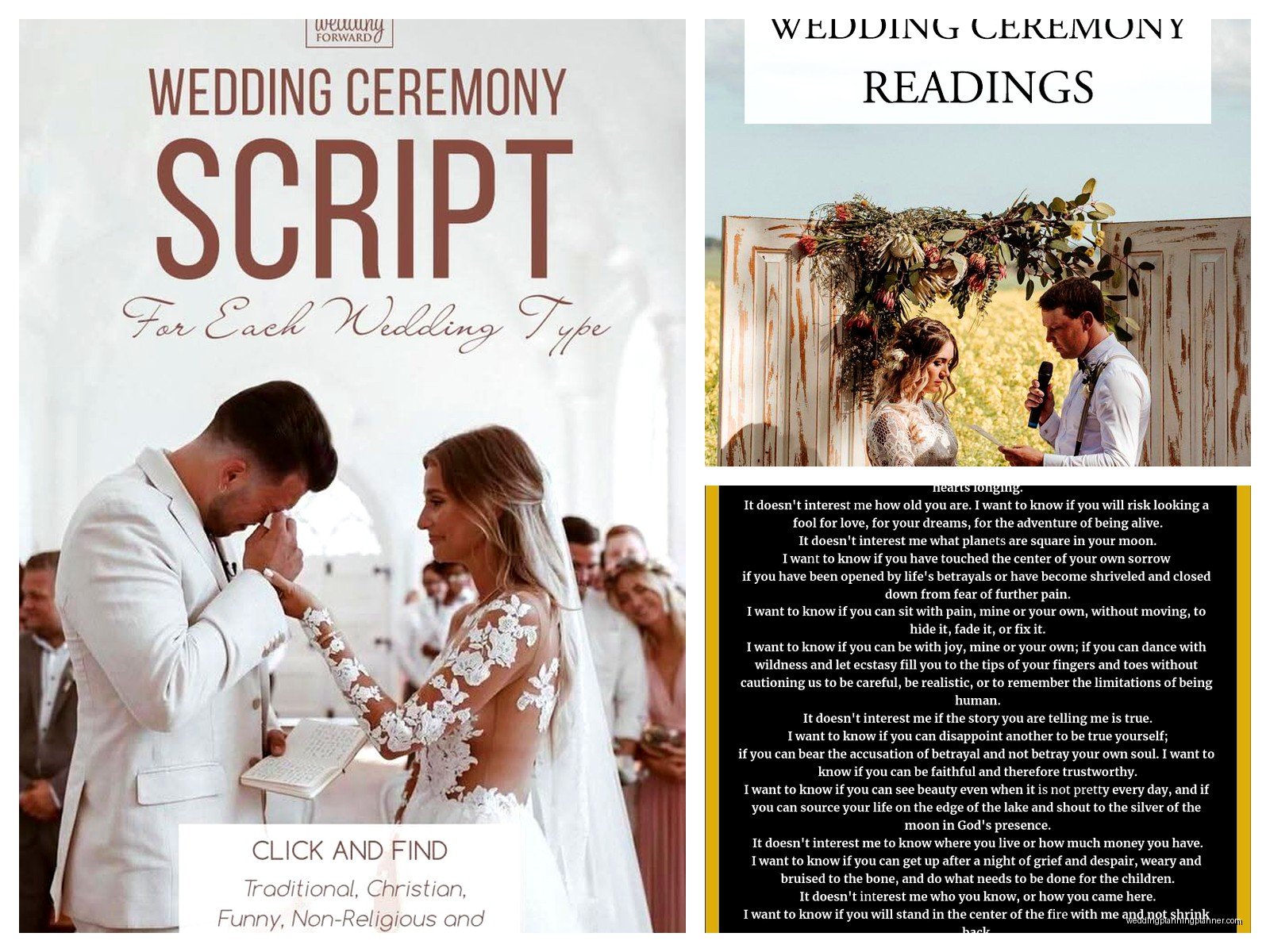
Do you, [Name], choose [Name] to be your partner, your best friend, your favorite person to binge-watch terrible reality TV with, for as long as you both shall live?
Or keep it traditional:
Do you, [Name], take [Name] to be your lawfully wedded spouse, to have and to hold from this day forward, for better or worse, for richer or poorer, in sickness and in health, to love and to cherish, till death do you part?
Vows – The Part Everyone Actually Cares About
Real talk: the vows are what people remember. Not the flowers, not the centerpieces (sorry), but what you actually say to each other. You’ve got options here.
Traditional Vows: These are the standard “to have and to hold” ones. They work. They’re time-tested. No one will judge you for using them. Sometimes simple is better, especially if you’re gonna cry through them anyway.
Personal Vows: This is where you write your own. I always tell couples to keep them between 1-2 minutes each when read aloud. Any longer and people start getting fidgety, any shorter and it feels rushed. Also – and this annoys me SO much – make sure you’re roughly the same length as your partner because I’ve seen situations where one person writes like a novel and the other person has three sentences and it gets awkward.
Sample personal vow framework:
- Start with what you love about them or a specific memory
- Talk about what they’ve taught you or how they’ve changed your life
- Make specific promises (not just “I’ll love you forever” but like “I promise to always let you control the thermostat” or whatever)
- End with your commitment statement
Example Personal Vow:
I promise to be your partner in all things. I promise to support your dreams even when they involve starting a sourdough obsession that takes over our entire kitchen. I promise to laugh at your jokes, even the bad ones, and to hold your hand through every scary movie you insist we watch. I choose you today and every day after.
Ring Exchange Wording
This part is quick but you need words for it. The officiant usually says something, then each person repeats a line as they put the ring on.
Officiant says: “The wedding ring is a symbol of eternity. It’s a circle with no beginning and no end, representing your endless love and commitment.”
Each partner says: “I give you this ring as a symbol of my love and commitment. Wear it as a reminder that I will love you every single day.”
Or go super simple: “With this ring, I thee wed.”
That’s literally all you need. I had a couple in summer 2021 who tried to write like a whole paragraph for the ring exchange and they both forgot their lines and it was just… you could skip this entirely if you’re not doing rings, by the way.
Unity Ceremonies and Rituals
These are optional but a lot of people like having something visual during the ceremony. Here’s what actually works:
Unity Candle: Two taper candles (representing each person or family) light one big candle together. Takes about 2 minutes. Pro tip: if you’re outside, this will not work because wind exists.
Sand Ceremony: Each person has different colored sand, you pour them into one container. It looks cool and works outdoors. The symbolism is that the colors can’t be separated once mixed, which is kinda dramatic but people love it.
Handfasting: Celtic tradition where you literally tie your hands together with ribbon or cord. This is where “tying the knot” comes from. It’s pretty and photographs well.
Wine/Whiskey Ceremony: You seal a bottle of wine or whiskey with love letters to each other, then you’re supposed to open it on your first anniversary or during a rough patch. I’ve seen couples do this with a wooden box they both hammer shut which is very dramatic in a good way.
Tree Planting: Each person adds soil to a potted tree or plant. Symbolizes growth together. Just make sure someone’s gonna actually take care of the plant after because otherwise it’s just sad.
Cultural and Religious Elements You Might Want
Depending on your background, there’s tons of traditions you can pull from. You don’t have to do all of them or even any of them, but here’s some common ones I see:
Jewish Ceremonies:
- Chuppah (wedding canopy) – everyone stands under it
- Ketubah signing (marriage contract)
- Breaking the glass at the end
- Seven blessings (Sheva Brachot)
- Circling (bride circles groom or they circle each other)
Catholic Ceremonies:
- Full mass (if you want it, adds like 45 minutes)
- Blessing and exchange of rings
- Nuptial blessing
- Presentation of flowers to Mary (optional)
Hindu Ceremonies:
- Saptapadi (seven steps around sacred fire)
- Kanyadaan (giving away of the bride)
- Sindoor and mangalsutra ceremonies
- These are typically way longer, like 2-3 hours, so plan accordingly
Celtic Traditions:
- Handfasting (mentioned earlier)
- Oathing stone ceremony
- Celtic knot symbolism
The Pronouncement and Kiss
This is the big moment. The officiant declares you married and then you kiss. Some officiants say “you may now kiss” and some say “you may seal your marriage with a kiss” or whatever. The wording doesn’t really matter as much as just… not making the kiss super long because everyone’s watching and it gets weird after like 3 seconds, trust me.
Sample pronouncement:
By the power vested in me by [state/country], I now pronounce you married! You may kiss!
Then usually there’s applause and cheering, the couple turns to face everyone, and the officiant introduces them: “For the first time as a married couple, [Names]!” or “It is my honor to present to you Mr. and Mrs. [Name]” if you’re going traditional, or “[Name] and [Name]!” if you’re keeping your names or doing something different.
Recessional
Everyone walks back down the aisle. Usually it goes: newly married couple first (obviously), then flower girl/ring bearer, then maid of honor with best man, then bridesmaids with groomsmen, then parents. The music is typically upbeat and celebratory. Think “Signed, Sealed, Delivered” or classical stuff like Mendelssohn’s Wedding March.
Some couples do a fun exit with sparklers or bubbles or whatever right after the recessional, some just walk straight to photos. Up to you.
Timing the Whole Thing
A typical ceremony runs 20-30 minutes. Anything under 15 feels rushed, anything over 45 and people start getting restless. Here’s a rough breakdown:
- Processional: 3-5 minutes
- Welcome: 2-3 minutes
- Readings/rituals: 5-10 minutes (if you include them)
- Vows: 5-8 minutes total
- Ring exchange: 2-3 minutes
- Unity ceremony: 3-5 minutes (if doing one)
- Pronouncement and kiss: 1 minute
- Recessional: 2-3 minutes
Non-Traditional Ceremony Ideas That Actually Work
Because not everyone wants the standard setup, here’s some alternatives I’ve seen work really well:
Circular Ceremony: Instead of rows of chairs, everyone stands in a circle around the couple. It’s more intimate and everyone can actually see. Works best with smaller weddings (under 100 people).
In-the-Round: Similar but with chairs in a circle, couple in the middle. Very theatrical, everyone feels included.
Casual Gathering: No processional at all. Everyone just gathers, couple is already standing there, officiant starts talking. Super low-key, works for backyard weddings or elopements with guests.
Adventure Ceremony: Hike to a location, have a 10-minute ceremony, hike back. Keep it short because everyone’s standing on a mountain or whatever.
Living Room Ceremony: Literally just in someone’s living room with like 20 people. I did one of these during a super stressful situation where the original venue flooded three days before and we moved everything to the bride’s parents’ house and honestly it was one of the most meaningful ceremonies I’ve witnessed because it was so intimate and real.
Guest Participation Ideas
If you want guests to feel involved beyond just watching:
- Ring warming: pass the rings around during the ceremony, everyone holds them for a moment and sends good wishes
- Community vows: officiant asks guests to promise to support the marriage, everyone says “we do”
- Rose ceremony: give roses to parents or important people during the ceremony
- Group blessing or prayer if that fits your vibe
- Ask guests to write marriage advice on cards during cocktail hour instead of a guestbook
What to Actually Tell Your Officiant
Whether it’s a friend, a professional, or a religious leader, you gotta communicate what you want. Give them:
- Your ceremony timeline/order of events
- Any specific wording you want included or avoided
- How much personality/humor you want (scale of 1-10)
- Religious or cultural elements to include
- Who’s doing readings and what they’re reading
- Any special circumstances (blended family acknowledgments, memorial moments, etc.)
- How to pronounce everyone’s names correctly because this matters more than you’d think
I always recommend having at least one meeting or call with your officiant to go through everything, then another one closer to the wedding to finalize. If you’re writing personal vows, decide if you’re gonna share them with each other beforehand or keep them secret – there’s no right answer but you should both be on the same page about it.
Also make sure your officiant knows where to stand, when to move, and that they need to speak LOUD especially if you’re outdoors because I’ve been to ceremonies where no one could hear anything and it defeats the whole purpose. Microphones are your friend, use them.