
Planning Guides, Style Guide
Desi Wedding Invitations: Design & Ordering Guide
Jun
Okay so Desi wedding invitations are their own beast
The first thing you need to know is that these aren’t your typical wedding invitations. Like, I had this client back in summer 2021 who thought she could just order from Minted and call it a day, and I had to basically sit her down and explain that Desi wedding invitations are more like… announcement packages? They’re telling a story, honoring multiple events, and honestly they’re kinda showing off your family’s style and taste level.
Start by figuring out how many events you’re actually inviting people to. Most Desi weddings have at minimum three events – mehndi, wedding ceremony, and reception. But you might also have sangeet, haldi, a separate cocktail hour, maybe a religious ceremony that’s different from the reception. I’ve worked with families doing seven events and honestly that’s when things get complicated with the stationery.
The whole insert card situation
So here’s what annoys me about Desi invitation ordering – vendors will quote you for “the invitation” but that’s literally just one piece of card stock. You need insert cards for each event, you need the main invitation card, you need envelopes (plural, because we’re doing inner and outer usually), RSVP cards, details cards, maybe a map card if your venues aren’t easy to find, and possibly a whole separate card for the religious ceremony if it’s Hindu or Sikh because those explanations get long.
I always tell couples to map this out on paper first. Write down every single event with the date, time, dress code, and venue. Then figure out what needs its own card versus what can share space. Like, if your mehndi and sangeet are back-to-back on the same day at the same venue, you can probably put those on one insert card.
Design styles and what actually works
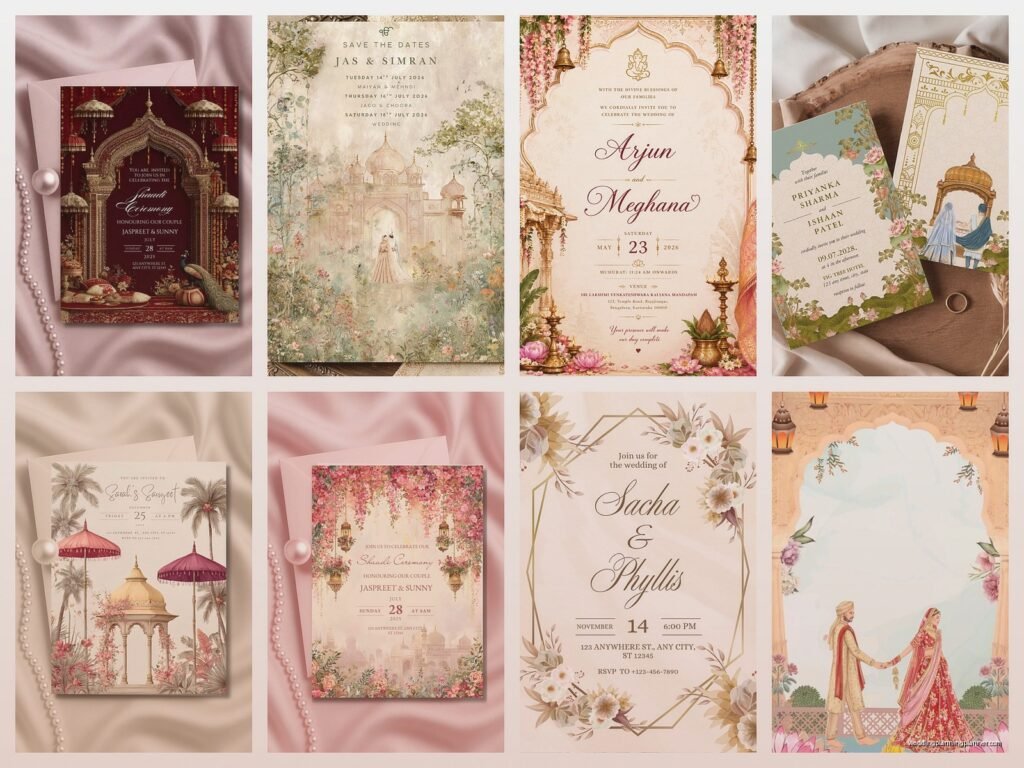
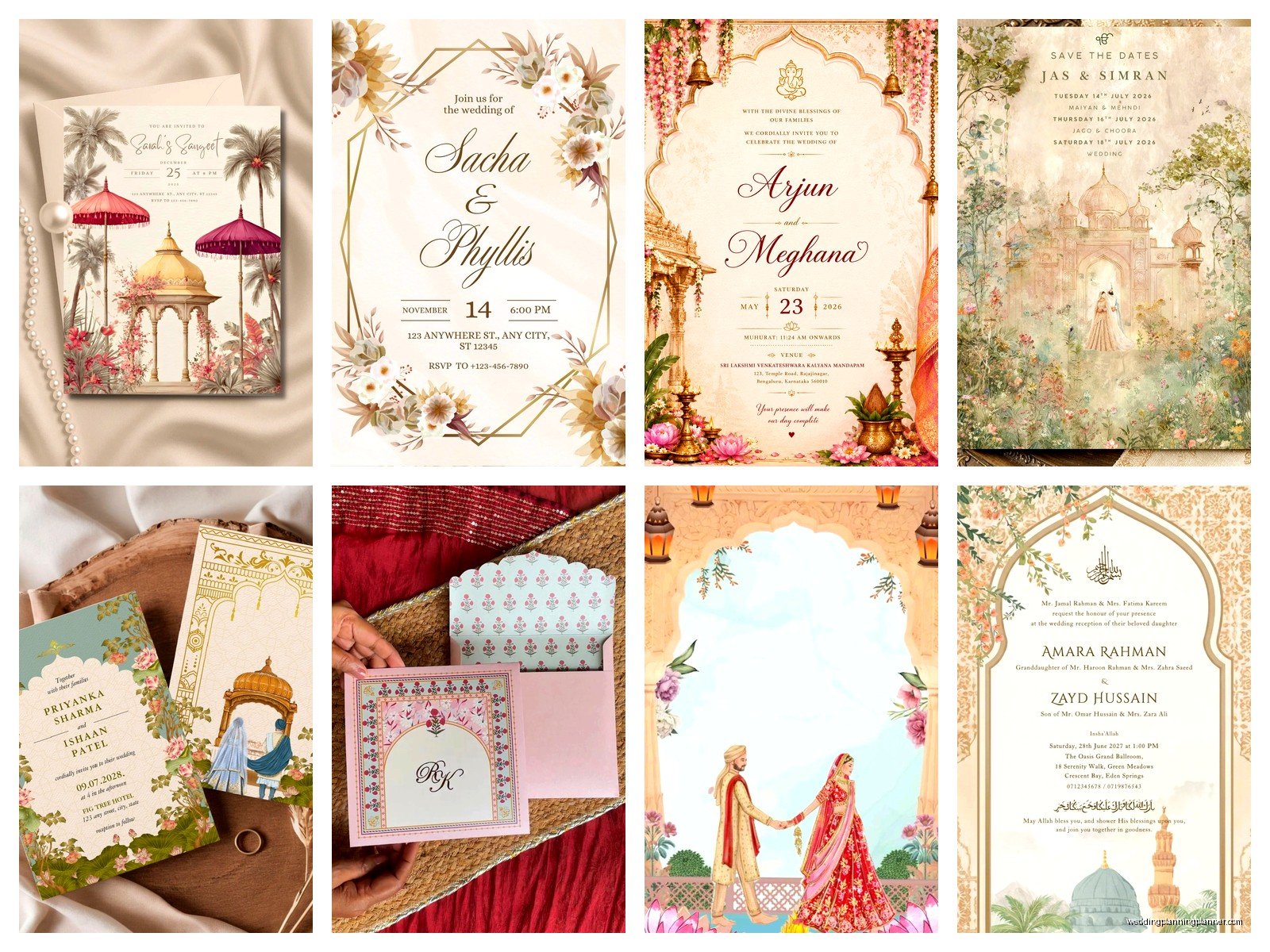
There are basically a few routes you can go design-wise. Traditional Indian motifs with paisley, lotus flowers, elephants, and those gorgeous mandala patterns. Modern minimal with just clean typography and maybe one metallic accent color. Fusion where you’re mixing Western elegance with Indian elements. Or full maximalist which is like… everything everywhere all at once but make it wedding.
The traditional route is safest if you have older family members who are gonna judge. And they will judge, trust me. I remember spring 2023 I had a bride who wanted these gorgeous modern invites with just her and her fiancé’s initials in rose gold, very minimal, very chic. Her grandmother literally called her mother crying because “where are the gods, where is the respect for tradition” and we ended up doing a whole second version with Ganesha for the older relatives.
Colors matter SO much. Red and gold is classic for a reason – it photographs well, it feels festive, it screams celebration. But I’ve seen beautiful invites in royal blue and silver, emerald green and gold, even blush pink and rose gold for more modern couples. Just… maybe avoid white as your main color because it reads as mourning in some communities, or at least that’s what my client’s aunties told her.
The wording is where people mess up
Okay so traditional Desi invitation wording is formal as hell. You’re naming both sets of parents (and sometimes grandparents), you’re using titles properly, you might be including a religious symbol or starting with a Ganesha verse. The hierarchy matters – whose names come first, how you’re titling people, whether you use “request the honor of your presence” versus “invite you to celebrate.”
If your parents are hosting, their names go first. If you’re hosting your own wedding but wanna honor your parents, you gotta figure out wording that does both. There are like seventeen different ways to phrase this and honestly I keep a Google doc with templates because I was tired of recreating the wheel every single time.
For Hindu weddings, you might start with a Ganesha symbol or “Shri Ganeshaya Namah” at the top. For Sikh weddings, the Ik Onkar symbol. Muslim weddings often include a bismillah or Quranic verse. If you’re doing an interfaith wedding, you’ll need to figure out how to honor both traditions without the invitation looking like a religious studies textbook.
Where to actually order these things
You’ve got options. There are Desi-specific invitation companies that totally get it – they know about the multiple events, they have designers who understand the aesthetic, they won’t look at you weird when you ask for 15 insert cards. Companies like Hyegraph, Parekh Cards, 123WeddingCards, they specialize in this.
Then there are local designers in your community who do custom work. This is gonna cost more but you get exactly what you want. I worked with a designer in Edison, New Jersey who did these insane hand-painted invitations with actual gold leaf and they were like $45 per invite but they were literal works of art.
You can also go the Etsy route for digital designs that you print yourself or send to a printer. This is cheaper but you’re doing more work yourself. And honestly, coordinating printing for 12 different cards in specific colors with specific paper weights… it’s a project.
Or there’s the fully custom route where you hire a graphic designer to create something from scratch. Expect to pay anywhere from $800 to $3000 just for design, then printing costs on top of that.
Timing and quantities
Order your invitations like 4-5 months before your wedding, maybe even 6 months if you’re doing custom design work. Desi invitations take longer because there are more components. The design process alone can take 4-6 weeks if you’re going back and forth on revisions.
For quantities, this is where it gets tricky. In Desi culture, you’re often inviting families not individuals. So that one invitation might be going to a household of 6 people. But you also need to account for the fact that some people get their own invite even if they live together – like, married couples who are both close to the family might expect separate invites sent to each of their parents’ houses? It’s a whole thing.
I usually tell people to make a spreadsheet. List every household you’re inviting, note how many people are in that household, figure out if anyone needs duplicate invites for complicated family politics reasons (divorced parents who both expect an invite, etc.). Then add 15-20 extra for mistakes, last-minute additions, and keepsakes.
The paper and printing specs nobody tells you about
Paper weight matters. You want at least 110lb cardstock for the main invitation, maybe 80-100lb for insert cards. Anything lighter feels cheap and flimsy, and auntie will notice and comment.
Printing methods: digital printing is cheapest and works fine for most people. Letterpress is gorgeous but expensive and doesn’t work well with super colorful designs. Foil stamping is that metallic shine you see on fancy invites – gold foil, rose gold foil, silver foil. It costs extra but it photographs really well. Thermography gives you raised printing that feels fancy without the letterpress price tag.
My cat literally sat on a proof sheet once and left paw prints all over it, and honestly the design with little gold paw prints looked kinda cute but obviously we didn’t go with that version.
Envelopes are their own drama
Inner and outer envelopes are traditional but honestly? Most people skip the inner envelope now unless they’re being super formal. The outer envelope is what gets addressed and mailed. If you do inner envelopes, that’s where you’d list the specific family members invited.
Envelope colors should coordinate with your invitation colors. You can do plain white or cream, or you can get colored envelopes – red, gold, navy, whatever matches your scheme. Lined envelopes are pretty but add cost.
Addressing options: you can hand-calligraphy them (expensive, beautiful), print directly on the envelopes (cheaper, clean), use printed labels (cheapest but kinda tacky-looking), or do digital calligraphy printing which is like a middle ground.
And um, this is important – get your envelopes at the same time as your invitations so you can test assembly and make sure everything fits. I’ve seen people order gorgeous invitations and then realize their envelope size is wrong and have to reorder envelopes and it’s a whole expensive mess.
What to actually include in the envelope
Main invitation card – this is the big formal one announcing the wedding. It might mention all events or just the main ceremony and reception, depending on your style.
Event insert cards – one for each event with specific details. Date, time, venue address, dress code. I like when people include dress code because guests genuinely don’t know if mehndi is casual or fancy unless you tell them.
RSVP card with a pre-addressed stamped envelope – yes you gotta pay for postage both ways, it’s annoying but necessary. Include a deadline that’s at least 3-4 weeks before your wedding. And maybe include meal choices if you’re doing a plated dinner, though some people do that on their website instead.
Details card – this is where you put your wedding website, hotel block information, airport info if you have out-of-town guests, maybe a note about parking or transportation.
Religious ceremony explanation card – if you’re having a traditional Hindu, Sikh, or Muslim ceremony, a lot of guests won’t know what’s happening. A brief explanation card is helpful and respectful. Like, explaining what the pheras mean, or why everyone sits on the floor, or what… actually this could be its own whole guide because there’s so much to explain.
The assembly process is tedious
You’re gonna be sitting at your dining table with all your cards spread out in piles, assembly-line style. I recommend doing this with family or your bridal party because doing 200+ invitations solo will make you lose your mind.
Standard assembly order: main invitation on bottom, then stack your other cards on top in order of importance, then put the whole stack in the inner envelope (if using) with the text facing the envelope flap. Put the inner envelope in the outer envelope with the names facing out when you open the flap. RSVP card and envelope usually go on top of the stack.
Some people use a belly band or ribbon to keep everything together. This looks nice but adds assembly time. Wax seals are gorgeous but if you’re mailing your invitations (versus hand-delivering), the post office might charge you extra because they’re not flat.
Budget real talk
Basic Desi wedding invitations from an online vendor: $3-7 per invitation suite
Mid-range with some customization and nicer paper: $8-15 per suite
High-end custom with foiling, letterpress, fancy paper: $15-40 per suite
Luxury insane showpiece invitations: $40-100+ per suite, and yes people actually order these
If you’re inviting 200 households, even at the low end you’re looking at $600-1400 just for invitations. At the high end, you could spend $8000-20000. So like, budget accordingly and figure out what matters to you.
Digital invitations are becoming acceptable
Honestly, younger couples are doing digital invites now and it’s fine. You can create a beautiful digital invitation with all the same design elements, send it via email or WhatsApp, and save literally thousands of dollars. Older relatives might side-eye this choice but if you’re paying for your own wedding and trying to allocate budget elsewhere, it’s a valid option.
There are services like Greenvelope or Paperless Post that let you create formatted digital invitations with RSVP tracking. Or you can just have a designer create a PDF suite that you email out. The environmental argument is solid too – you’re not creating waste, you’re not using paper and ink and fuel for shipping.
Some couples do a hybrid – digital save-the-dates and maybe digital invites for the satellite events, but a physical printed invitation for the main ceremony and reception. That’s a decent compromise if you want something tangible without going broke.
Common mistakes I see all the time
Not ordering enough invitations. You always need more than you think. Order extras.
Forgetting about postage costs. Big thick invitation suites need extra postage, sometimes $2-3 per envelope instead of one stamp. Take a fully assembled invite to the post office and have them weigh it before you buy stamps.
Not proofreading carefully enough. Get like five people to proofread. Check spelling of names, venues, dates, times. I once saw invitations go out with the wedding date listed as a Tuesday when it was actually Saturday and that was… an expensive mistake.
Waiting too long to send them. Mail invitations 8-10 weeks before your wedding, maybe 12 weeks if you have lots of international guests. This gives people time to arrange travel, request time off work, etc.
Not matching your invitation style to your actual wedding vibe. If your invitations are super traditional with gold elephants and paisley but your wedding is modern minimalist in a contemporary art gallery, guests are gonna be confused about what to expect.
Forgetting to include critical info like whether kids are invited, what the parking situation is, if there’s a specific entrance to use. These details matter and people will call you asking if you don’t include them, which kinda defeats the purpose of sending detailed invitations in the first place.
