
Planning Guides, Style Guide
Chinese Wedding Invitation Card: Design & Ordering Guide
Jun
Getting Started with Chinese Wedding Invitations
So you’re ordering Chinese wedding invitations and honestly there’s way more to think about than you’d expect. I had this client back in spring 2023 who came to me three months before her wedding date thinking she could just order bilingual invites like ordering business cards and… nah, it doesn’t work that way. Chinese wedding invitations have their own etiquette rules, design considerations, and honestly some stuff that’ll trip you up if you don’t know what you’re doing.
First thing – you gotta decide if you’re doing traditional red and gold or if you’re gonna modernize it. The traditional route uses red (obviously, for luck and happiness) and gold accents, with lots of symbolic imagery like double happiness symbols, dragons, phoenixes, peonies. But I’ve seen gorgeous modern takes that use burgundy, blush pink, or even navy with gold foil. Your older relatives might have opinions about straying too far from red though, just warning you now.
The Double Happiness Symbol and Other Design Elements
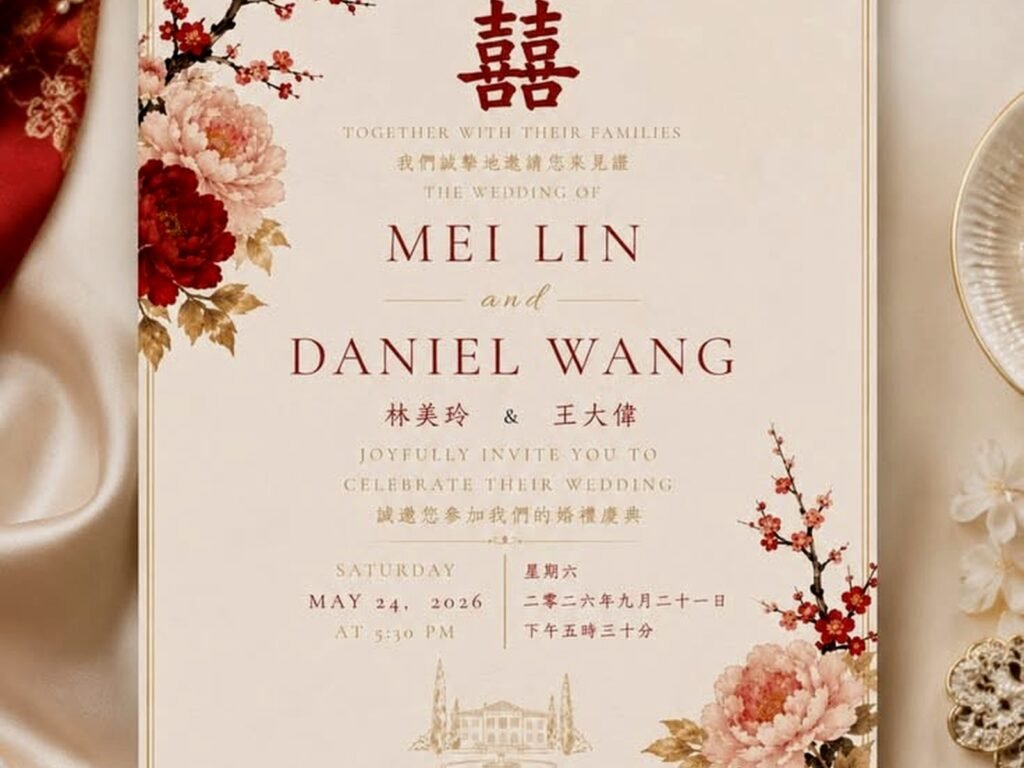
The 囍 (double happiness) symbol is pretty much non-negotiable if you want it to read as a Chinese wedding invitation. You can make it subtle or make it the main focus, but it should be there somewhere. I usually recommend placing it either at the top center or as a decorative element woven throughout the design.
Other traditional elements you might include:
- Dragon and phoenix (representing the groom and bride)
- Mandarin ducks (symbol of marital happiness and fidelity)
- Peonies (prosperity and honor)
- Lotus flowers (purity)
- Cherry blossoms (beauty and feminine grace)
- Bamboo (strength and resilience)
Don’t feel like you need to cram all of these onto one invitation though. I’ve seen some designs that look like they raided every Chinese symbol they could find on Google Images and it just looks… busy. Pick one or two elements that mean something to you.
Bilingual Text Layout (This Is Where It Gets Tricky)
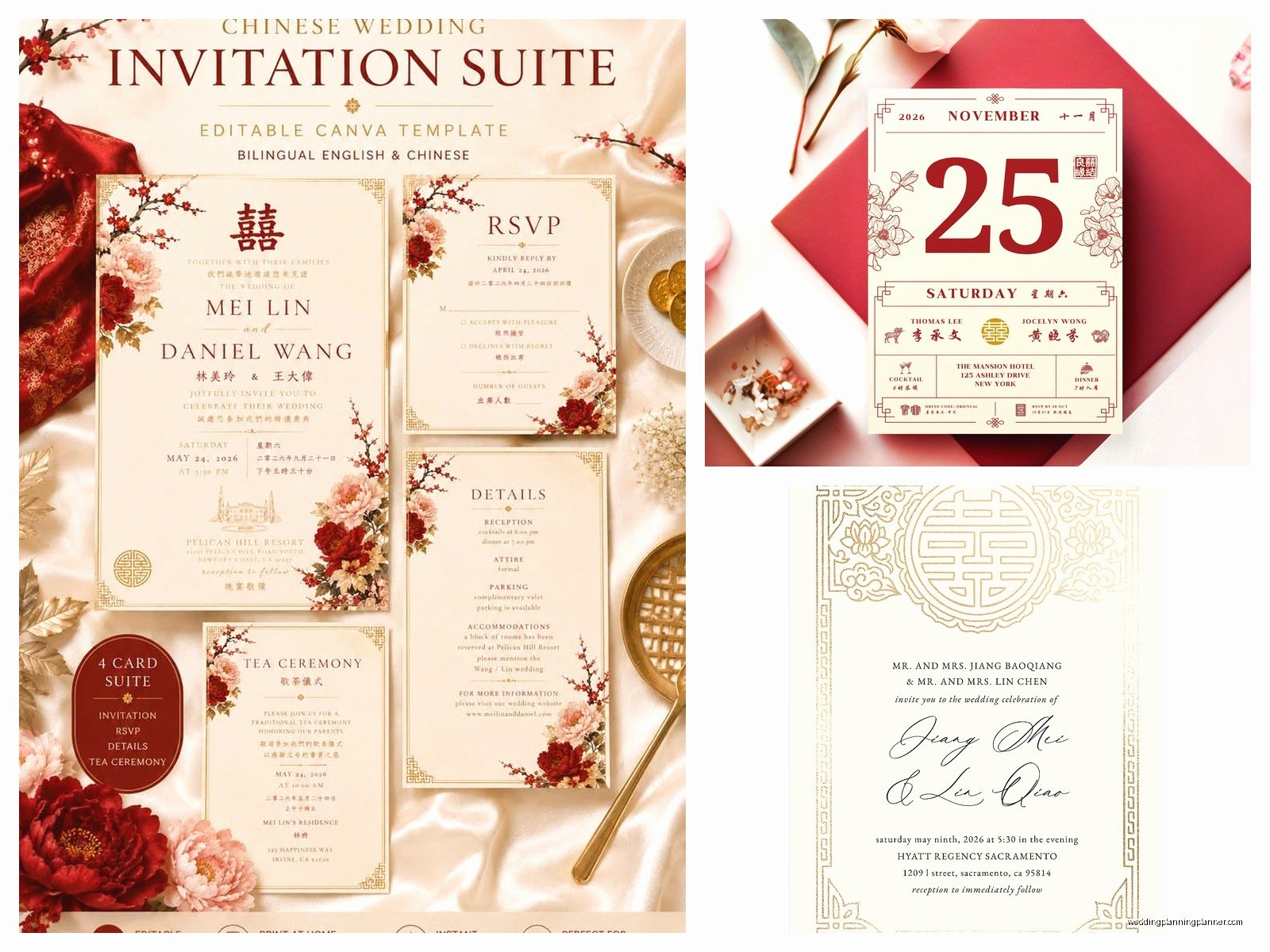
Okay so here’s what really annoys me about Chinese wedding invitation templates you find online – they almost never account for proper bilingual layout. You can’t just slap English text on one side and Chinese on the other and call it a day. The reading flow matters, the hierarchy matters, and the way information is traditionally presented in Chinese vs English is different.
Traditional Chinese invitations read vertically, right to left. Modern ones usually read horizontally, but you still need to think about whether you’re doing traditional or simplified Chinese characters. If your families are from different regions (like one family from Taiwan, one from mainland China), this actually matters because some relatives will have strong preferences.
For bilingual invites, I usually recommend these layouts:
- Side-by-side: English on left panel, Chinese on right panel when opened
- Back-to-back: English on front, Chinese on back (or vice versa)
- Integrated: Both languages on same panel with clear visual separation
- Separate cards: Two different invitation cards in the same envelope suite
That last option is actually my favorite for traditional families because it respects both languages equally and you don’t have to compromise on the design or text layout for either version.
Wording and Names (So Many Rules)
Chinese invitation wording follows specific etiquette about whose names appear and in what order. Traditionally, the parents’ names appear first as the hosts, then the couple’s names. The format usually goes something like the father’s name plus “and Mrs.” or both parents’ full names, then they “request the honor of your presence at the marriage of their daughter/son.”
In Chinese text, you’ll typically see something like: 敬請光臨 (respectfully request your presence) or 敬備喜筵 (respectfully prepare wedding banquet). The formal classical Chinese can get really elaborate and honestly unless you or your parents are fluent, you’re gonna want someone who knows what they’re doing to write this part.
I had a client once who used Google Translate for their Chinese text and it was… it was bad. Like grammatically weird and some of the characters didn’t even make sense in that context. Her grandmother was so confused she thought maybe it was a different dialect or something. Get a native speaker to review your Chinese text before printing, I’m serious.
The Date and Time Format
Chinese dates can be listed according to the lunar calendar, Gregorian calendar, or both. If you’re having a traditional tea ceremony on a different day than the reception, you might need to include both dates. The format typically shows:
- Year (sometimes with the zodiac animal year)
- Month (can be written as lunar or regular calendar month)
- Day
- Day of the week
- Time (often listed as specific auspicious hours)
Speaking of auspicious timing – some families are really particular about choosing dates based on the Chinese almanac. If your parents or future in-laws consulted a fortune teller or checked the Tong Shu for lucky dates, make sure that date is very clearly stated on the invitation. Getting this wrong would be… not great.
Envelope Addressing
The envelopes for Chinese wedding invitations sometimes use gold or red ink for addresses instead of black. Black ink is associated with death in traditional Chinese culture, so older generations might find it inappropriate for a joyful occasion. I usually suggest gold ink for outer envelopes – it looks elegant and sidesteps any potential cultural concerns.
For the Chinese text on envelopes, you’ll write the family name first, then the given name, then any titles (Mr., Mrs., etc. come after the name in Chinese). If you’re addressing to a family, you might write 全家福 (whole family’s happiness) after the family name.
Paper and Printing Considerations
Traditional Chinese invitations often use thicker cardstock because it symbolizes a more substantial, important occasion. I typically recommend at least 120lb cardstock, though some families prefer even heavier stock. The texture matters too – a slight pearl or shimmer finish is popular, though matte can look really sophisticated.
For printing methods, you’ve got options:
- Digital printing (most affordable, good quality, fast turnaround)
- Thermography (raised printing, traditional look, medium price)
- Letterpress (beautiful impression, expensive, very elegant)
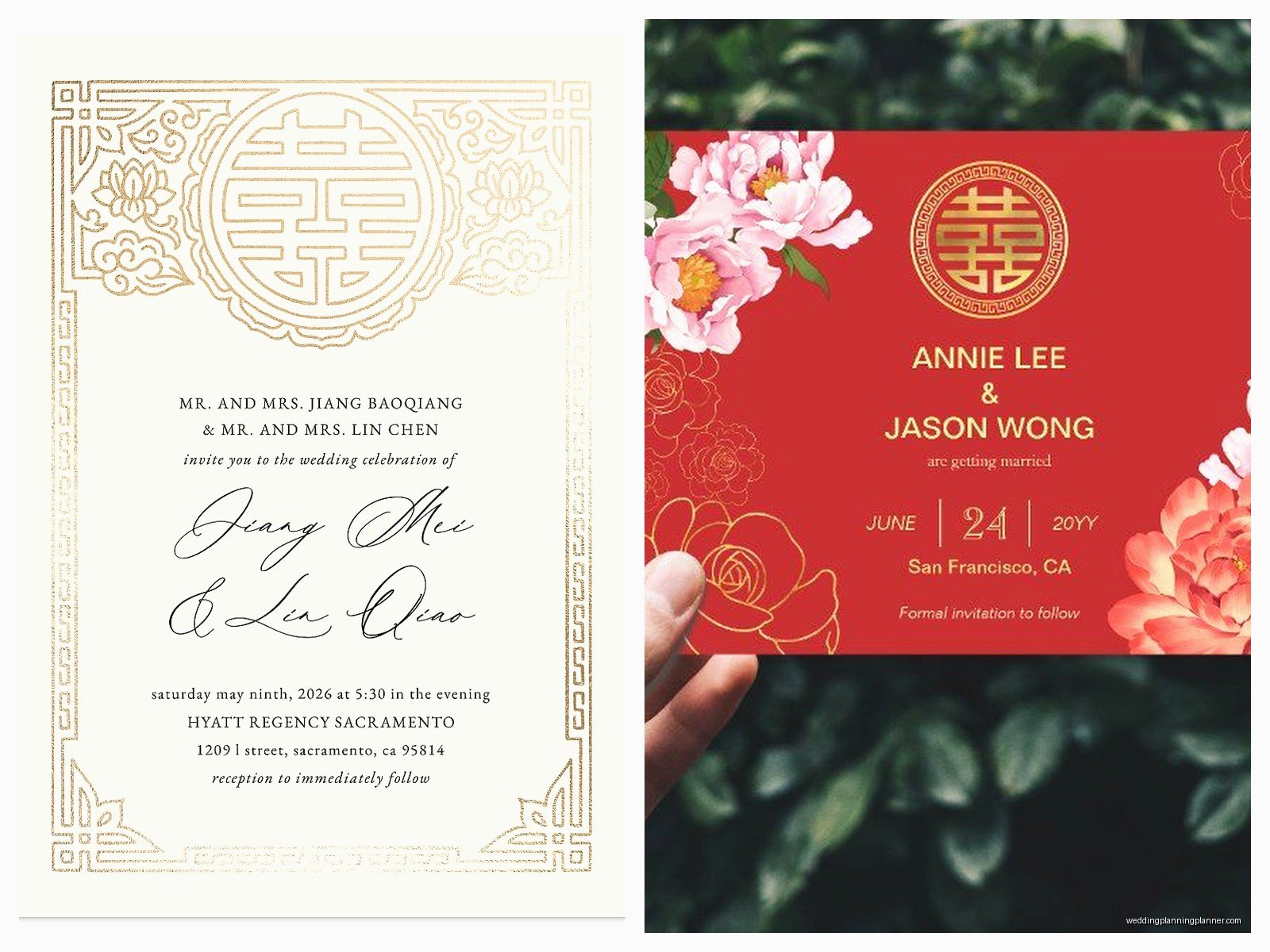
- Foil stamping (gorgeous for gold accents, pricier)
- Engraving (most formal and expensive option)
My cat knocked over my coffee while I was working on a foil stamping sample last month and honestly that gold foil is harder to damage than you’d think, so there’s that. But anyway – foil stamping is really popular for Chinese invitations because you can do gold or rose gold accents on the double happiness symbol, borders, or other decorative elements. It catches the light beautifully and photographs really well.
Timing Your Order
Chinese wedding invitations should traditionally be sent out with enough time for guests to prepare, especially if people are traveling. I recommend this timeline:
- 6-8 months before: Finalize your guest list and start design process
- 4-5 months before: Order invitations (allows time for proofs, revisions, printing)
- 3 months before: Mail invitations (traditional Chinese etiquette suggests even earlier for important guests)
- 1 month before: RSVP deadline
That spring 2023 client I mentioned? She wanted everything done in six weeks total because she didn’t realize custom bilingual invitations take longer than English-only ones. The Chinese text needs translation review, the layout needs more careful attention to reading direction, and if you’re doing any special printing techniques… yeah, it takes time.
Finding the Right Designer or Printer
You want someone who has experience with Chinese wedding invitations specifically, not just someone who does wedding stationery in general. Ask to see samples of their bilingual work. Check that they understand things like:
- Proper character spacing and alignment
- Traditional vs simplified character differences
- Cultural symbolism and color meanings
- Appropriate formal language and titles
Online options like Minted, Zazzle, and Etsy have Chinese wedding invitation templates, but you’ll probably need to customize them heavily. Minted actually has some decent options with the double happiness symbol already incorporated, but double-check their Chinese text with someone who reads Chinese fluently.
For fully custom work, look for designers who specialize in multicultural weddings. They cost more – usually starting around $800-1200 for custom design plus printing for 100 invitations – but they’ll understand the nuances you need.
The Invitation Suite Components
A full Chinese wedding invitation suite might include:
- Main invitation card (the actual invite to the ceremony/reception)
- RSVP card with envelope
- Reception card (if ceremony and reception are separate)
- Details card (accommodations, website, etc.)
- Outer envelope
- Inner envelope (optional but traditional)
- Envelope liner (decorative, usually with Chinese motifs)
- Belly band or ribbon (often red or gold)
- Wax seal with double happiness symbol (if you’re feeling fancy)
You don’t need all of these components, but traditional Chinese families sometimes expect a more elaborate presentation. The double envelope system (outer and inner) is actually a nice way to have English addressing on the outer envelope and Chinese on the inner, or vice versa.
Red Envelopes and Monetary Gifts
Okay so this isn’t technically part of the invitation itself, but since Chinese weddings traditionally involve monetary gifts in red envelopes (紅包/hongbao), some couples include a subtle note about this. It’s kinda awkward to directly say “give us money” but you can include wording like “Your presence is the only gift we need” which is understood to mean cash gifts are welcome.
Some modern couples include their wedding website where they explain the red envelope tradition for non-Chinese guests who might not be familiar with it. This helps avoid the situation where some guests bring wrapped gifts and others bring red envelopes and everyone feels awkward.
Proofing and Final Checks
Before you approve the final proof, get multiple people to review it:
- Native Chinese speaker (preferably older generation) to check the Chinese text
- English proofreader for the English text
- Someone to verify all names are spelled correctly in both languages
- Someone to confirm dates, times, and addresses
- Your parents or future in-laws to make sure cultural elements are appropriate
I cannot stress this enough – once they’re printed, you can’t fix them. I’ve seen couples have to completely reorder invitations because they caught an error after printing and it was… expensive and stressful and delayed everything.
Order extra invitations too, like 15-20 more than you think you need. You’ll want some for keepsakes, some inevitably get damaged or lost in the mail, and you might remember additional people you need to invite or…
Modern vs Traditional: Finding Your Balance
The thing about Chinese wedding invitations is that you’re often balancing what you want aesthetically with what your family expects culturally. I’ve worked with couples who went full traditional with vertical text and classical Chinese language, and couples who did minimalist modern designs with just a small double happiness symbol in the corner.
Both are valid. Both can honor your heritage. Don’t let anyone make you feel like you’re doing it wrong if you’re not going full traditional red and gold with dragons and phoenixes everywhere. But also be prepared for potential feedback from older relatives if you go too modern – it might help to have a conversation with your parents beforehand about your design choices.
Some couples do a compromise where the invitation going to Chinese-speaking relatives is more traditional in design and language, while the one going to English-speaking friends is more modern. That’s totally acceptable and actually kinda smart.
Budget Considerations
Chinese wedding invitations can range from like $2 per invitation for basic digital printing to $15+ per invitation for custom letterpress with foil stamping. Here’s a rough breakdown:
- Template + digital printing: $2-4 per invite
- Semi-custom + thermography: $4-7 per invite
- Custom design + letterpress or foil: $8-15+ per invite
These prices usually include basic envelopes but not fancy stuff like envelope liners, wax seals, or special ribbons. If you want all the extras, budget accordingly.
One way to save money is to do digital printing for the main suite but splurge on foil stamping just for the double happiness symbol or the couple’s names. This gives you that luxury look without the full luxury price tag. Or do a simpler design that looks good with basic printing – not everything needs to be elaborate to be beautiful.