
Planning Guides, Style Guide
Mexican Wedding Invitations: Cultural Traditional Designs
Nov
The Basics You Gotta Know First
Okay so Mexican wedding invitations are absolutely stunning and they’re having this huge moment right now but honestly a lot of couples don’t realize how many cultural elements they should be incorporating. I had this couple in spring 2023 who wanted “Mexican vibes” but then showed me like… a cactus clipart situation and I had to basically start from scratch explaining what actually makes these invitations culturally significant versus just southwestern themed.
The main thing is that traditional Mexican wedding invitations are deeply rooted in family honor and religious tradition. You’re not just inviting someone to a party, you’re inviting them to witness a sacred union and usually the wording reflects that the parents are hosting or at least heavily involved. Even if the couple is paying for everything themselves, the invitation typically lists both sets of parents because that’s just how it’s done.
Color Schemes That Actually Matter
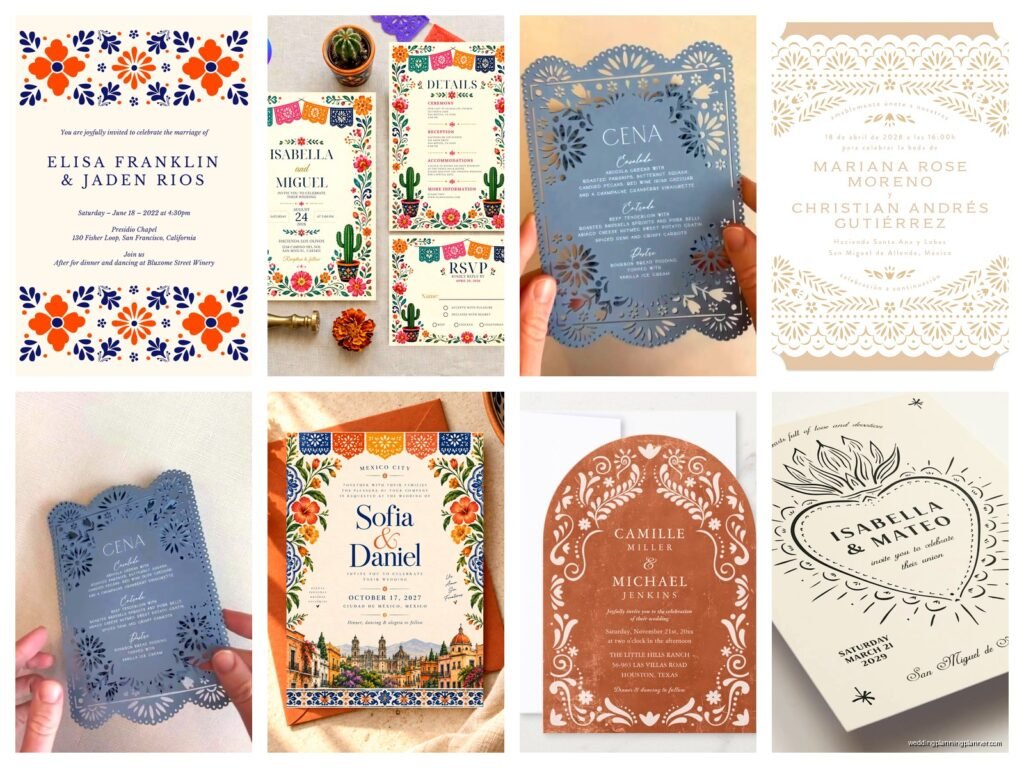
So colors are kinda everything in Mexican design. You’ll see a lot of vibrant jewel tones – deep reds, rich purples, bright yellows, hot pinks, and emerald greens. These aren’t random choices, they come from traditional Mexican textiles and folk art. Papel picado (those cut paper banners) often use these exact color combinations.
What really annoys me though is when people just slap on some bright colors and call it “Mexican inspired” without understanding the symbolism. Red represents passion and also the blood of Christ in Catholic tradition which is huge in Mexican culture. White obviously means purity. Yellow and orange connect to marigolds which are used in Day of the Dead celebrations and represent the fragility of life. Purple has royal connotations but also ties to religious observances.
You can also go with a more elegant approach using metallic golds and coppers paired with ivory or cream. This reflects the Spanish colonial influence and works beautifully for formal church weddings. I’ve done invitations with gold foil stamping on textured cardstock that looked absolutely incredible.
Design Elements You Should Include
Alright so here’s where it gets fun. Traditional Mexican wedding invitations can incorporate so many different design elements:
- Papel picado patterns – either as a border or background texture
- Talavera tile designs – these are the gorgeous hand-painted ceramic tiles you see all over Mexico
- Embroidered fabric patterns – think traditional huipil or rebozo textiles
- Religious imagery – crosses, Virgin of Guadalupe, rosaries
- Floral motifs – especially roses, dahlias, and marigolds
- Agave plants or succulents if you’re going more modern
- Arches or doorways which symbolize entering a new phase of life
My cat knocked over my entire sample board once while I was working on a Mexican-themed invitation suite and honestly the random arrangement looked better than what I had planned, but anyway.
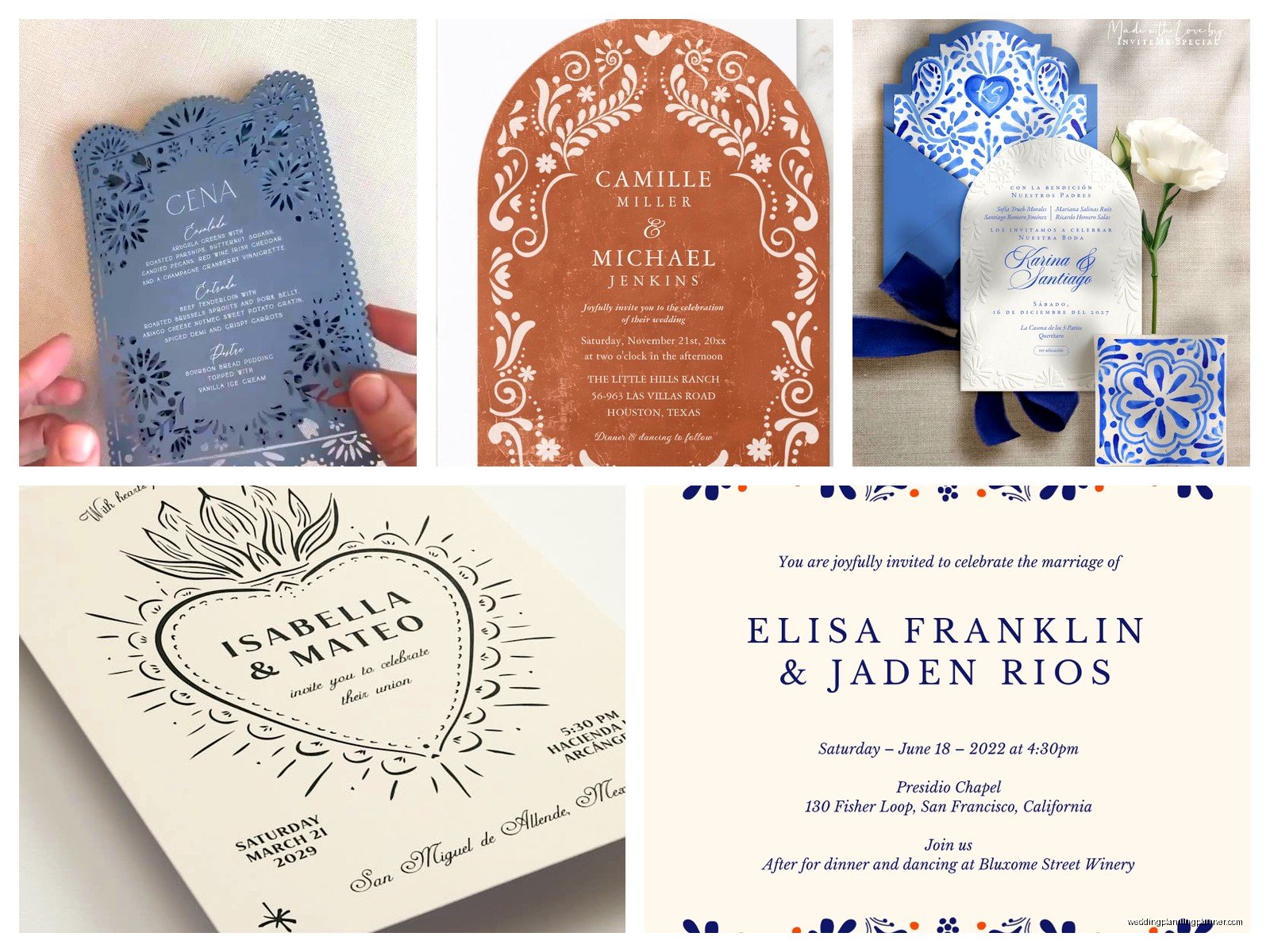
The papel picado thing is probably the most recognizable element. You can use it as an actual overlay (like a laser-cut layer over the invitation) or just incorporate the pattern into the design. I worked with a couple who wanted their entire invitation to look like it was printed on papel picado and we did this really cool thing where we… well actually it was more complicated than it needed to be because the printer didn’t understand what we were going for at first.
Talavera Tiles Deserve Their Own Section
These tiles are so iconic. They came to Mexico from Spain in the 16th century but Mexican artisans made them completely their own. The patterns are intricate, symmetrical, and usually feature blues, yellows, greens, and terra cotta colors. You can use a single tile design as a central motif or create a border pattern using multiple tile designs.
I usually suggest using Talavera patterns on the invitation belly band or as a backing card. It creates this gorgeous layered effect without overwhelming the text. You want people to actually read the invitation, not just admire it.
The Wording Situation
This is where cultural tradition really comes through. Traditional Mexican wedding invitations are bilingual – Spanish and English – especially if you have guests who speak both languages. But even if everyone speaks English, including Spanish phrases or having a fully Spanish version shows respect for the culture.
The format usually goes like this: parents are listed first, then the couple, then the details. You’ll often see phrases like “Con la bendición de Dios y de nuestros padres” (With the blessing of God and our parents) or “Tienen el honor de invitarle” (Have the honor of inviting you).
A super traditional invitation might include:
- Los Padrinos (the godparents or sponsors)
- Separate details for the church ceremony and reception
- Information about las arras (the thirteen gold coins)
- Details about el lazo (the wedding lasso)
- Sometimes even the names of the padrinos for specific elements like the bouquet, the Bible, or the rosary
I had this situation in summer 2021 where the bride’s family wanted to list like fifteen different padrinos on the invitation and we literally ran out of space. We ended up creating a separate insert card just for the padrinos because there was no way to fit everything on one piece without using microscopic font.
Paper and Printing Techniques
You’re gonna want to think about texture here. Smooth, glossy cardstock doesn’t really capture the handcrafted feel of traditional Mexican design. I usually recommend:
- Textured cardstock with a linen or felt finish
- Handmade paper with visible fibers (amate paper is traditional Mexican bark paper)
- Metallic or shimmer cardstock for formal invitations
- Kraft paper for a more rustic approach
For printing, letterpress is gorgeous and gives you that tactile, artisanal quality. Foil stamping in gold or copper looks amazing, especially on darker cardstock. Digital printing works fine too if you’re on a budget, but try to add some handcrafted element – maybe a ribbon in traditional colors or a wax seal.
Embellishments That Make Sense
This is where you can really personalize things. I love adding:
- Satin or grosgrain ribbons in traditional colors
- Twine or raffia for rustic designs
- Laser-cut overlays in papel picado patterns
- Wax seals with custom designs
- Small milagros (metal charms) attached to the invitation
- Pressed flowers
The milagros thing is really special – these are small metal charms traditionally used as offerings or prayers. You can find them shaped like hearts, crosses, or people. Attaching one to each invitation is a beautiful touch but also kinda time-consuming if you’re doing 150 invitations, just saying.
Modern Versus Traditional Approaches
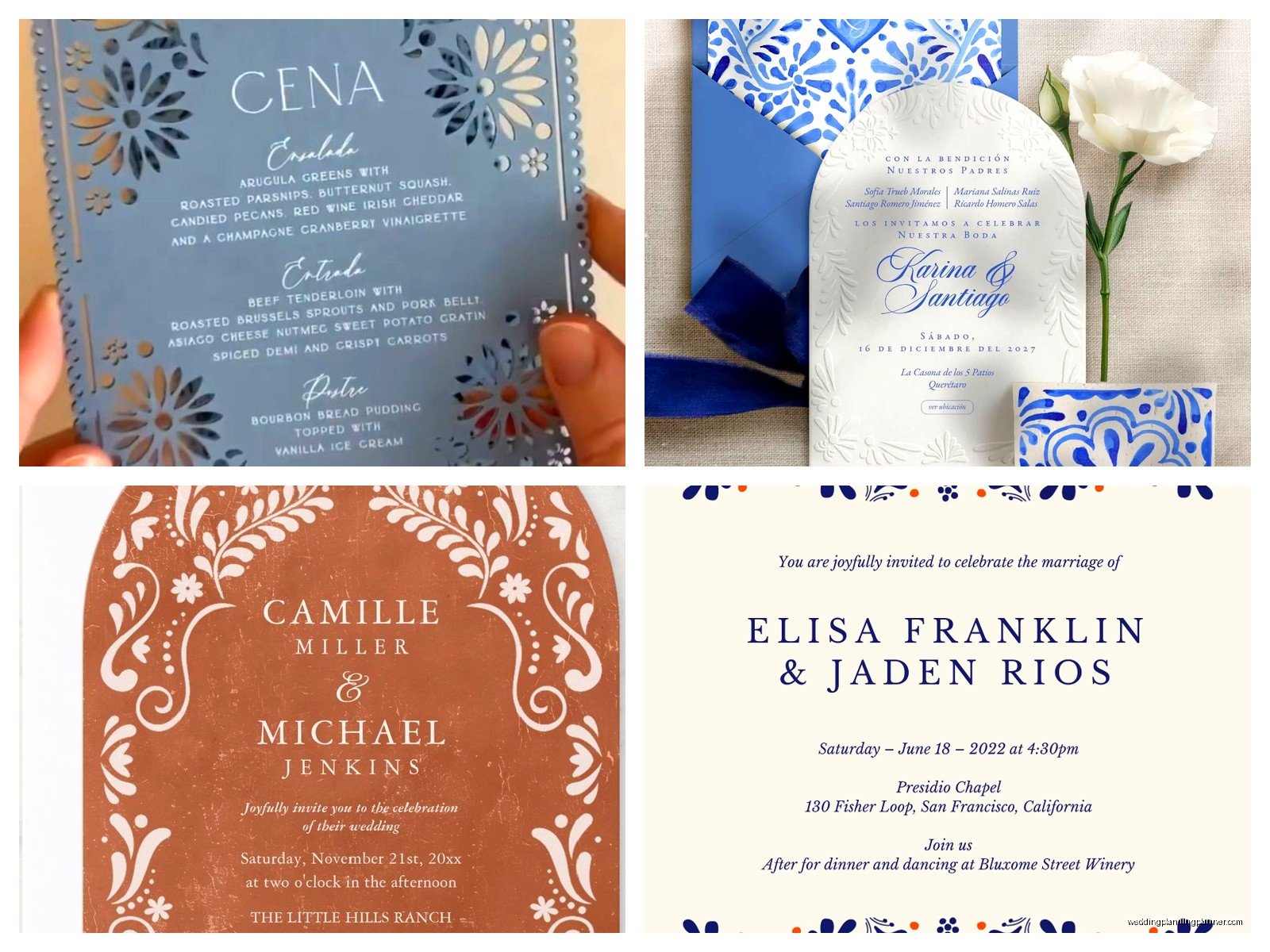
So here’s the thing – you don’t have to go full traditional if that’s not your style. A lot of couples are blending modern design with cultural elements and it looks incredible when done right. You might use a minimalist layout with clean lines but incorporate a subtle Talavera tile border. Or go with modern typography but use traditional color combinations.
I’ve seen couples use watercolor illustrations of Mexican flowers paired with modern calligraphy. Or geometric designs inspired by traditional patterns but executed in a contemporary way. The key is that it should feel intentional, not like you just grabbed random “Mexican” elements and threw them together.
One trend I’m seeing is couples creating invitation suites that tell their story – maybe using design elements from the specific region of Mexico their family is from. Oaxacan textiles look different from Puebla designs which look different from Jalisco patterns. Getting specific like that makes it way more personal and meaningful.
The Suite Components
A full Mexican wedding invitation suite typically includes more pieces than a standard American invitation. You’re looking at:
- The main invitation
- Reception card (if separate from ceremony)
- RSVP card and envelope
- Details card (hotel accommodations, dress code, etc.)
- Ceremony program
- Sometimes a lazo ceremony explanation card for non-Mexican guests
Each piece should coordinate but they don’t all need to be identical. You can use different patterns from the same Talavera tile set across different cards, or vary the papel picado designs while keeping the color scheme consistent.
Oh and definitely include a details card explaining any cultural traditions you’re incorporating that guests might not be familiar with. I can’t tell you how many times I’ve had couples skip this and then field a million questions from confused guests about what las arras means or why there’s a lasso involved.
DIY Versus Professional Design
Look, I’m biased because this is literally my job, but Mexican wedding invitations benefit from professional design more than most styles. The cultural elements need to be represented respectfully and accurately, and it’s easy to veer into stereotypical territory if you don’t know what you’re doing.
That said, if you’re crafty and willing to do research, you can DIY elements of it. Maybe hire a designer for the main invitation but assemble the suites yourself. Or purchase a template from a designer who specializes in cultural wedding stationery and customize it.
If you go DIY, please please please run it by someone from the culture to make sure you’re not doing anything offensive or inaccurate. I’ve seen some… choices… that were well-intentioned but missed the mark.
Budget Considerations
Mexican wedding invitations can range from super affordable to extremely expensive depending on what you want. A simple digital design printed on nice cardstock with a ribbon – maybe $3-5 per invitation. A full letterpress suite with laser-cut overlays, foil stamping, and hand-tied ribbons – you’re looking at $15-25+ per invitation easily.
Ways to save money without sacrificing style:
- Use digital printing instead of letterpress
- Skip the envelope liner or use a printed pattern instead of actual patterned paper
- DIY the assembly and embellishments
- Use fewer suite components
- Go with a smaller size invitation (A6 instead of A7)
- Choose one special printing technique as a focal point instead of multiple techniques
Honestly the ribbon alone can add up when you’re buying enough for 200 invitations, so think about where you want to splurge and where you can pull back.
Working With Designers and Printers
If you’re hiring a stationery designer, look for someone who either specializes in cultural weddings or at least has experience with them. Ask to see their portfolio specifically for Mexican or Latin American wedding invitations. A good designer will ask you questions about your family traditions, which elements matter most to you, and how traditional versus modern you want to go.
For printing, make sure your printer can handle the paper weight and embellishments you want. Not all printers can do foil stamping or work with handmade paper. Get samples before committing to anything because colors can look totally different printed versus on a screen, and texture matters so much with these designs that you really need to feel it in person before deciding
