
Planning Guides, Style Guide
Spanish Wedding Invitations: Bilingual Design Options
Nov
okay so bilingual Spanish wedding invitations are trickier than people think
I had this couple back in spring 2023 who waited until like 8 weeks before their wedding to tell me half their guest list only spoke Spanish and oh by the way could we make the invitations bilingual? I was already knee-deep in their design and had to basically rework everything. That whole situation taught me SO much about what actually works and what just looks messy.
First thing you gotta know is there are like three main approaches to bilingual invitations and each one has different pros and cons depending on your guest list breakdown and how much you wanna spend.
The Side-by-Side Layout
This is where you put English on one side and Spanish on the other side of the same card. It’s clean, it’s elegant, but it eats up space like crazy. You need a bigger invitation size to pull this off without making the text so tiny that your abuela needs a magnifying glass.
I usually do English on the left, Spanish on the right because that’s how we read naturally in both languages. Some designers flip it but honestly I think that just confuses people’s eyes. You want a subtle divider between the two sides – maybe a thin line or just extra spacing. Don’t get fancy with borders or decorative elements between them because it starts looking cluttered real fast.
The font size thing is what annoys me most about this layout honestly. Spanish takes up more space than English almost always. The word “ceremony” is just that, but “ceremonia” is longer, “reception” versus “recepción” – you see what I’m saying? So you’re constantly adjusting and re-adjusting to make both sides balance visually. It’s tedious.
The Stacked Method
This is where you put one language above the other on the same card. English on top, Spanish below, or vice versa. I usually put whichever language the majority of guests speak first, just makes sense.
The nice thing here is you can use a standard invitation size – like 5×7 which is the most common and cost-effective. But you’re gonna need to be strategic about your wording because if you write a novel in English and then translate it, your invitation becomes a scroll.
Keep it SHORT. Like, really short. You don’t need “together with their families” AND “junto con sus familias” if you can just… I mean you could say “junto a sus familias” and make it slightly less wordy. Work with your translator to find the most concise phrasing that still sounds natural and warm.
Pro tip: use different font weights to differentiate the languages. Maybe English in regular weight and Spanish in light weight, or vice versa. This helps guests quickly scan to their preferred language without reading through both every single time.
The Separate Insert Card Approach
Okay so this is my personal favorite for couples who have a pretty even split in their guest list or when the main invitation design is just too gorgeous to mess with by cramming two languages onto it.
You create your main invitation in one language – usually English if you’re in the US – and then you include a separate insert card that’s the full invitation text in Spanish. You can even flip it and do Spanish main with English insert if most of your guests are Spanish-speaking.
The separate card can be slightly smaller, maybe 4×6 if your main invite is 5×7. It should coordinate with your design suite but doesn’t have to be identical. I’ve done ones where the main invite had this elaborate floral border and the Spanish insert was simpler with just a small matching motif in the corner.
Here’s what I learned the hard way: you gotta include the Spanish insert for EVERYONE, not just Spanish-speaking guests. Otherwise you’re sitting there trying to figure out which envelope gets what and you WILL mess it up. My assistant and I spent an entire afternoon in summer 2021 re-stuffing 200 envelopes because we thought we were being efficient by only including Spanish cards for certain guests and we got confused halfway through. Just include both for everyone. It’s easier and honestly, bilingual guests appreciate having both anyway.
Design Elements That Work Across Both Languages
The visual stuff needs to work for both languages equally. I’ve seen designers create these beautiful invitations with English calligraphy woven into the design and then they just… stick the Spanish text in a basic font underneath and it looks like an afterthought. Don’t do that.
If you’re using custom calligraphy for names or key phrases, get it done in both languages with the same style. Yes, it costs more. Yes, it’s worth it. Your Spanish-speaking guests deserve the same level of beauty in their language.
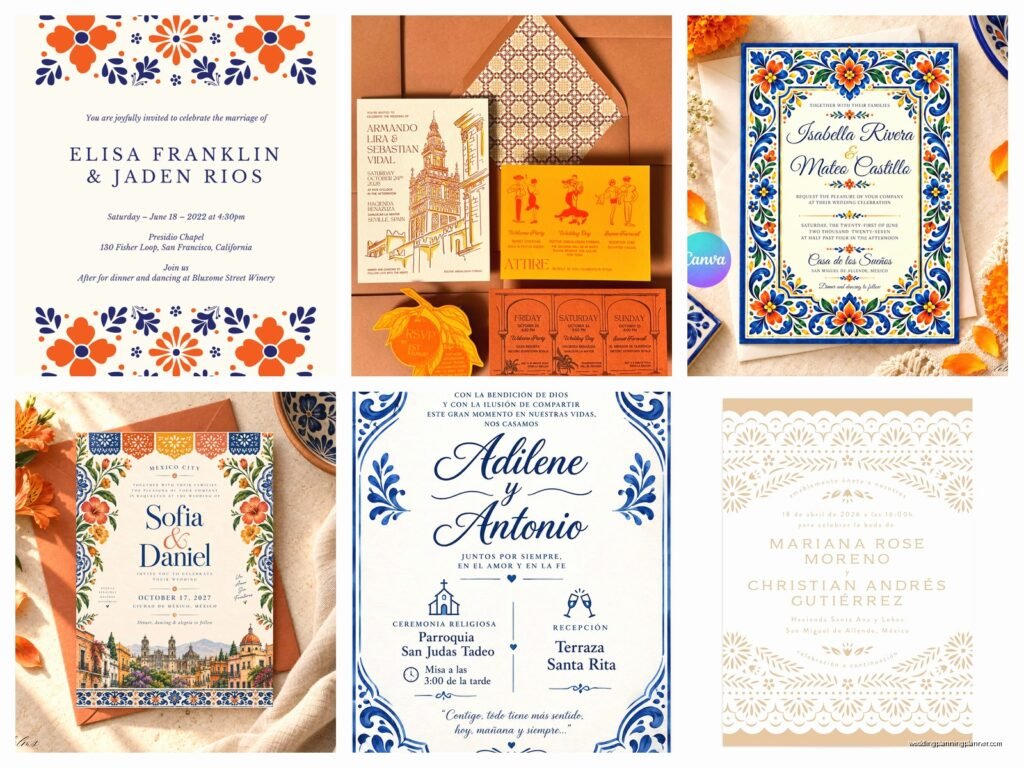
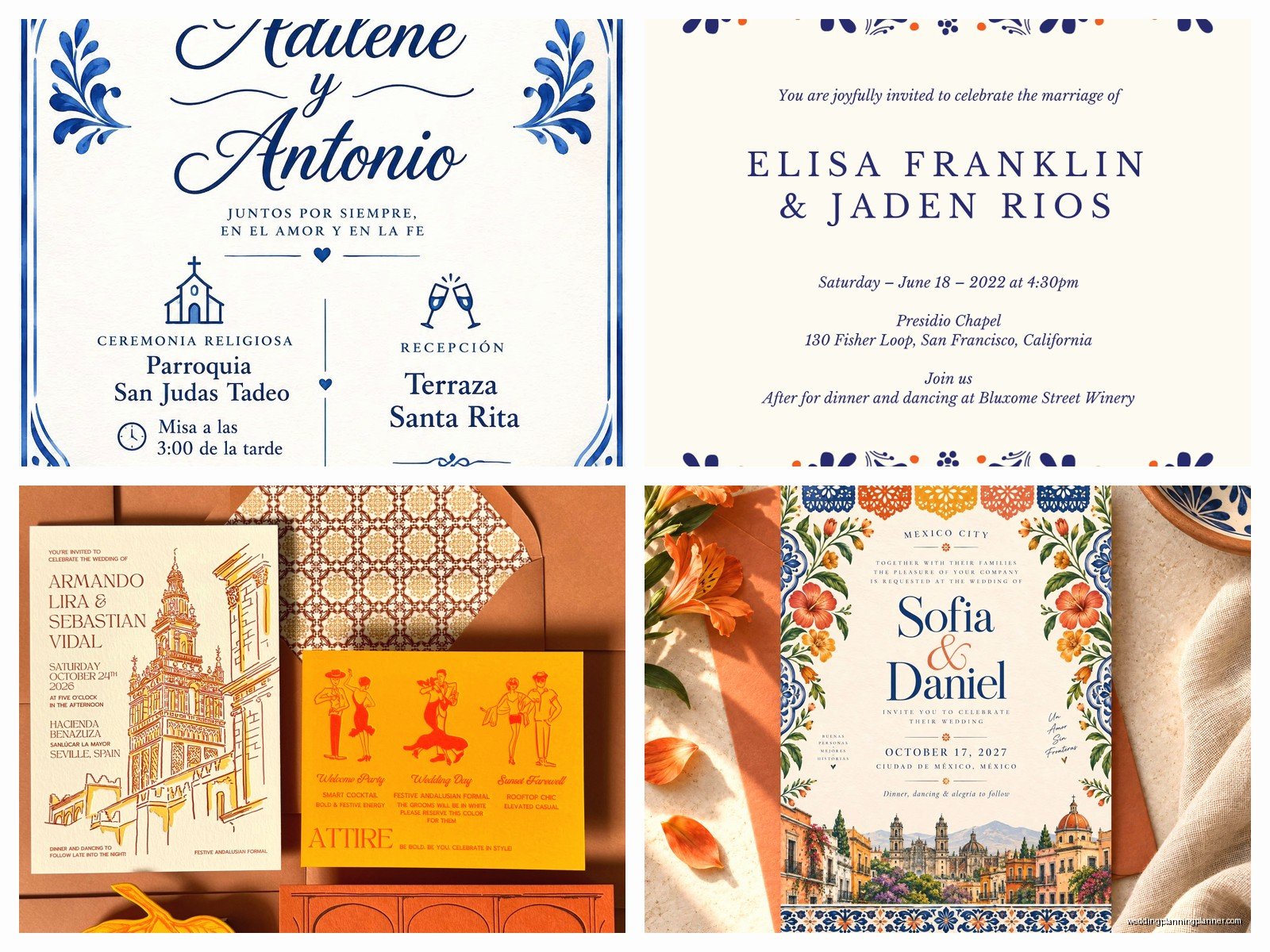
Floral elements, geometric patterns, watercolor washes – these are all great because they’re language-neutral. I’m obsessed with using papel picado designs for Mexican-heritage weddings or Spanish tiles for Spanish-culture weddings. These visual elements communicate culture without words and then your text can be straightforward in both languages.
Color choices matter too. Some couples want to incorporate the colors of their heritage – like the red and yellow from the Spanish flag or specific colors meaningful in Latin American cultures. Just make sure whatever colors you choose, the text is still readable. I’ve had to talk so many couples out of red text on a pink background because they thought it looked romantic but literally no one could read it.
The Wording Itself Gets Complicated
Okay so you can’t just Google Translate your invitation text, please don’t do that. You need either a native Spanish speaker or a professional translator who understands formal invitation wording. The tone in Spanish wedding invitations is often more formal than English ones, and there are regional differences too.
Mexican Spanish is different from Puerto Rican Spanish is different from Spanish from Spain. The way you phrase things, certain words you use – it varies. If your families are from different Spanish-speaking countries, you might need to find middle-ground phrasing that works for both.
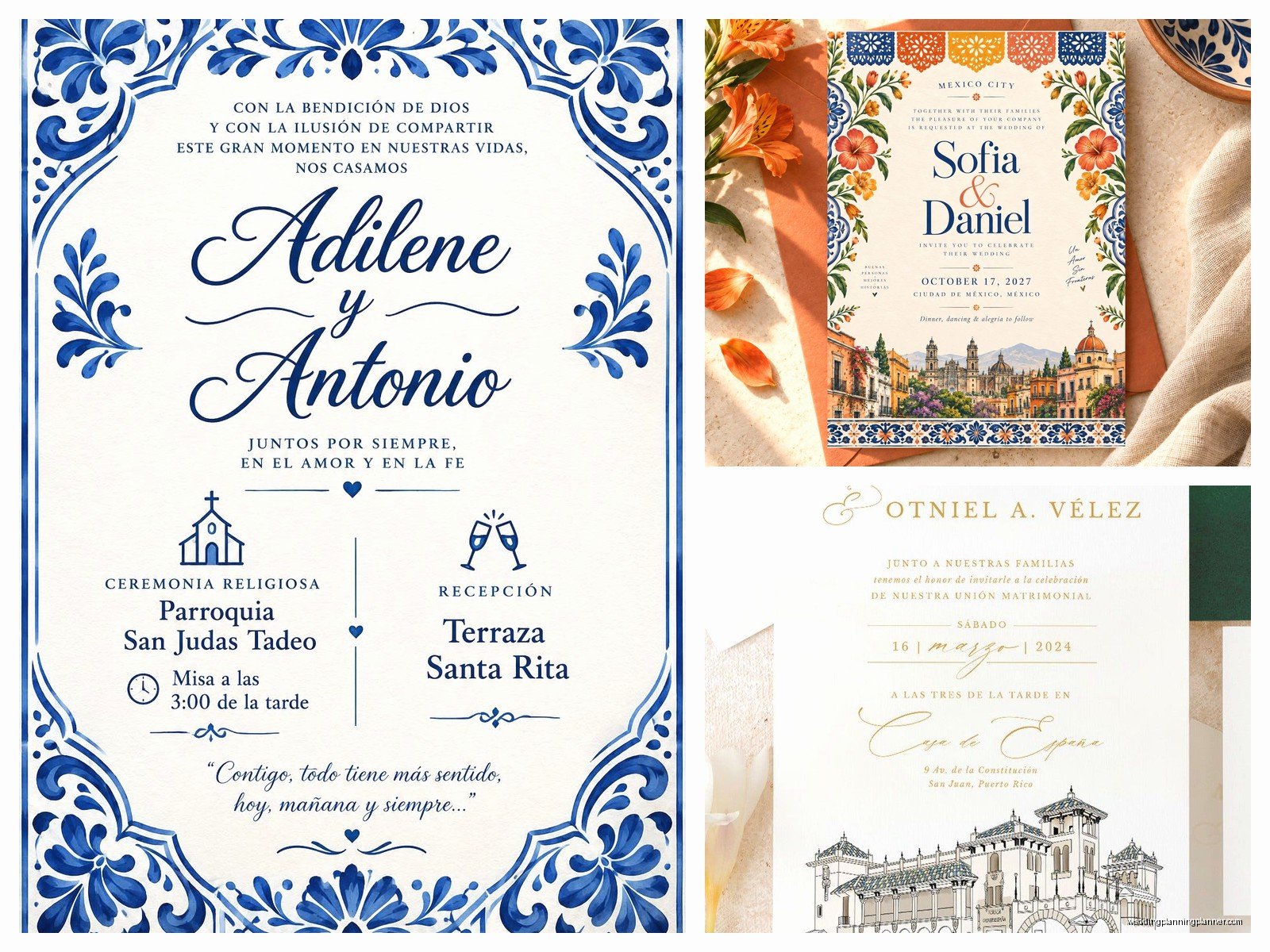
For example, “reception to follow” – I’ve seen this translated as “recepción a continuación,” “recepción después de la ceremonia,” “la recepción seguirá” – they all basically mean the same thing but have slightly different feels. Talk to your family members about what sounds right to them.
The parents’ names section is where it gets really tricky because Spanish-speaking cultures often include both parents’ surnames and sometimes even grandparents depending on how traditional the family is. You might have “Mr. and Mrs. John Smith” in English but in Spanish it could be “Señor Juan Carlos Rodríguez Mendoza y Señora María Elena Fernández de Rodríguez” and now you’ve got a whole paragraph just for one set of parents.
This is where I sometimes suggest simplifying the English side too, just so both languages take up similar space. Or you embrace that Spanish is more elaborate and you adjust your layout accordingly.
The Details Cards Need Love Too
Don’t forget about your insert cards – the reception card, accommodations card, RSVP card, all of it. These need to be bilingual too if you’re doing a bilingual suite.
For RSVP cards, I usually do a simple bilingual format where the response options are in both languages. Like “_____ accepts with pleasure / acepta con mucho gusto” or whatever phrasing you prefer. Keep it simple here because RSVP cards are already tiny.
Website information should definitely be in both languages. If you have a wedding website (and you should because it makes everything easier), make sure the website itself has a language toggle or separate pages in Spanish. Then on your details card, you can say something like “For more information visit / Para más información visite” with your URL.
My cat just knocked over my coffee which is perfect timing because I need a break from thinking about… wait, no, back to accommodations cards. These are important for destination weddings or when you have out-of-town guests. List hotel blocks in both languages with the same information. You don’t need to translate the hotel name obviously, but the booking instructions and group code info should be clear in both languages.
Envelope Addressing Is Its Own Thing
So you’ve got your beautiful bilingual invitations all printed and now you gotta address the envelopes. Do you use Spanish titles for Spanish-speaking guests? Do you do everything in English? Do you mix them?
I usually match the envelope addressing to what language the recipients speak primarily. Spanish-speaking guests get “Señor y Señora” and English-speaking guests get “Mr. and Mrs.” – but honestly some couples just pick one language for all the envelopes to keep it consistent and that works too.
If you’re doing calligraphy on the envelopes, make sure your calligrapher is comfortable with Spanish characters and accent marks. Those little tildes and accents are not optional – they change the meaning of words. I’ve seen envelopes with “Senor” instead of “Señor” and it’s just sloppy.
Return addresses can be in either language or both. I’ve done ones where we put both languages on the return address, just stacked small on the back flap. Looks kinda cute actually.
Timing and Etiquette Stuff
Spanish wedding invitation etiquette can be more formal than American etiquette. In some cultures, you’re expected to invite people with a longer lead time, or the wording needs to be more elaborate. Check with your family about what’s expected.
Also, some traditional Spanish-speaking families expect physical invitations even for people who definitely can’t come – like distant relatives in other countries. It’s a respect thing. So you might be printing more invitations than you’d think necessary, but it matters to your family, so you do it.
One couple I worked with had to send invitations to like 50 relatives in Mexico who they knew weren’t coming to the wedding in California, but the family would’ve been offended if they didn’t receive a formal invitation. We did a simplified version for those – just the main invite without all the insert cards – to save on postage since we were mailing internationally.
Digital vs. Print Considerations
If you’re doing digital invitations (which I know some people hate but they’re practical and eco-friendly and sometimes necessary), bilingual is actually easier. You can have tabs or buttons for language selection, you can include both languages on one scrolling page without worrying about physical space constraints.
But I gotta say, for older Spanish-speaking relatives especially, a physical invitation means more. There’s something about receiving that formal paper invitation in the mail that communicates respect and importance. My own grandmother keeps every wedding invitation she’s ever received in a box, and if someone sent her a digital-only invite she’d probably be confused about whether she was actually invited or if it was just a casual mention.
You could do a hybrid – digital save-the-dates that are bilingual and easy to update, then formal paper invitations for the actual invite. That’s becoming more common and it works well.
Budget Real Talk
Bilingual invitations cost more, let’s just be honest about it. You’re using more paper if you’re doing inserts, you’re paying for more design time because everything takes longer to lay out, translation isn’t free if you’re hiring it out.
But there are ways to manage costs. Using the stacked method on standard-size cards is cheaper than doing oversized side-by-side layouts. Printing in one color instead of multiple colors saves money. Choosing a simpler design that doesn’t require custom calligraphy in two languages helps too.
I always tell couples to prioritize where they want to spend. If having a gorgeous bilingual invitation suite is important to you and your families, maybe you save money on favors or something else. It’s all about what matters most to you.
Also, order extra invitations beyond your guest count – like at least 20-25 extra. You’ll want them for keepsakes, you’ll mess up some envelope addressing, and inevitably someone will spill coffee on theirs (speaking from experience) and need another one. It’s cheaper to print extras upfront than to do a small reprint later.
Working with Your Printer or Designer
Make sure whoever is designing and printing your invitations has experience with bilingual work. It’s different from just doing a standard English invitation. They need to understand spacing issues, cultural considerations, how to handle special characters and accents in their design software.
Ask to see samples of previous bilingual work they’ve done. If they’ve never done it before, they’re gonna be learning on your project and that’s… I mean it might be fine, but it might also mean lots of revisions and frustration.
Get a printed proof before you approve the full print run. Screen colors look different than printed colors, and you want to see how the actual paper feels, how the text reads in both languages, all of it. Don’t skip the proof to save time or money because fixing mistakes after you’ve printed 200 invitations is way more expensive.
Communication is key here – be really clear about what you want, share examples of invitations you like, explain your family’s cultural expectations. The more information your designer has upfront, the smoother the process goes. That spring 2023 couple I mentioned earlier? Part of why it was so stressful was because they hadn’t communicated their needs clearly from the start, and we ended up redoing work that could’ve been done right the first time if I’d known.
Anyway, bilingual Spanish wedding invitations are totally doable and they’re a beautiful way to honor both cultures and make all your guests feel included. Just plan ahead, budget appropriately, and don’t try to Google Translate your way through it

Canva
Wedding Memories Hardcover Template Canva Editable For Notebook, Journal, Novel, Hard Covers, Canva template For KDP Cover 6×9″ 120 pages
Canva
The Ultimate Wedding Planning Bundle, Canva Editable.
Canva
Customizable Wedding Video Invitations templates, Canva Editable Digital Wedding invitation Minimalist, Animated Custom Invitation
Digital Planning Templates
Wine Wedding Planner Bundle – 200-Page Printable PDF + 10 Editable Wedding Invitations | Instant Digital Download
Canva
Orange Wedding Planner Bundle – 200-Page Editable Canva Templates + 10 Editable Wedding Invitations | Instant Digital Download
Digital Planning Templates
Champagne Wedding Planner Bundle – 200-Page Printable PDF + 10 Editable Wedding Invitations | Instant Digital Download
Canva
Wedding Memories Hardcover Template Canva Editable For Notebook, Journal, Novel, Hard Covers, Canva template For KDP Cover 6×9″ 120 pages
Digital Planning Templates
Yellow Wedding Planner Bundle – 200-Page Printable PDF + 10 Editable Wedding Invitations | Instant Digital Download
Canva
Dusty Blue Wedding Planner Bundle – 200-Page Editable Canva Templates + 10 Editable Wedding Invitations | Instant Digital Download