Planning Guides, Style Guide
Wedding Card Paper: Design & Ordering Guide
Jun
Paper Weight Is Where Most People Screw Up
Okay so the biggest mistake I see with wedding invitations is people ordering 80lb paper thinking it’ll feel luxurious and then it arrives and it’s literally just… regular paper. Like the stuff in your home printer. I had this happen with a client in spring 2023 and she actually cried when the box arrived because she’d spent $800 on invitations that felt flimsy.
Here’s what you actually need to know: paper weight in the US is measured in pounds (lb) or sometimes GSM (grams per square meter) if you’re ordering from European suppliers. For wedding invitations, you want at least 100lb cardstock, but honestly 110lb or 120lb is where things start feeling substantial. I usually tell clients to go for 120lb cover stock because it has that nice rigid feel without being so thick you can’t fit it in an envelope.
Cover stock versus text weight is gonna confuse you at first. Text weight is for like… the inner pages of books. Cover stock is the thick stuff. So when someone says “80lb text” versus “80lb cover,” the cover is way thicker. It’s not intuitive at all and it annoyed the hell out of me when I first started because printers just assume you know this.
Paper Types That Actually Matter
There are basically four types you’ll encounter when ordering wedding stationery:
- Matte cardstock: This is your safe bet. No shine, takes ink beautifully, feels sophisticated without being flashy. Works for literally any wedding style.
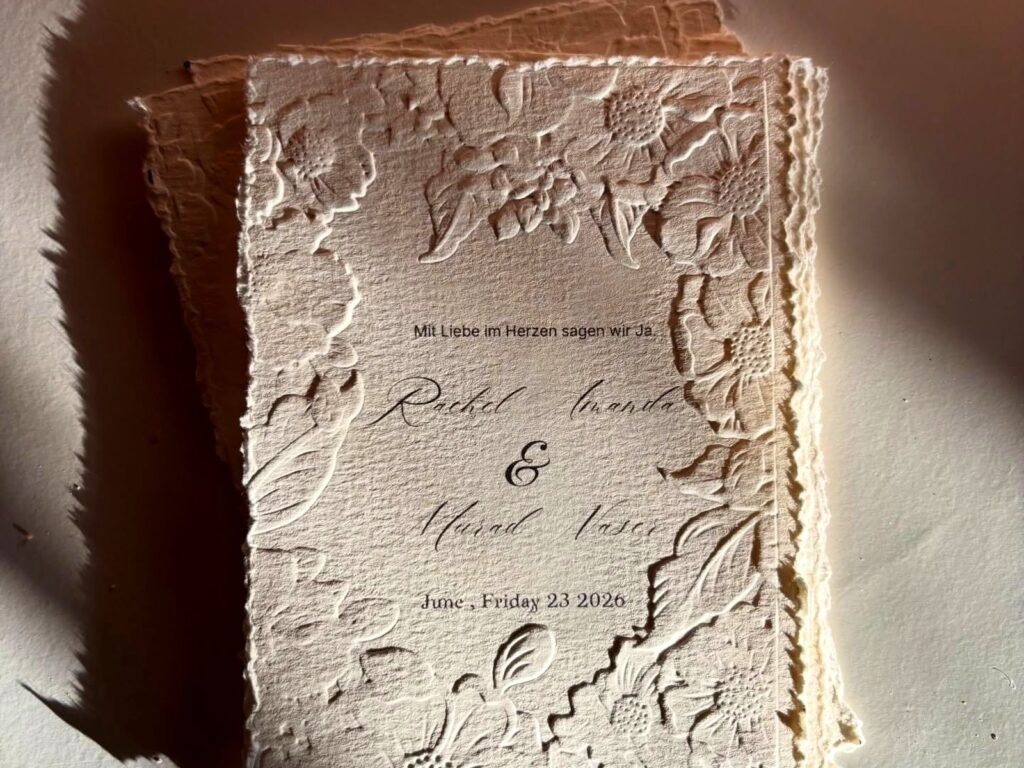
- Cotton paper: Has a subtle texture and usually contains actual cotton fibers (25% to 100%). Feels expensive because it kinda is. Great for letterpress or foil stamping.
- Linen or laid paper: Has visible texture lines. Very traditional looking. My mom’s generation loves this stuff.
- Shimmer or metallic paper: Has a pearlescent or metallic finish. Can look amazing or cheap depending on the design and print method.
I’ve used cotton paper for probably 60% of my higher-end clients and it’s just… it’s worth the extra cost if you can swing it. The way it feels in your hand is different. You can actually feel the fibers. But it’s also more expensive and some print methods don’t work as well on it.
Finishes and Coatings (This Gets Weirdly Complicated)
So you’ve picked your paper weight and type, but then there’s the finish situation. Uncoated paper has no finish – it’s just the raw paper. This is what you want if you’re doing letterpress, foil stamping, or if you want people to be able to write on the RSVP cards easily. Coated paper has a layer that makes it smoother and often more vibrant for printing.
Matte coating is subtle, cuts down on glare, and still feels pretty natural. Gloss coating is shiny and makes colors pop but can look cheap if you’re not careful with the design. I personally think gloss is too much for wedding invitations unless you’re doing like a modern minimalist thing with bold graphics.
Then there’s UV coating which is applied after printing and creates this super smooth, almost plastic-like finish. Some people love it. I think it makes invitations look like restaurant menus but that’s just me.
Printing Methods and Why They Actually Matter for Paper Choice
This is where it gets frustrating because you can’t just pick any paper for any printing method. They have to work together or the whole thing falls apart.
Digital printing is what most online companies use. It’s affordable, fast, and works on most papers. Quality has gotten really good in the past few years. You can use pretty much any paper weight up to about 130lb cover. Colors are vibrant but not quite as rich as offset printing.
Offset printing is traditional printing press stuff. Better color accuracy, richer blacks, but you need to order higher quantities (usually 100+ pieces) to make it cost-effective. Works on almost any paper type.
Letterpress is where a plate presses into the paper creating an indent. Looks gorgeous and vintage-y. But you NEED soft, thick paper for this – cotton paper is ideal. If you try letterpress on regular cardstock it either won’t indent properly or the paper will crack. I learned this the hard way in summer 2021 with a client who insisted on using this pearlescent cardstock she’d fallen in love with and the letterpress shop basically told us it wouldn’t work and… yeah, we had to start over.
Foil stamping uses heat and metallic foil to create shiny designs. Looks expensive because it is expensive. Works best on uncoated, textured papers. The foil needs something to grip onto. On glossy coated paper it can look weird or not adhere properly.
Thermography creates raised printing using powder and heat. It’s like fake letterpress – gives you texture but raised instead of indented. Cheaper than letterpress. Works on most cardstocks but not on super textured papers because the powder won’t settle evenly.
Color Choices (White Isn’t Just White)
Okay this is gonna sound insane but there are like fifty shades of white paper and they all have different names. Bright white is actually WHITE white – almost blue-toned. Natural white or soft white is creamier. Ecru is beige-ish. Ivory is warmer and more yellow-toned.
The paper color affects how your ink colors look. If you print navy blue ink on ivory paper, it’ll look different than on bright white paper. Warmer. More vintage. I usually tell clients to request paper samples before committing because you really can’t tell from a computer screen.
Most online printers will send you sample packs for free or like $5. Request them. Touch them. Hold them up to your wedding colors. My cat knocked over my entire sample collection last month and I’m still finding little paper squares under the couch but honestly it’s worth having physical samples.
Ordering Quantities (Do the Math Right)
You need more invitations than you think. Here’s my formula: count your guest households (not individual guests), add 15-20% for mistakes, last-minute additions, and keepsakes. So if you’re inviting 100 households, order 115-120 invitations.
Most printers have quantity breaks at 25, 50, 100, 150, etc. Sometimes it’s only $20 more to jump from 100 to 125 pieces, so do the math. I’ve had clients order exactly 100, then realize they forgot Aunt Susan and their mom’s new boyfriend, and then reordering 10 more costs almost as much as the original 100 because of setup fees.
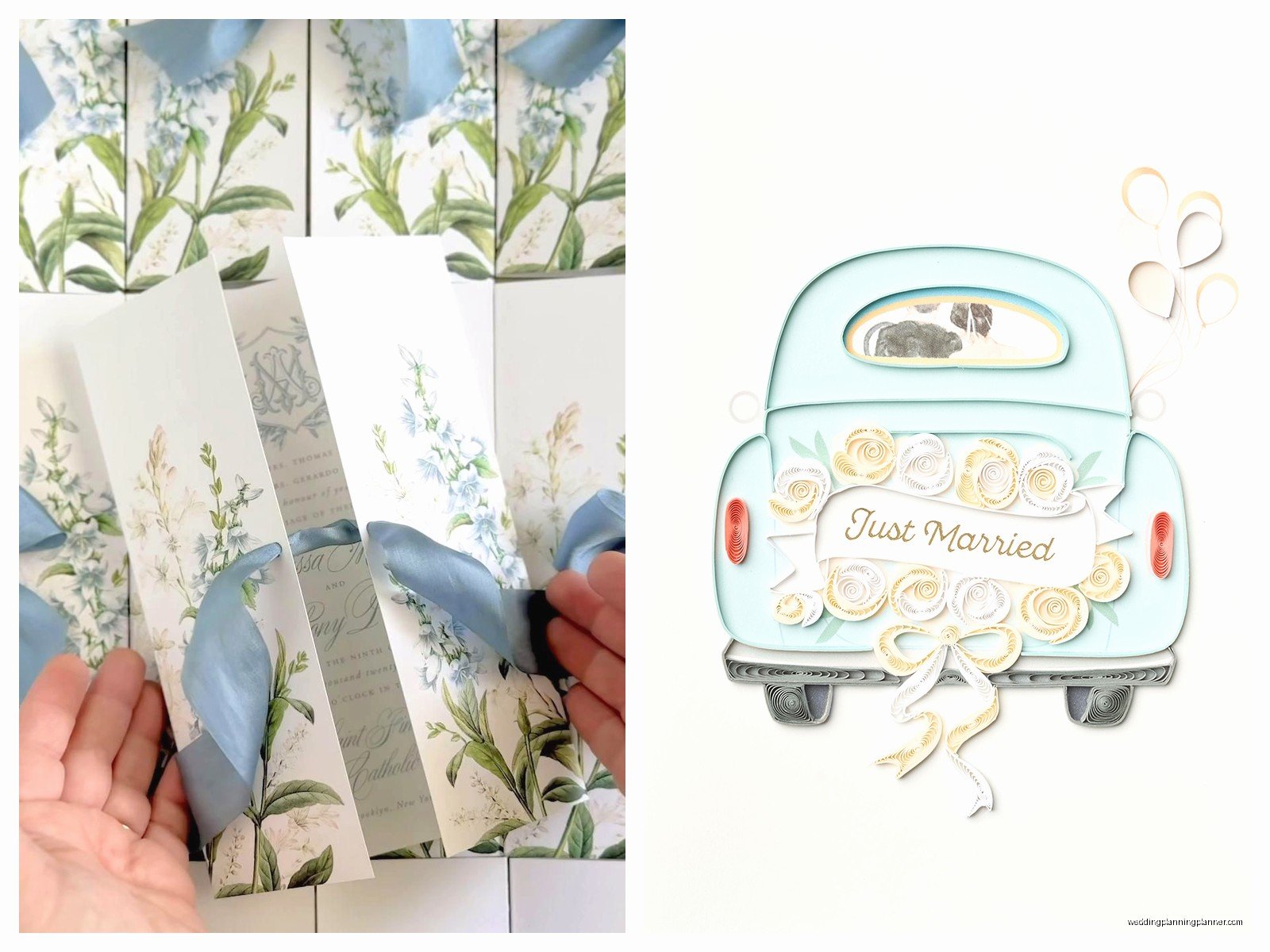
Also consider if you’re doing multiple inserts – like an invitation, RSVP card, details card, and maybe a map or accommodation card. Each piece can be different paper weights and types, but they should coordinate. I usually do the main invitation in the heaviest stock (120lb) and inserts in slightly lighter stock (100lb or 110lb) so the whole suite doesn’t weigh a ton and cost a fortune in postage.
Envelopes Are Their Own Nightmare
Envelope paper is different from card paper and honestly this whole section could be its own guide but I’ll keep it brief. Standard invitation envelopes are usually 80lb or 100lb text weight – thick enough to feel substantial but thin enough to fold and seal.
You can get envelopes with different flaps – pointed (euro flap), straight, square. Euro flaps look more formal and elegant. Straight flaps are traditional and safe.
Envelope liners are optional but they make such a difference when someone opens the invitation. They’re usually printed or patterned paper that you glue inside the envelope flap. They add cost and assembly time but the wow factor is real. You can DIY these or order them pre-cut from places like Cards & Pockets or… wait, I’m spacing on the other major supplier, but there are several.
One thing that drives me nuts: people pick super dark envelopes (like navy or black) and then get frustrated when addresses don’t show up well. If you’re using dark envelopes, you pretty much have to do white ink, paint pens, or print on clear labels. Regular black ink just disappears.
Where to Actually Order From
For DIY printing at home, you can buy paper from Paper Source, Cards & Pockets, or LCI Paper. They sell by the sheet or in smaller quantities. But honestly, home printing wedding invitations is… it’s a lot. Your printer will jam. Colors won’t match. You’ll run out of ink at 9pm the night before you need them done. I’ve seen it happen so many times.
Online print companies like Minted, Zola, Paperless Post (wait, they do paper now too), and Vistaprint offer full-service printing. You upload your design, pick your paper, they print and ship. Quality varies but it’s convenient. Minted uses pretty good paper stock – their Signature or Luxe options are 130lb+ and feel substantial.
For letterpress or foil stamping, you need specialty printers. Bella Figura, Dauphine Press, and tons of smaller local letterpress shops. These are way more expensive – expect to pay $8-$15+ per invitation – but the quality is stunning.
Trade printers like CatPrint or Overnight Prints are what I use for clients sometimes. Cheaper than consumer-facing companies, but you need to know exactly what you’re ordering. They don’t hold your hand through the process.
Design Considerations for Different Papers
Your design needs to match your paper choice or it’ll look off. Delicate script fonts look gorgeous on cotton paper with letterpress but can be hard to read if digitally printed on glossy cardstock. Bold, modern designs work great on bright white smooth cardstock but might look too stark on natural textured paper.
If you’re using textured paper, keep your design simple. The texture IS part of the design. Don’t overcomplicate it with too many fonts or graphics or… actually I saw this invitation once that had like six different fonts and a floral border and it was on linen paper and it just looked chaotic. Less is more with textured papers.
For shimmer or metallic papers, the paper itself is already flashy, so your design should be clean and elegant. Let the paper do the work.
Testing Before You Commit
Order samples. Seriously. Every printer offers them. Get the actual paper you’re considering with similar printing to what you want. Hold it. Bend it slightly. Does it crease weird? Does it feel cheap or luxurious? Show it to your fiancé, your mom, your brutally honest friend.
If you’re designing yourself and printing online, most companies let you order a single proof before the full run. Do this. I cannot stress this enough. You’ll catch typos (there’s always a typo), color issues, alignment problems. That proof costs $15-30 but saves you from ordering 150 invitations with “Saterday” on them.
Also test your envelopes if you’re printing addresses at home. Some envelope papers are coated and ink smears. Some printers can’t handle thick envelopes and they jam constantly. Print five test envelopes before you commit to a method.
Timing Your Order
Paper production and printing takes time. If you’re ordering custom letterpress or foil, allow 6-8 weeks minimum. Digital printing is faster – usually 2-3 weeks including shipping. But then you have to assemble everything, address envelopes, add postage, and mail them.
Invitations should go out 6-8 weeks before your wedding. So work backward from there. If your wedding is in October, you should be finalizing your invitation design and placing orders by early August at the latest, which means you should be requesting paper samples in July, which means… okay you see how this timeline gets tight.
I always build in buffer time because things go wrong. Printers make mistakes. Shipping delays happen. You realize you hate the font you picked. During COVID the paper shortages were insane and some cotton papers were backordered for months, which was a whole thing.
Budget Reality Check
Paper quality affects cost dramatically. Basic 100lb cardstock invitations with digital printing run maybe $1.50-3 per invitation for the full suite. Cotton paper bumps that to $3-5. Letterpress on luxury cotton paper with custom envelope liners and you’re at $10-20 per invitation easily.
For 100 invitations, you’re looking at $150-300 for budget-friendly options, $300-600 for mid-range quality, and $800-2000+ for high-end letterpress or foil stamping. And that doesn’t include postage, which for a heavy invitation suite can be $1-2 per piece if you need extra postage for weight or odd shapes.
My advice is always: splurge on paper quality over fancy printing techniques if you have to choose. A beautifully designed invitation on thick, luxurious paper with simple digital printing looks better than a mediocre design with letterpress on cheap cardstock. The paper is what people touch and feel. It matters more than you’d think.