
Planning Guides, Style Guide
Wedding Response Cards: RSVP Reply Card Guide
May
RSVP Cards Are Way More Important Than You Think
Okay so response cards seem super simple right? Like just throw “yes or no” on a card and call it done. Nah. I’ve been planning weddings for almost 15 years now and I gotta tell you, the RSVP card is where so many couples drop the ball and then wonder why their guests are confused or why they’re chasing people down two weeks before the wedding.
The main thing you need to understand is that your response card has ONE job: make it completely idiot-proof for your guests to tell you if they’re coming. And I say that with love because even smart people get confused by poorly designed response cards. I had this situation back in spring 2023 where a bride used this “clever” wording that was like a fill-in-the-blank poem situation and literally 40% of her guests filled it out wrong or didn’t fill it out at all. We were calling people at 9pm on weeknights trying to get a headcount.
What Actually Goes On The Card
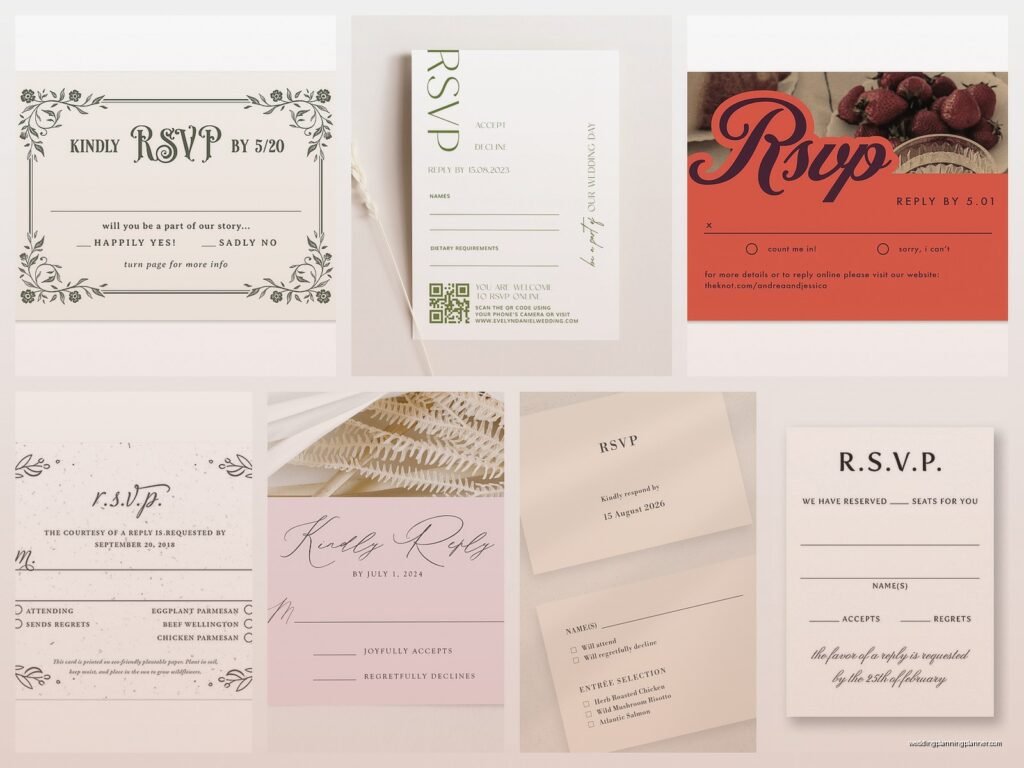
The basic elements you absolutely need are pretty straightforward. You need a line for the guest name, you need an accept/decline option, and you need the response deadline date. That’s it. That’s the foundation.
For the name line, most people do something like “M_____” which is kinda old-fashioned but it works. The M is there so guests can write “Mr. and Mrs. Smith” or “Ms. Jones” or whatever. Honestly though, I’ve started telling couples to just write “Name(s)” because not everyone uses traditional titles anymore and the M thing confuses people sometimes.
The accept/decline part can be done a bunch of ways. The most common is checkboxes like:
- ___ Accepts with pleasure
- ___ Declines with regret
Or you can do fill-in-the-blank style like “_____ of _____ guests will attend” which gives you a number right away. I actually prefer this method because it’s clearer, especially when you’ve invited someone with a plus-one or a family.
The Deadline Date Thing That Everyone Messes Up
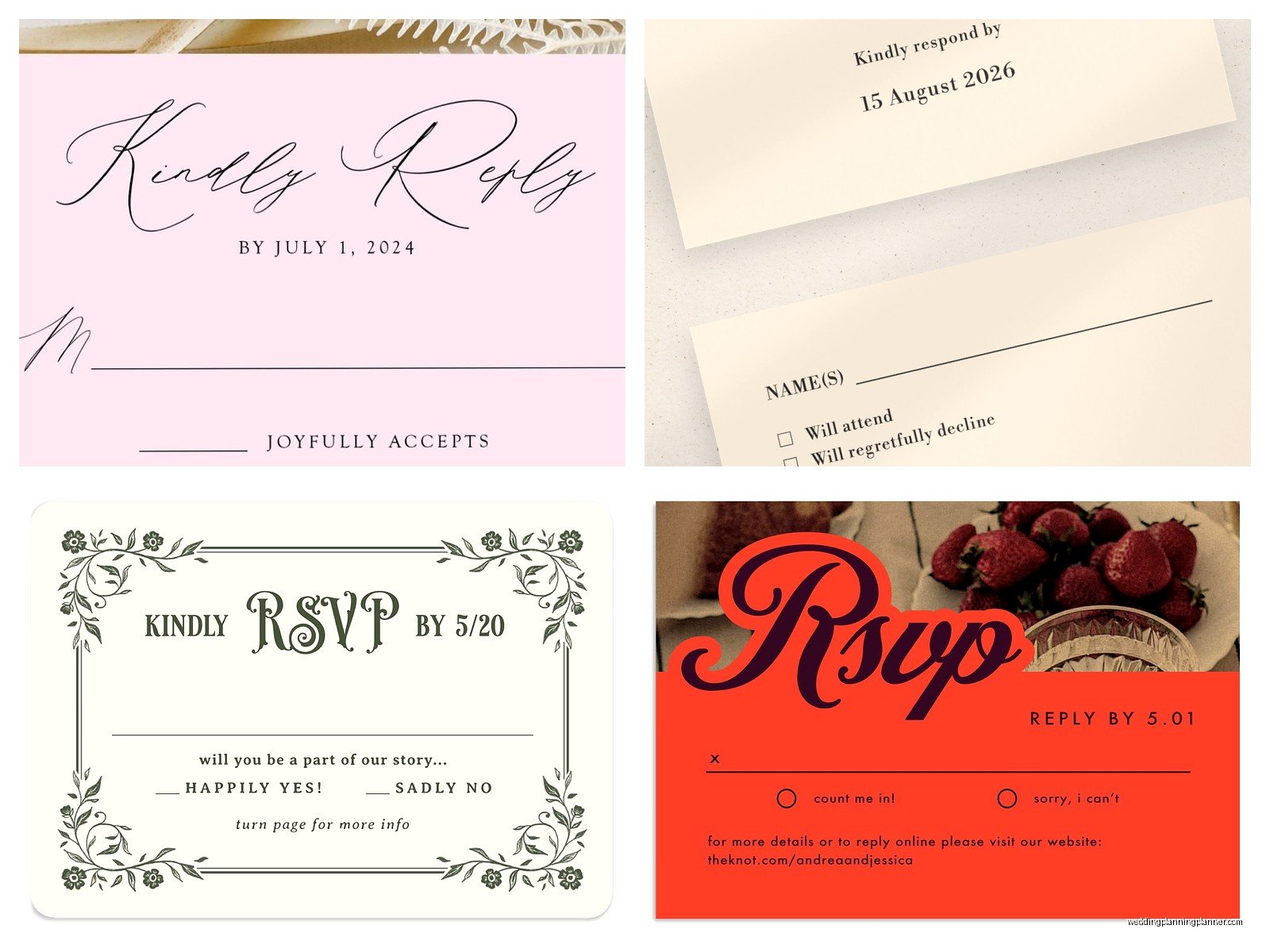
Your RSVP deadline should be at MINIMUM three weeks before your wedding date. I usually tell couples to make it four weeks because you’re gonna have stragglers no matter what, and you need time to track those people down. Your caterer needs final numbers usually 7-10 days before the event, and you need that buffer time to hunt down the people who “forgot” or whose card “got lost in the mail” (it didn’t, they just didn’t send it).
Write the date clearly. “Please respond by May 15th, 2024” not “Please respond by 5/15/24” because dates get confusing. And definitely not something cutesy like “Please respond before the flowers bloom” because Karen from accounting will take that literally and respond in March when you meant April.
Meal Choices Are Their Own Nightmare
If you’re doing plated dinner service with meal options, you gotta include that on the response card. This is where things get messy because you need to make sure each person selects their meal AND you need to be able to match meals to specific guests.
The way I usually set this up is:
- Number of guests attending: ___
- Entrée selection (please initial your choice):
- ___ Chicken Marsala ___
- ___ Beef Tenderloin ___
- ___ Vegetarian Pasta ___
That little “initial your choice” instruction is KEY because otherwise you get families where someone checked all three boxes and you have no idea who wants what. I learned this the hard way at a wedding in summer 2021 where we had to literally guess at the reception who ordered what meal because the cards just had checkmarks with no names.
Also always include a vegetarian option even if you think nobody needs it. Someone will need it.
Dietary Restrictions Line
You should add a line that says “Please list any dietary restrictions: ___________” because people have allergies and preferences and it’s way better to know ahead of time than to have someone sitting there unable to eat anything. Your caterer will thank you.
What drives me absolutely CRAZY though is when guests write their entire life story in this section. Like “I’m doing keto and I don’t eat dairy or gluten or anything fun and I prefer organic vegetables” and it’s like… I needed to know about your peanut allergy, not your lifestyle choices. But whatever, at least you have the information.
The Return Envelope Situation
Your response card needs to come with a pre-addressed, pre-stamped return envelope. PRE-STAMPED. Do not make your guests provide postage. I don’t care if it costs you an extra $50 in stamps, just do it. If you make people find their own stamp, your response rate will drop significantly.
Address the return envelopes to whoever’s collecting the RSVPs. Usually that’s the couple, but sometimes it’s a parent or the wedding planner (me, sometimes). Make sure the address is correct because I’ve seen return envelopes with typos and then cards end up in USPS limbo.
The envelope should be small, like an A1 or A2 size that fits the response card. You don’t need anything fancy here.
Wording Options That Actually Work
Traditional wording is fine but you can definitely make it more personal. Instead of “M_____” you could say “We’ve saved you a seat!” or just “Name(s):”. Instead of “Accepts with pleasure” you could do:
- ___ Can’t wait to celebrate!
- ___ Will be celebrating from afar
Or keep it simple with:
- ___ Will attend
- ___ Will not attend
Just make sure the language is crystal clear. This isn’t the place for inside jokes or overly creative wording that might confuse your great aunt.
The “Plus One” Problem
Okay so this is where couples get themselves in trouble. If you’re giving someone a plus-one, you need to be clear about it. On the outer envelope, address it to “Sarah Johnson and Guest” and then on the response card, make sure there’s space for two names or indicate “2 seats reserved in your honor” or whatever.
If someone is NOT getting a plus-one, only put their name on the envelope. Just “Sarah Johnson” and then on the response card you could write “We have reserved 1 seat in your honor” to make it extra clear. Will some people still try to bring a date? Yeah probably. But at least you were clear.
The thing that gets messy is families with kids. If you’re inviting the whole family, address it to “The Johnson Family” or list out the kids’ names on the inner envelope. If you’re NOT inviting kids, only put the parents’ names. And maybe consider adding something on your wedding website about it being an adults-only celebration.
Online RSVPs vs. Physical Cards
Look, I know everyone’s doing online RSVPs now through their wedding website and honestly? It’s fine. It’s easier to track, you get instant notifications, and you can send reminder emails. But I still think you should include a physical response card in your invitation suite even if you prefer online responses.
Some of your older guests aren’t gonna want to deal with a website. My own mom still prints out driving directions instead of using GPS, so like… you gotta accommodate different comfort levels. You can include both options by putting the website on the response card with something like “Prefer to respond online? Visit ourwedding.com” and still include the mail-back option.
If you’re doing online RSVPs, make sure the website is mobile-friendly because people are gonna respond from their phones. And test it thoroughly before you send invitations because I’ve seen websites that crashed or didn’t save responses correctly and that’s a disaster.
What About Song Requests And Other Add-Ons?
Some couples like to add a line for song requests or drink preferences or whatever on their response cards. Personally, I think this clutters things up but if you wanna do it, go for it. Just don’t add too much or the card becomes overwhelming.
A simple “Song request: ___________” at the bottom is fine. Or “We’ll be drinking: ___ Beer ___ Wine ___ Cocktails” if you’re trying to estimate bar needs. Just keep it to one additional question max.
My cat literally just knocked over my coffee while I’m writing this so if this section seems scattered that’s why…
Timing For Sending And Receiving
Your invitations (with response cards) should go out 6-8 weeks before the wedding. For destination weddings, send them 10-12 weeks out. This gives people enough time to make plans but not so much time that they forget about it.
Set your RSVP deadline for about 3-4 weeks before the wedding like I mentioned earlier. This means you’re asking people to respond about 2-4 weeks after they receive the invitation, which is reasonable.
You’ll start getting responses back within a few days of people receiving invites. The organized people respond immediately. Then you’ll get a trickle for a couple weeks. Then nothing. Then the week of your deadline you’ll get another wave. And then you’ll have to chase down like 15-20% of your guest list who just… didn’t respond.
Tracking Responses
You need a system for tracking who’s responded and who hasn’t. I use spreadsheets with columns for: guest name, number attending, meal choices, dietary restrictions, and notes. Some couples use wedding planning apps that have RSVP tracking built in.
Number your response cards on the back with a small pencil mark that corresponds to your guest list. This way if someone forgets to write their name (happens more than you’d think), you can still figure out who it’s from based on the number. This is like a secret wedding planner trick that saves so much hassle.
The Follow-Up Process
After your RSVP deadline passes, make a list of everyone who hasn’t responded. Then you gotta reach out. Start with a friendly text or email like “Hey! Just checking if you got our wedding invitation? We need to give final numbers to our caterer soon!” Most people will be like “Oh my god I’m so sorry, yes we’re coming!” or whatever.
For people who don’t respond to the first message, try calling. I know phone calls are awkward now but sometimes that’s what it takes. And honestly some older guests prefer a phone call anyway.
Give yourself at least a week of follow-up time before you absolutely need to give final numbers to your vendors. This is why that 3-4 week buffer before the wedding is so important.
Common Response Card Mistakes To Avoid
Don’t use confusing wording or poems or riddles or… just don’t be cute here, basically. Clear and simple wins every time.
Don’t forget to include the year on your RSVP deadline date. “Please respond by June 10th” could technically be any June 10th.
Don’t make the response card too small. A standard 4.25″ x 5.5″ card is good. If it’s too tiny, people (especially older guests) will struggle to write on it.
Don’t use super light colored ink or fancy fonts that are hard to read. Black or dark navy ink on white or cream cardstock is classic for a reason.
Don’t forget to include meal selections if you’re doing plated dinner with choices. And don’t offer too many meal choices because that complicates things for the caterer. Three options max.
What If Someone Responds For More People Than Invited?
This happens and it’s awkward. Someone will write “4 guests attending” when you only invited them plus one. You gotta call them and politely explain that you’ve reserved 2 seats for them and due to venue capacity, you’re unable to accommodate additional guests. Most people will be understanding once they realize their mistake, though some will be annoyed. But like, you can’t just let people add random guests to your wedding because then your numbers are completely off and you’re paying for extra meals and…
Anyway. Just be polite but firm. “I’m so sorry for any confusion, but we’ve reserved 2 seats in your honor. We hope you can still join us!” Something like that.
Digital RSVP Card Design Tips
If you’re having a designer create your response cards, make sure the layout is clean and there’s enough space for people to actually write. I’ve seen cards where the font is so large or there’s so much decorative stuff that there’s barely room for guests to fill in information.
Match your response card to your invitation design but it doesn’t need to be as elaborate. The invitation is the showpiece, the response card is functional.
Consider printing a small map or directions to your wedding venue on the back of the response card. Or your wedding website URL. Just bonus information that doesn’t clutter the main RSVP side.
Make sure your printer can handle whatever paper or finish you choose. Some really textured papers don’t work well with certain printing methods and the ink can smear or not adhere properly.
Postage And Mailing Stuff
Check with USPS about postage costs before you mail everything. Response cards with their return envelopes usually need regular First Class stamps, but your invitation suite might need extra postage if it’s heavy or oversized. Take a fully assembled invitation to the post office and have them weigh it to be sure.
Also hand-cancel your invitations if they’re fancy or have wax seals or anything that might get damaged in the sorting machines. It costs a little extra but it’s worth it to make sure your invitations arrive looking good.
For the return envelopes, Forever stamps are fine. They’ll be valid whenever the guest mails them back, even if postage rates increase.
Alright so that’s basically everything I’ve learned about response cards over the years. The key is keeping it simple, clear, and making it as easy as possible for your guests to respond. Give yourself plenty of time for follow-ups, number your cards secretly, and don’t stress too much when people inevitably make it more complicated than it needs to be because that’s just gonna happen no matter what you do