Planning Guides, Style Guide
Wedding Script Examples: Sample Ideas & Examples
Apr
Okay so wedding scripts are honestly one of those things people stress about way too much
Like I get it, you want your ceremony to sound perfect and meaningful and not like you just copied something off the internet, but here’s the thing – you’re gonna need to start somewhere and that somewhere is usually… copying something off the internet and then making it yours. I’ve been planning weddings since 2008 and I still reference script examples for my couples because there’s only so many ways to say “do you take this person” before your brain just stops working.
The biggest mistake I see is couples waiting until like two weeks before the wedding to even think about their script. Then they’re panicking and the officiant is texting me at 11pm asking if the couple wants a unity candle or not. Just don’t do that to yourself.
Basic ceremony structure that actually makes sense
Every wedding ceremony follows pretty much the same flow, whether it’s religious or secular or whatever. You’ve got your opening remarks, then maybe some readings or music, then the vows, then rings, then pronouncement, then kiss. Done. The script is just the words that fill in those sections.
Here’s what a super basic outline looks like:
- Welcome and opening words
- Declaration of intent (the “do you take” part)
- Readings or special elements
- Exchange of vows
- Exchange of rings
- Pronouncement
- The kiss
- Presentation of the couple
You can add or subtract things obviously but that’s your skeleton. I had this couple back in spring 2023 who wanted to do like seven different unity ceremonies and I had to gently tell them that their guests would literally fall asleep standing up. We compromised on two.
Opening remarks examples
The opening is where your officiant welcomes everyone and sets the tone. This is where you can get personal or keep it traditional or whatever vibe you’re going for.
Traditional option:
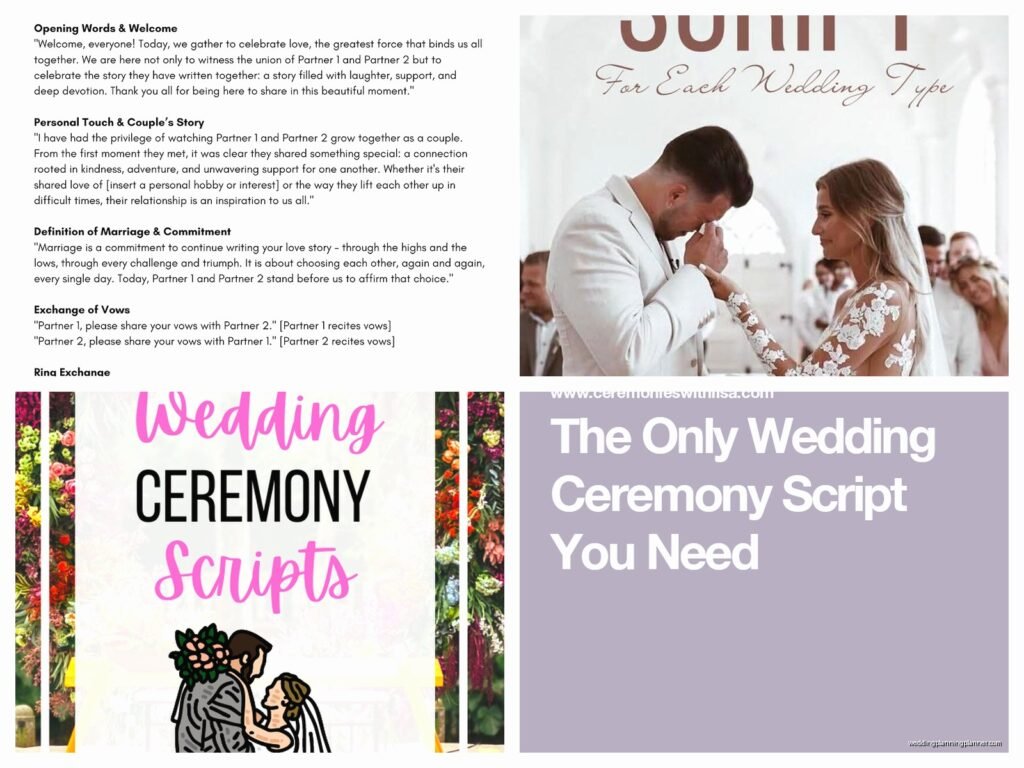
Welcome family and friends. We are gathered here today to witness and celebrate the union of [Name] and [Name] in marriage. This is a day of great joy and celebration as these two individuals come together to pledge their love and commitment to one another.
More casual option:
Good afternoon everyone! We’re so glad you’re here to celebrate [Name] and [Name]. These two have been planning this day for months, and they’re so excited to finally make it official in front of all the people they love most. So let’s get started!
Personal option:
Welcome everyone. For those who don’t know me, I’m [Officiant Name], and I’ve known [Name] since college when we both thought we could survive on ramen and ambition. Watching [Name] meet [Name] and fall in love has been one of the greatest joys of my life, and I’m honored to be standing here today.
See how different those feel? That’s what I mean about tone. You gotta pick what sounds like YOU, not what sounds like a wedding is “supposed” to sound like.
Declaration of intent (the important legal-ish part)
This is the part where the officiant asks if you actually wanna get married. It’s kinda required in most places for the marriage to be legal, so don’t skip it even if it feels cheesy.
Traditional version:
[Name], do you take [Name] to be your lawfully wedded wife/husband/spouse, to have and to hold from this day forward, for better, for worse, for richer, for poorer, in sickness and in health, to love and to cherish, till death do you part?
Modern version:
[Name], do you choose [Name] as your partner in life? Do you promise to love, respect, and support them through all of life’s adventures, both the amazing ones and the really difficult ones?
Short and sweet:
[Name], will you take [Name] to be your spouse, your partner, your best friend, from this day forward?
And then they say “I do” or “I will” or once I had a groom say “Absolutely” which was adorable and everyone laughed. The response doesn’t have to be formal as long as it’s clear they’re agreeing.
Vows are where people really overthink everything
Okay so vows. This is where I see the most stress and also where things can go really wrong or really right. You’ve got three main options: traditional vows that everyone knows, personalized vows you write yourself, or a hybrid where you use a template but customize parts of it.
Traditional vows (the safe choice)
These are the vows everyone has heard a million times, and honestly? There’s nothing wrong with using them. They’re traditional for a reason – they cover all the important stuff.
I, [Name], take you, [Name], to be my lawfully wedded wife/husband/spouse. I promise to love and cherish you, in sickness and in health, for richer or poorer, for better or worse, and forsaking all others, keep myself only unto you, for as long as we both shall live.
One thing that really annoys me is when people act like traditional vows are “boring” or “meaningless.” Like… no. They’re beautiful and they’ve worked for literally millions of couples. If you want to use them, use them. Don’t let anyone make you feel like you’re not being creative enough.
Personal vows (the risky but rewarding choice)
Writing your own vows can be amazing but it can also be a disaster. I’ve seen grown men cry reading their vows and I’ve also seen people freeze up and forget everything they wanted to say. My cat literally walked across my keyboard while I was helping a couple edit their vows last week and somehow made them better by deleting a whole paragraph that was too wordy anyway.
If you’re writing your own vows, here’s what you need to include:
- A statement of commitment (I promise to…)
- Specific promises or intentions
- Acknowledgment of the future together
- Something personal that reflects your actual relationship
Example of personal vows:
Sarah, five years ago you walked into that coffee shop and completely changed my life, even though you accidentally ordered my drink and didn’t realize it until you’d already taken three sips. From that moment on, I knew you were special. Today, I promise to always be your partner in adventure, to support your dreams even when they scare me, to laugh with you every single day, and to love you more with each passing year. I promise to always let you have the last french fry, to listen when you need to talk, and to build a life with you that’s full of joy, meaning, and really good coffee. I choose you today and every day for the rest of my life.
See how that’s personal but still covers the important commitment stuff? That’s the balance you want.
Hybrid vows (the middle ground)
This is honestly what I recommend to most couples because it gives you structure but lets you personalize. You use a template but fill in your own details.
I, [Name], choose you, [Name], to be my partner in life. I promise to [personal promise], to [personal promise], and to [personal promise]. I vow to love you in times of [specific situation] and in times of [specific situation]. From this day forward, you will never walk alone. My heart will be your shelter, and my arms will be your home.
You fill in those brackets with your own stuff and suddenly it’s personal without having to write the whole thing from scratch.
Ring exchange wording because rings are expensive and deserve good words
The ring exchange is usually pretty short but it’s meaningful. The officiant says something about the rings and then each person puts the ring on and says a little something.
What the officiant might say:
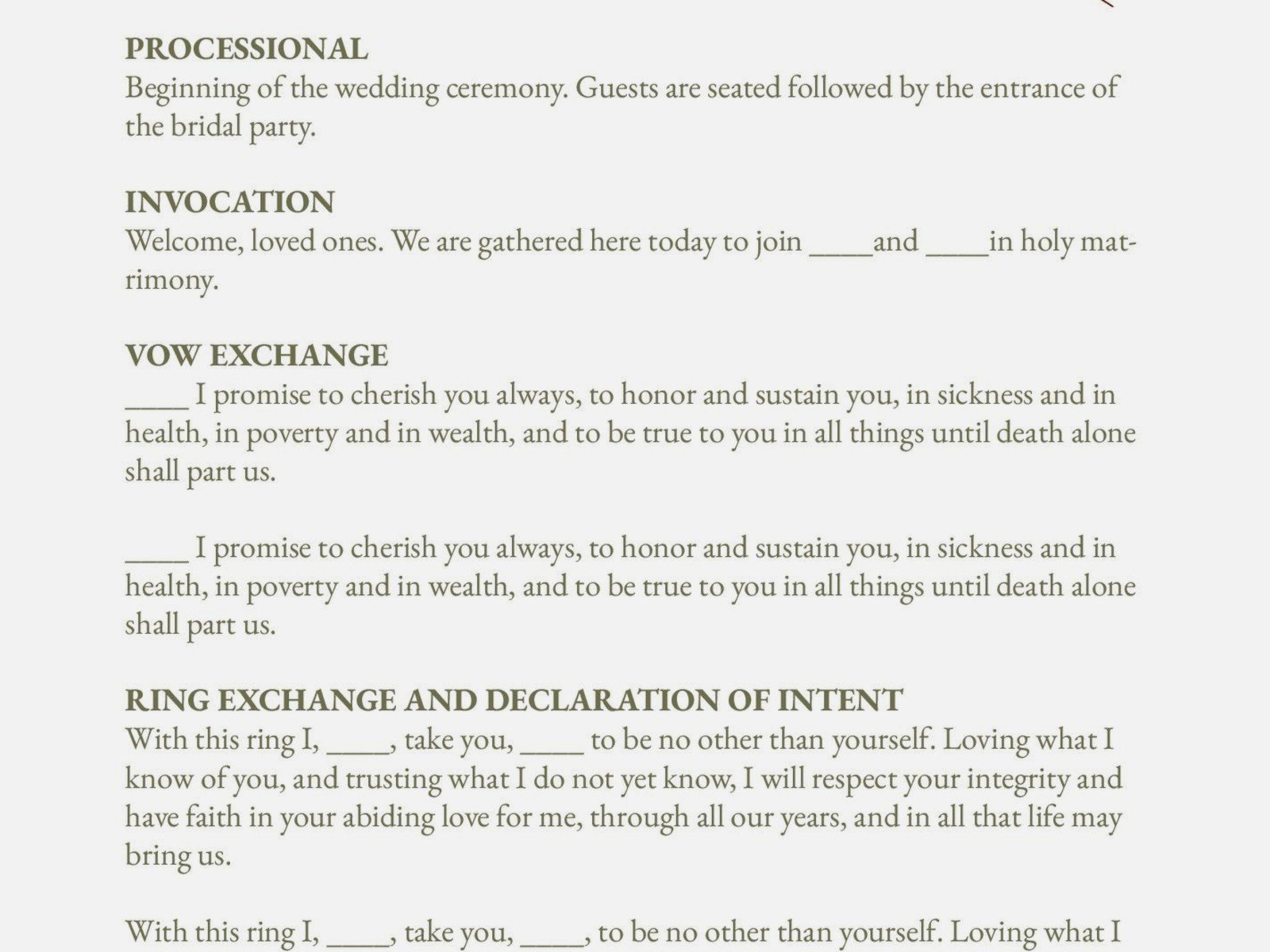
Wedding rings are a symbol of unending love and commitment. These rings represent the promises you’ve made to each other today and serve as a daily reminder of your love.
What you say while putting on the ring:
I give you this ring as a symbol of my love and commitment. With this ring, I thee wed.
Or you can get more personal:
With this ring, I promise to love you, honor you, and cherish you for all the days of my life.
Or super simple:
This ring is my promise to you.
I had a couple in summer 2021 who forgot to tell me they were doing a ring warming ceremony where all the guests held the rings during the ceremony and like… we had to pause everything to collect the rings back and it was awkward but also kinda sweet? Anyway, make sure your officiant knows about any special ring stuff ahead of time.
Adding readings or poems (optional but nice)
Some couples want readings from literature, religious texts, or poems. These usually go after the opening remarks but before the vows. You can have friends or family members read them.
Popular reading options:
- 1 Corinthians 13 (the love is patient love is kind one)
- Excerpt from “The Velveteen Rabbit”
- Apache Wedding Blessing
- Poetry by Rumi, Pablo Neruda, or Maya Angelou
- Excerpts from favorite books or movies
Just keep readings under 2-3 minutes each or people zone out. I’m sorry but it’s true.
The pronouncement and presentation (the grand finale)
After vows and rings, the officiant pronounces you married and then you kiss and then they present you to your guests as a married couple.
Pronouncement example:
By the power vested in me by the state of [State], I now pronounce you married! You may kiss!
Or more formal:
Now that you have declared your love and commitment to one another and exchanged rings as a symbol of your promises, by the authority vested in me, I now pronounce you husband and wife / married / partners for life.
Presentation example:
Ladies and gentlemen, it is my honor to present to you for the first time, Mr. and Mrs. Smith! / the newly married couple! / [Names]!
This is where people usually cheer and you walk back down the aisle and the ceremony is over.
Unity ceremonies if you want them (sand, candle, whatever)
These are totally optional but some couples love them. The most common ones are unity candles, sand ceremonies, handfasting, and wine ceremonies.
Unity candle wording:
[Name] and [Name] will now light the unity candle, symbolizing the joining of their two lives and families into one. The individual candles represent their lives before today – their families, friends, and experiences that have made them who they are. The center candle represents their new life together, built on the foundation of their past but creating something entirely new.
These usually go right before or after the vows. Just don’t do too many or your ceremony gets really long and people get fidgety.
Religious vs secular scripts
If you’re having a religious ceremony, you’ll probably be working with a priest, minister, rabbi, or imam who has their own script requirements. Catholic ceremonies are pretty structured, Jewish ceremonies have specific blessings and the ketubah signing, Hindu ceremonies have multiple days of rituals… you kinda have to work within those frameworks.
But if you’re doing a secular ceremony, you have way more freedom. You can pull from different traditions, write your own stuff, include whatever readings or rituals feel meaningful to you. Just make sure someone (your officiant) knows what order everything goes in so the day-of isn’t chaotic.
Actually writing or choosing your script
So here’s what you actually do: sit down with your partner and talk about what kind of ceremony you want. Serious or funny? Long or short? Religious elements or nah? Then find examples that match that vibe and start mixing and matching pieces you like.
I usually tell couples to create a Google doc and just start copying and pasting sections they like from different examples. Then you edit it together until it sounds like something you’d actually say. Read it out loud because what looks good on paper might sound weird when spoken.
Share it with your officiant at least a month before the wedding so they can practice and give feedback. And please, for the love of everything, print out multiple copies the day of because someone will forget theirs or the wind will blow it away or… I’ve seen it all.
Common mistakes I see all the time
Making the ceremony too long – 20-30 minutes is the sweet spot, anything over 45 minutes and people start checking their phones
Using words you’d never actually say – if you don’t use the word “henceforth” in real life, don’t put it in your vows
Forgetting to tell the officiant about special elements or name pronunciations
Writing vows that are wildly different lengths – if one person talks for 5 minutes and the other says two sentences it feels unbalanced
Not having a backup plan for outdoor ceremonies – I once watched an entire wedding party get rained on because they refused to move inside and honestly the script was great but nobody could hear it over the thunder
Including inside jokes that literally nobody else will understand – one or two is fine but don’t make your whole ceremony a private conversation
Sample full ceremony script
Alright so here’s what a complete ceremony might look like start to finish:
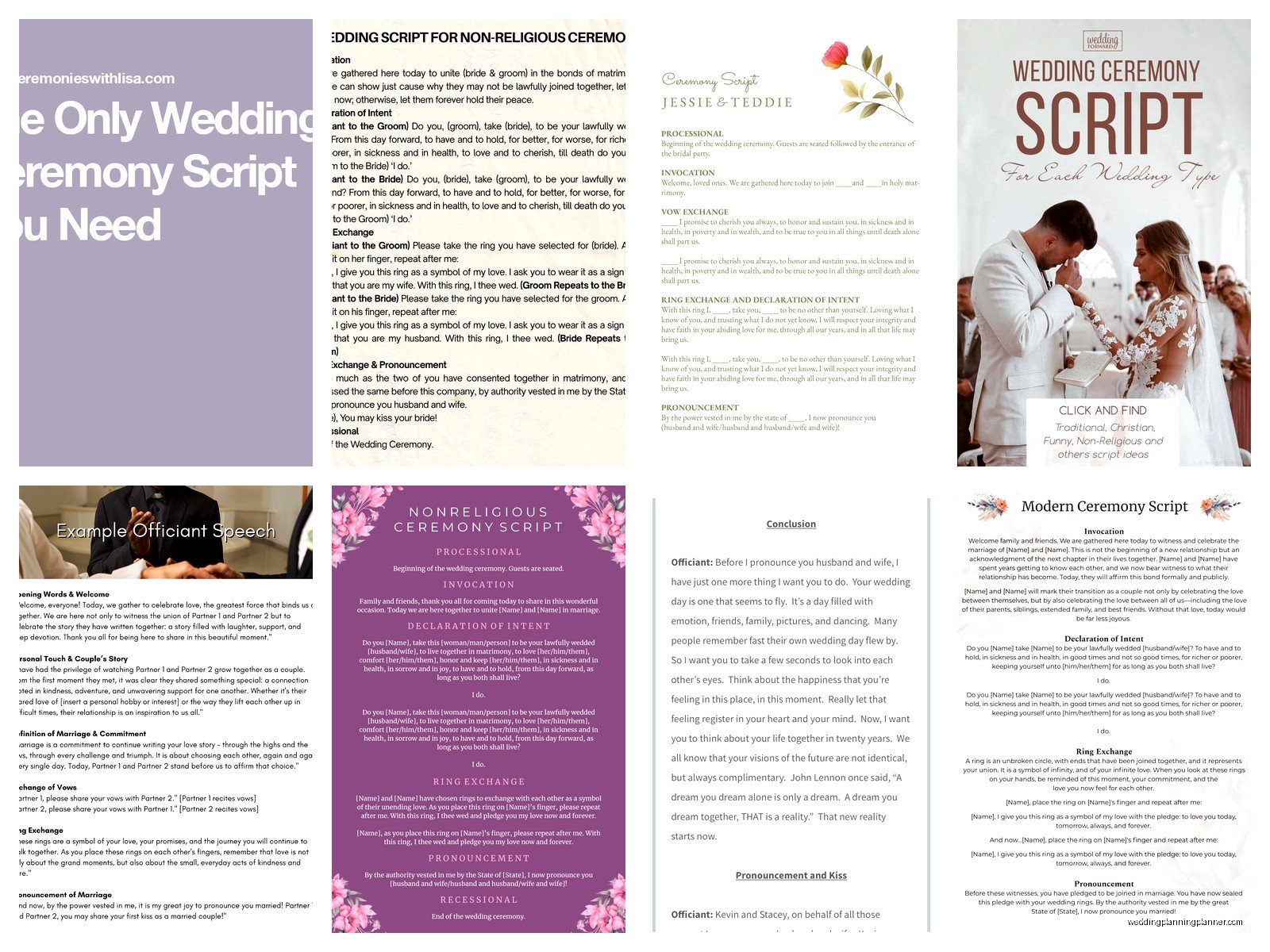
Opening: Welcome everyone. We’re here today to celebrate the marriage of Emily and James, two people who found each other and decided they never wanted to be apart again.
Reading: [Friend reads excerpt from “The Velveteen Rabbit” about becoming real]
Officiant remarks: Emily and James, you’ve chosen to build a life together. Marriage isn’t just about the good times – it’s about showing up for each other even when things are hard, even when you’re tired, even when you’d rather be right than kind.
Declaration of Intent: Emily, do you take James to be your husband? Do you promise to love him, support him, and grow with him for all the days of your life? [I do] James, do you take Emily to be your wife? Do you promise to love her, support her, and grow with her for all the days of your life? [I do]
Vows: [Personal vows from each person]
Ring Exchange: These rings represent the unbroken circle of love. Emily, place this ring on James’s finger and repeat after me: “With this ring, I thee wed.” [Repeat] James, place this ring on Emily’s finger and repeat after me: “With this ring, I thee wed.” [Repeat]
Pronouncement: By the power vested in me, I now pronounce you married! You may kiss your spouse!
Presentation: Everyone, please help me celebrate the newly married couple, Emily and James!
That’s it. That’s a whole ceremony. You can make it fancier or simpler or add stuff or take stuff away, but that’s your basic structure and it works.
Working with your officiant
Your officiant is gonna be the one actually saying all this stuff so make sure you pick someone who can public speak without freaking out. I’ve seen friends-as-officiants absolutely nail it and I’ve seen them completely freeze up and forget everything.
If you’re using a professional officiant, they’ll probably have their own script templates and can help you customize. If you’re having a friend get ordained online (which is totally fine), you need to give them way more support and practice time. Maybe don’t pick your friend who gets nervous speaking in front of three people to officiate your 150-person wedding, you know?
Give your officiant the final script at least two weeks early so they can memorize or get comfortable with it. Have them practice with a microphone if you’re using one because microphone technique is a whole thing.
Last-minute script tips
Have a backup plan for everything – what if someone starts crying during their vows, what if the wind blows papers everywhere, what if the microphone cuts out
Print the script in large font so it’s easy to read quickly
Number the pages in case they get dropped
Include pronunciation guides for any tricky names
Mark where people should pause or where there’s a cue for music
Have tissues readily available because someone’s gonna cry
Remember that small mistakes don’t matter – I’ve seen officiants mess up names, couples forget their lines, rings get dropped, and every single one of those weddings was still beautiful and meaningful because the love was real
The script is just words on paper until you’re actually standing there saying them to the person you love in front of everyone who matters to you, and then suddenly those words become something real and permanent and that’s