Planning Guides, Style Guide
Examples Of Wedding Invitation Cards: Sample Ideas & Examples
Apr
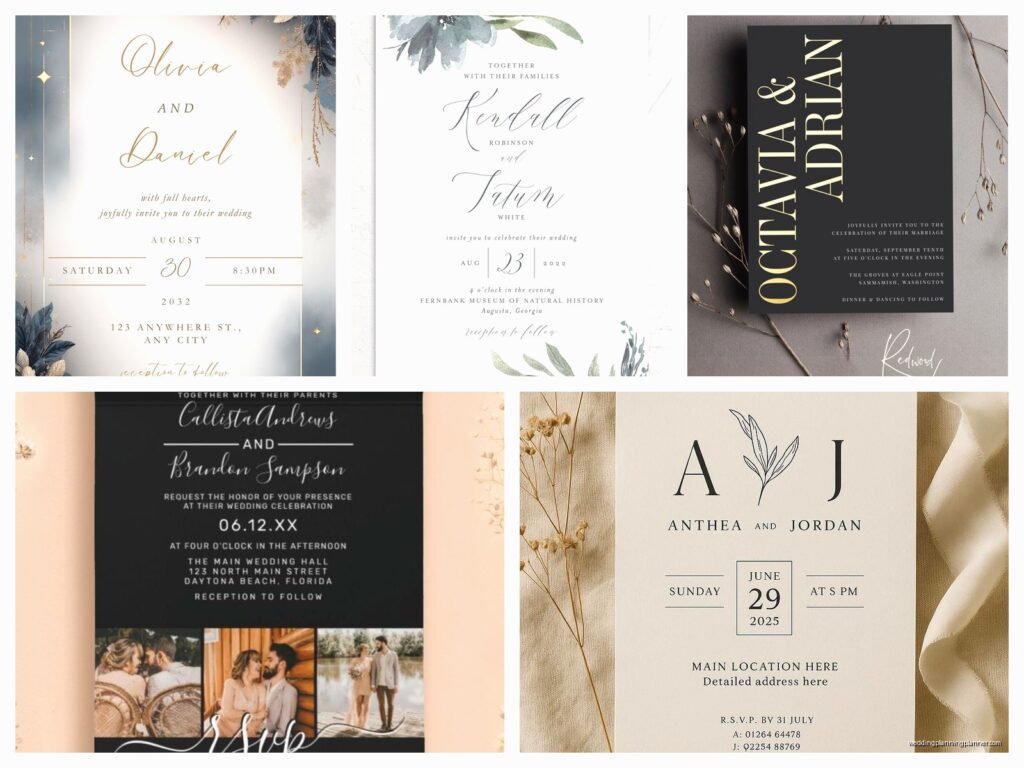
Formal Traditional Wedding Invitations
So the classic formal invite is still what most of my clients go for honestly, especially if their parents are helping pay for the wedding. You’re gonna want the full names spelled out, no nicknames, and this very specific wording that honestly took me forever to memorize when I first started doing this back in like 2015.
The format goes like this: “Mr. and Mrs. Jonathan Michael Peterson request the honour of your presence at the marriage of their daughter Catherine Anne to Mr. James Robert Williams” and then you list the date, time, venue. Notice that “honour” is spelled the British way with a u – that’s traditional for formal invites. If the ceremony is in a church or religious venue, you use “honour of your presence” but if it’s not religious, you’d say “pleasure of your company” instead.
I had this bride in summer 2021 who absolutely insisted on the most formal wording possible even though they were getting married in a barn, and I mean… it worked? But it was kinda funny seeing “honour of your presence” for a venue with hay bales as decor. Not judging, it was actually beautiful, but you get what I mean.
For formal invites, you spell out everything. No “Sept” – it’s “September.” No “4:00 PM” – it’s “four o’clock in the afternoon.” Numbers under twenty get spelled out too. The year is usually “two thousand and twenty-four” not “2024.” The dress code goes on the bottom right corner, like “Black Tie” or “Formal Attire.”
What Annoys Me About Formal Invites
Okay so the thing that drives me absolutely crazy is when couples want formal invitations but then they don’t want to follow ANY of the actual rules. Like they want it to look fancy but then they’re like “can we put ‘Cash bar’ on the invitation?” and I have to explain that no, you literally never mention bars or gifts or anything like that on a formal invitation. That stuff goes on your wedding website or nowhere at all. I’ve had this conversation probably three hundred times at this point.
Modern Casual Wedding Invitations
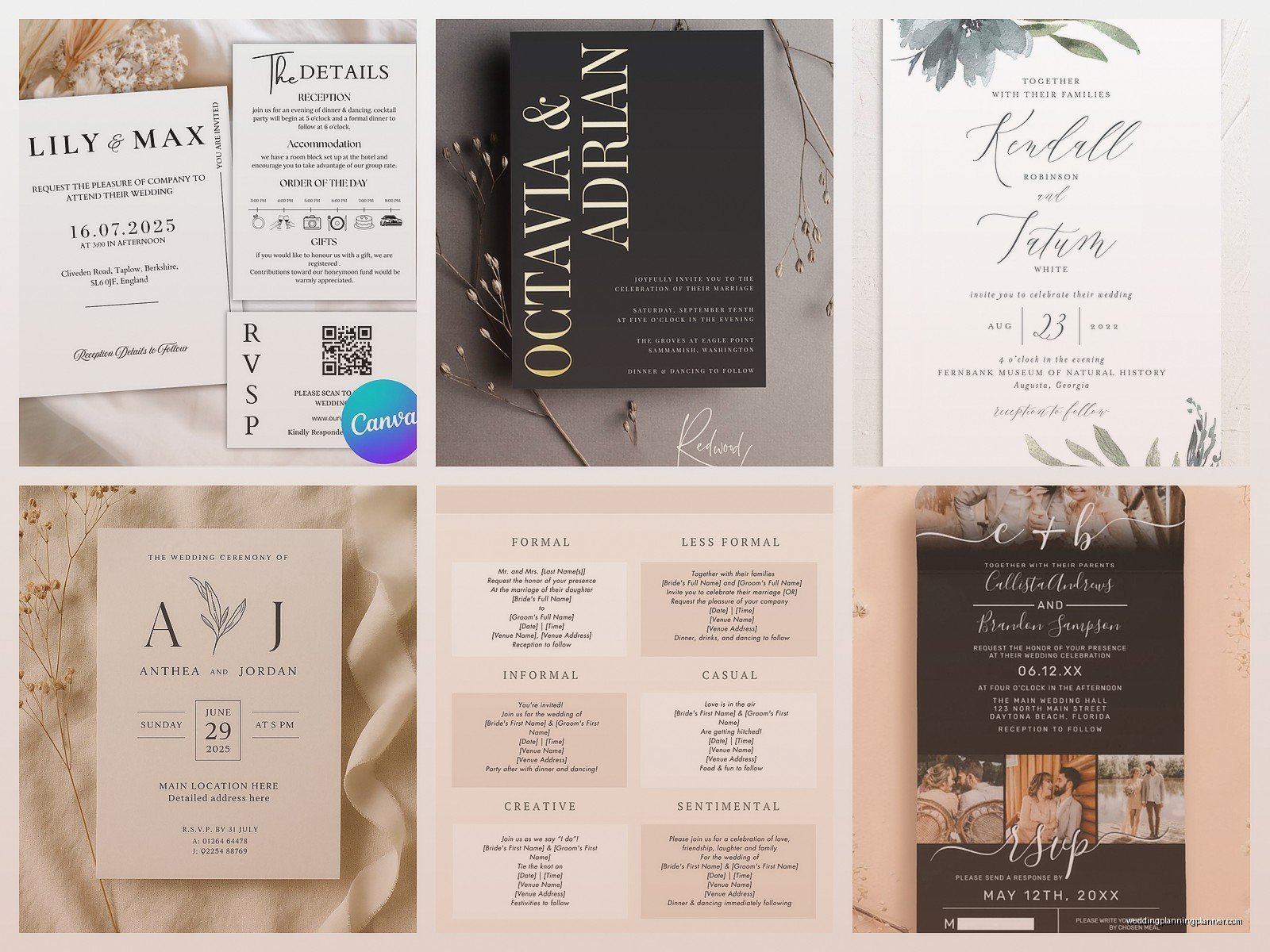
These are way more fun to design honestly. You can use first names only, casual language, and actually show some personality. Something like “Sarah and Mike are getting married! Join us for tacos, tequila, and terrible dancing on Saturday, June fifteenth at five thirty in the evening.”
I love when couples do the “Together with their families” opening instead of listing parents, especially if both people are older or paying for their own wedding or if there’s complicated family situations. It just makes everything easier and you don’t have to navigate like… divorced parents who hate each other or figuring out whether to include a step-parent who’s been around for twenty years but technically isn’t a biological parent or whatever.
For casual invites, you can use ampersands (&), contractions, exclamation points, emojis even if you want though I personally think that’s gonna look dated in like five years but whatever. You can also use numerals for everything – “6/15/2024” is totally fine. Time can be “5:30 PM” instead of spelled out.
The venue address should still be clear though. I’ve seen invites that just say “The Beach” and I’m like… which beach? There are thousands of beaches. Give people the actual address or at least a specific beach name and parking info.
Semi-Formal Middle Ground Invites
This is probably where most couples land tbh. It’s formal enough that your grandmother won’t be offended but casual enough that it doesn’t feel stuffy. You might do something like “Margaret and Robert Peterson invite you to celebrate the marriage of their daughter Kate to James Williams” – see how I used Kate instead of Catherine? That’s the semi-formal sweet spot.
You can mix spelled-out numbers with numerals. Like spell out the time but use numbers for the date. Or spell out the date but use “5:00 PM” for time. There’s no strict rule here which is honestly refreshing after dealing with ultra-formal invites where everything has to be perfect.
Semi-formal invites usually have a cleaner design than casual ones but aren’t as ornate as formal. Think simple elegant fonts, maybe one decorative element like a monogram or a thin border, neutral colors or one accent color. My cat knocked over my entire sample book of semi-formal invites last month and I’m still finding pages under my couch, but anyway—
Destination Wedding Invitations
These need way more information than regular invites. You gotta include travel details, accommodation options, maybe a weekend itinerary. A lot of couples do a postcard-style invitation which is cute and on-theme.
Example wording: “Pack your bags! Katie and Josh are getting married in Cabo San Lucas, Mexico on October 10th, 2024. Join us for a weekend of sun, sand, and celebration. Ceremony at 4 PM on the beach at Resort Las Palmas. Reception to follow. Travel and accommodation details enclosed.”
You need to send these out earlier than regular invites – like four to six months in advance so people can request time off work and book flights. And honestly you should have a wedding website with all the details because there’s too much info to fit on one invitation card.
Also include a separate card with hotel room block information, airport codes, transportation from airport to hotel, what’s included vs what guests pay for. I had a client in spring 2023 who didn’t include any of this and then got SO many phone calls from confused guests and she was stressed out of her mind trying to answer everyone individually when we could’ve just… put it in the invitation suite from the beginning.
The Passport Invitation Style
Some couples do their destination wedding invite as a literal passport booklet which is adorable but also expensive to print. It folds out and has different “pages” with ceremony details, travel info, weekend events, RSVP card, etc. Super cute if you have the budget for it.
Non-Traditional and Creative Examples
Okay so this is where couples get really creative and I’m here for it. I’ve seen invitations that look like concert tickets, movie posters, boarding passes, festival wristbands (well, printed to look like them), vintage postcards, illustrated maps, you name it.
One couple did their entire invitation as a crossword puzzle where filling it out revealed the wedding details. Guests either loved it or were extremely confused, no in-between. Another couple who met at a coffee shop did invitations that looked like coffee cup sleeves.
For these you really don’t need to follow any traditional wording at all. Just make sure the important info is clear: who’s getting married, where, when, how to RSVP, dress code if there is one. Everything else is just decoration.
The risk with super creative invites is that sometimes they’re not immediately recognizable as wedding invitations? I’ve heard stories of people throwing them away thinking they were junk mail or promotional materials. So maybe make sure “wedding” or “marriage” appears somewhere prominent.
Wording for Different Host Situations
This gets complicated fast so bear with me. If the bride’s parents are hosting: “Mr. and Mrs. Whoever request the honour of your presence at the marriage of their daughter…” If both sets of parents are hosting: “Mr. and Mrs. Bride’s Parents and Mr. and Mrs. Groom’s Parents request the honour of your presence at the marriage of their children…”
If the couple is hosting themselves: “The honour of your presence is requested at the marriage of Kate Peterson and James Williams” or just “Kate Peterson and James Williams invite you to their wedding.”
Divorced parents hosting together (if they get along): “Mrs. Sarah Peterson and Mr. Jonathan Peterson request the honour of your presence…” Notice the mom goes first and you use their individual titles, not “Mr. and Mrs.”
Divorced parents who remarried: This is where it gets messy and honestly I need to look it up every single time even after doing this for years. “Mrs. Sarah Thompson, Mr. Jonathan Peterson and Mrs. Linda Peterson request…” basically you list the parent the bride is closest to first, then the other parent and their spouse.
If one parent is deceased, you don’t list them as a host but you can include them in the couple’s names section: “Kate Peterson, daughter of Sarah Peterson and the late Jonathan Peterson, and James Williams…”
RSVP Card Wording Examples
The RSVP card seems simple but people mess it up constantly. You need a deadline (usually three to four weeks before the wedding), you need to know how many people are coming, and you might want meal choices if you’re doing a plated dinner.
Simple version: “Kindly respond by May 1st. M___ will ___ attend / ___ decline.” That M___ line is where guests write their names, the M is for Mr., Mrs., Ms., etc.
With meal choices: “Please respond by May 1st. M___ ___ accepts ___ declines. Number of guests ___. Please select: ___ Chicken ___ Beef ___ Vegetarian.”
Casual version: “Can you make it? ___ Yes! Can’t wait! ___ No, but we’re there in spirit. Name(s): ___”
Here’s the thing though – more and more couples are doing online RSVPs only through their wedding website which I totally get because it’s easier to track and you don’t have to pay for RSVP card printing and postage. But you’ll always have like… someone’s grandma who doesn’t do computers and calls you directly to RSVP anyway.
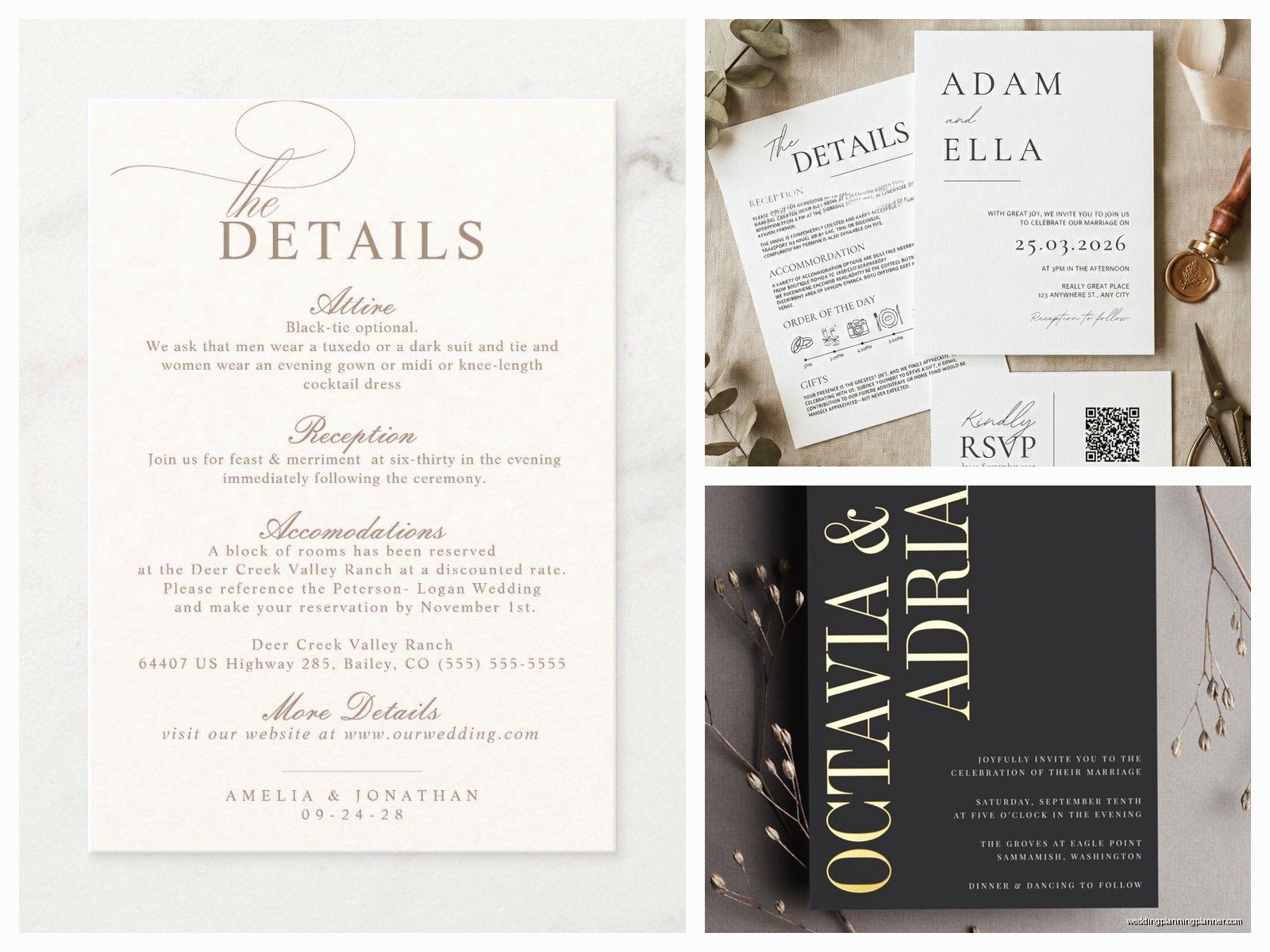
Details Card and Accommodations Card
These are the extra cards that go in your invitation suite. The details card usually has your wedding website URL, directions to the venue, parking information, and maybe a note about your registry though some etiquette people say registry info should only be on the website, not in the invitation.
Example: “For travel and accommodation information, please visit our website at kateandJames2024.com. Limited parking available at venue. Shuttle service provided from Hotel Name at 4:00 PM.”
The accommodations card lists hotel room blocks: “For your convenience, blocks of rooms have been reserved at: Hotel Name, 123 Main Street, (555) 123-4567, mention Peterson-Williams wedding for group rate. Available until September 1st.”
You can also include a weekend events card if you’re doing a welcome dinner or day-after brunch: “Join us Friday, October 9th for a Welcome Dinner at Restaurant Name, 7:00 PM, casual attire.”
Digital and Email Invitations
Okay so I know traditional wedding planners are gonna come for me but digital invitations are totally fine for certain weddings. Like if you’re having a super casual backyard wedding or a small elopement celebration or you’re just not into paper waste, go for it.
There are platforms like Paperless Post, Greenvelope, and others that let you send really beautiful digital invites that don’t look cheap. You can animate them, include videos, link directly to your RSVP form, and track who’s opened them.
The wording is the same as paper invites, just digital. You can be more playful with it since the medium is already casual. I wouldn’t do digital invites for a formal black-tie wedding at a five-star venue though… that’s gonna feel weird to your guests who are expecting something fancy.
Text Message Save-the-Dates
I’ve seen couples send save-the-date texts which is… I mean it works for very casual weddings? But even then I’d probably do at least a digital card rather than just a text. There’s something about getting a text that says “hey we’re getting married June 5th save the date!” that feels a bit too casual even for me, and I’m pretty relaxed about this stuff. But you do you.
Wording for Second Marriages
The rules are way more relaxed here. Usually the couple hosts their own wedding regardless of age, so you’d go with “Kate Peterson and James Williams request the pleasure of your company…” or “The honour of your presence is requested…”
You don’t usually mention that it’s a second marriage on the invitation itself. If there are kids from previous marriages that you want to include, you could do something like “Together with their families, Kate Peterson and James Williams invite you…” Some couples have their kids listed as junior hosts which is sweet: “Kate Peterson and her children Emma and Noah, together with James Williams and his daughter Sophie, invite you to celebrate their marriage.”
I worked with a couple where both had been married before and they did the cutest invitation that said “Two families become one” with little illustrations of their blended family including their dog. Very modern and personal but still gave all the necessary info.
Religious and Cultural Variations
Different religions and cultures have specific invitation traditions. For Jewish weddings, you might include Hebrew text alongside English, and the invitation traditionally comes from both sets of parents. For Hindu weddings, there’s often a Ganesh symbol and the invitation might include multiple events like the Sangeet and Mehndi ceremonies, not just the wedding itself.
Catholic wedding invitations sometimes include a note about the Nuptial Mass: “Nuptial Mass at 2:00 PM, Reception to follow.” For interfaith weddings, you might mention both traditions: “Kate and James invite you to witness their marriage in a ceremony blending Jewish and Christian traditions.”
I always tell couples to talk to their families about what’s important to include culturally because I definitely don’t know every tradition and I’d rather ask than assume. Had a bride once who didn’t tell me her family expected a specific Bengali phrase on the invitation and we had to rush reprint them three weeks before the wedding which was… stressful for everyone involved.
Dress Code Communication
This goes in the lower right corner of the invitation usually. Your options are basically: White Tie (most formal, basically royalty level), Black Tie (tuxedos and formal gowns), Black Tie Optional (tuxes encouraged but dark suits okay), Formal or Cocktail Attire (suits and cocktail dresses), Semi-Formal (suits and nice dresses), Casual (sundresses and khakis), and then there’s stuff like “Beach Casual” or “Garden Party Attire” or “Festive Attire.”
You can also get creative with it: “Boots and Bling” for a country wedding, “Island Casual” for a beach wedding, “Comfortable shoes recommended” for a wedding with lots of outdoor walking. Just be clear enough that people know what you mean because I’ve seen guests show up wildly inappropriately dressed because the invitation said something vague like “Come as you are” and someone interpreted that as literally pajamas.
Plus-One and Guest Name Specifics
This is crucial: the names on the outer envelope determine who’s invited. “Mr. James Williams and Guest” means he can bring someone. “Mr. James Williams” means just him. For families, “The Williams Family” means everyone, but “Mr. and Mrs. Williams” means just the parents, not the kids.
Be really careful with this because it’s how you control your guest count. I’ve had couples who were too vague and ended up with way more people RSVPing yes than they had space for because guests assumed their kids were invited when they weren’t, or they assumed they could bring a date when they couldn’t.