
Planning Guides, Style Guide
Islamic Wedding Invitation: Muslim Cultural Traditional Designs
Nov
Starting With The Basics of Islamic Wedding Invitations
Okay so Islamic wedding invitations are honestly one of my favorite categories to work with because there’s SO much cultural variation and the designs can be absolutely stunning. The thing is, when clients come to me asking for “Muslim wedding invitations,” I have to immediately start asking questions because Muslim isn’t a monolith – you’ve got Arab traditions, South Asian traditions, Turkish, Indonesian, African… the list goes on.
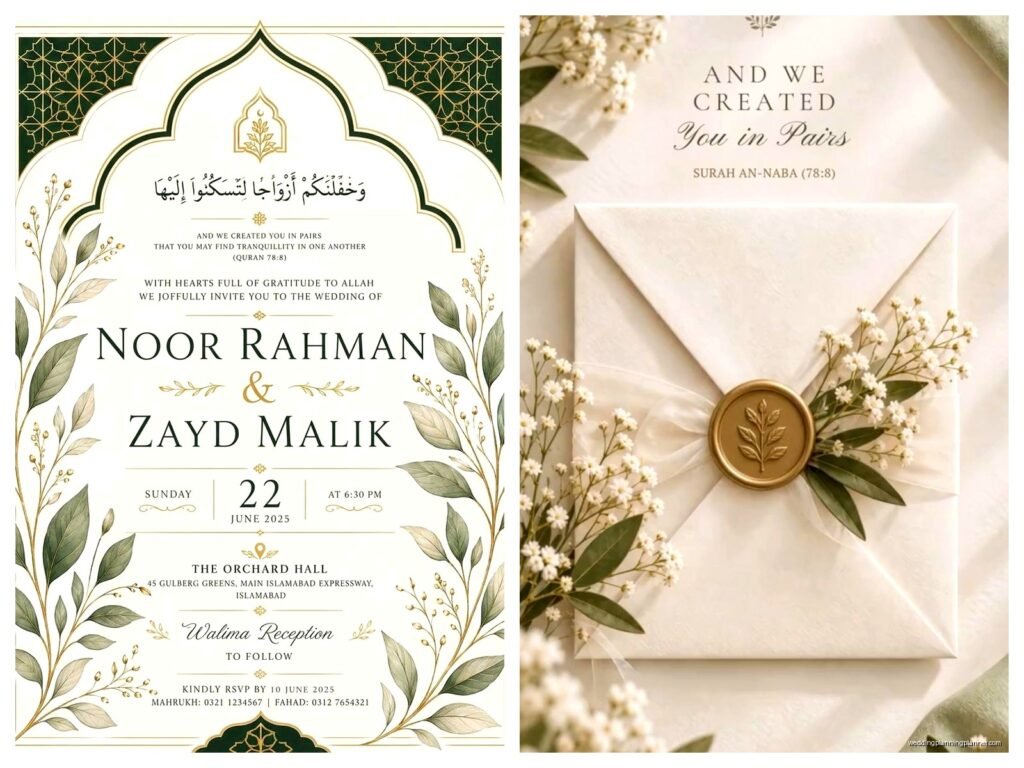
First thing you gotta know is that Islamic invitations typically need to include the Bismillah at the top. That’s “Bismillah ar-Rahman ar-Rahim” which translates to “In the name of Allah, the Most Gracious, the Most Merciful.” This is pretty much standard across all Muslim cultures. Some families are super particular about the calligraphy style used for this, others are more relaxed. I had this one bride back in summer 2021 who changed her mind about the Bismillah calligraphy style THREE times because her grandmother kept sending her different references from weddings back in Lebanon.
The Color Palette Situation
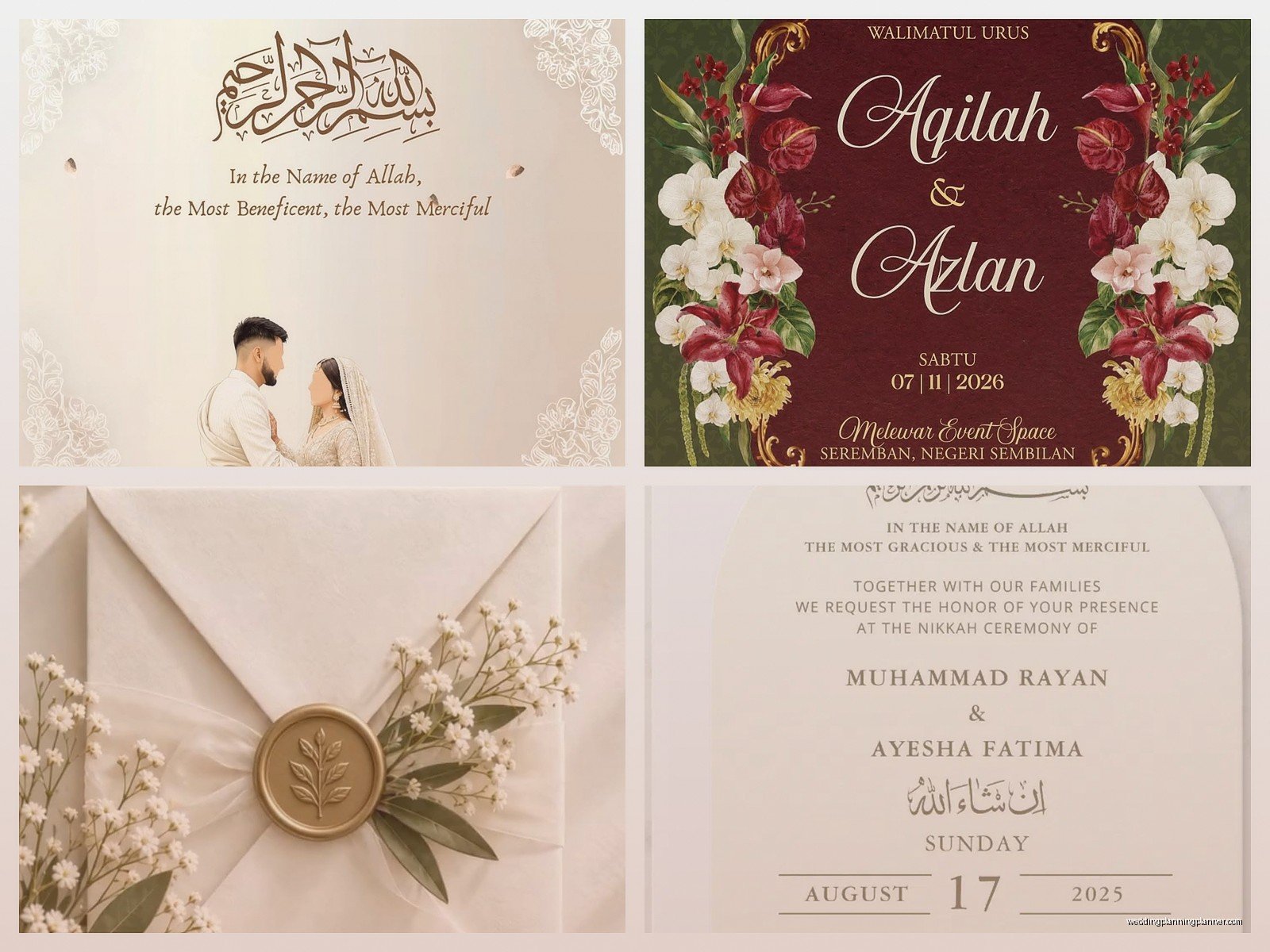
Now colors – this is where it gets interesting. A lot of people assume all Islamic wedding invitations are green and gold because green is associated with Islam, but nah, that’s kinda limiting yourself. I’ve done gorgeous invitations in deep burgundy and cream for Pakistani clients, navy and rose gold for Arab clients, and even this stunning black and copper design for a modern Emirati couple.
South Asian Muslim weddings (Pakistani, Indian, Bangladeshi) tend to go BOLD with colors. Think fuchsia, orange, emerald green, royal blue. These invitations often look more maximalist – lots of paisley patterns, intricate borders, maybe some peacock motifs. Arab weddings tend to be slightly more… I don’t wanna say subdued because that’s not quite right, but they often lean toward jewel tones with metallic accents. Gold foiling is huge in Arab wedding stationery.
Design Elements That Actually Matter
Islamic geometric patterns are your best friend here. These are those intricate interlocking shapes you see in mosque architecture – stars, hexagons, tessellations. They’re gorgeous and they immediately signal Islamic aesthetic without being too literal. What annoys me though is when designers just slap on a generic “arabesque” pattern from a stock site without understanding that different regions have different geometric traditions. Moroccan zellige patterns look different from Persian girih patterns, you know?
Calligraphy is another massive element. Arabic calligraphy specifically, even if your invitation text is primarily in English. A lot of couples will have their names written in Arabic calligraphy, or include Quranic verses. The most common verse I see is Surah Ar-Rum, verse 21: “And of His signs is that He created for you from yourselves mates that you may find tranquility in them; and He placed between you affection and mercy.” It’s beautiful and directly relevant to marriage.
If you’re working with a calligrapher, make sure they actually know Arabic if you’re including Arabic text – I’ve seen some disasters where people used Google Translate and the calligrapher just copied it without understanding the language, and the result was… not great.
Regional Variations You Need To Know
South Asian Muslim Invitations
These are often booklet-style or multi-card sets because South Asian weddings typically have multiple events. You’ve got the Mehndi ceremony, the Nikah (the actual Islamic marriage contract), the Walima (the reception), and sometimes a Sangeet if there’s cultural crossover with Hindu traditions. Each event might get its own card or at least its own section in the invitation.
Design-wise, think rich and ornate. Paisley motifs everywhere, elephant and peacock designs are common (though some stricter families avoid animal imagery), lots of floral patterns. Marigold flowers are huge in South Asian design. The typography tends to be decorative – you’ll see a lot of scripts that look almost like they’re dripping with jewels or have that hand-painted truck art vibe if you’re going for Pakistani styling.
Fabric or textured elements are popular too. I’ve done invitations with silk wraps, invitations tucked into embroidered pouches, cards with actual fabric backing. Spring 2023 I had a client who wanted her invitations to match her wedding lengha, so we literally got fabric swatches from her designer and incorporated them into the invitation design. It was beautiful but also kinda stressful because fabric doesn’t always photograph well for printing references.
Arab/Middle Eastern Muslim Invitations
Arab invitations often have this elegant, sophisticated look. Less is sometimes more here compared to South Asian designs. You’ll see a lot of geometric patterns, arabesque scrollwork, and architectural elements inspired by Islamic architecture – think arches, domes, minarets.
The paper quality tends to be really important for Arab weddings. Heavy cardstock, letterpress, foil stamping, edge painting. I’ve noticed Gulf Arab clients (UAE, Saudi, Qatar) especially love luxury finishes. One Emirati client told me the invitation sets the tone for the entire wedding, so if the invitation feels cheap, guests will think the wedding will be cheap.
Color-wise, you see a lot of navy, burgundy, emerald, with gold or silver accents. White and gold is classic. Recently I’ve been seeing more couples go for dusty rose and gold or sage green with copper, which gives a more modern feel while still being elegant.
Turkish and Persian Influences
Turkish invitation designs often incorporate tulip motifs (tulips are significant in Turkish culture), Ottoman-era patterns, and sometimes Iznik tile designs. The color palette might include turquoise, which you don’t see as much in Arab or South Asian designs. Persian-influenced invitations might feature nightingale and rose imagery, which comes from Persian poetry and symbolism.
Text and Wording Considerations
Okay so this is where you need to pay attention because the wording matters a lot. Traditional Islamic invitations often start with Quranic verses or Hadith quotes about marriage. Then you’ve got the actual invitation text, which can be tricky because different families have different preferences about whose names appear first and how formal it should be.
Some families want very formal wording with both sets of parents’ names prominently featured because in many Muslim cultures, marriage is seen as uniting two families, not just two individuals. Other couples want something more modern and personal. You gotta feel out what your client wants.
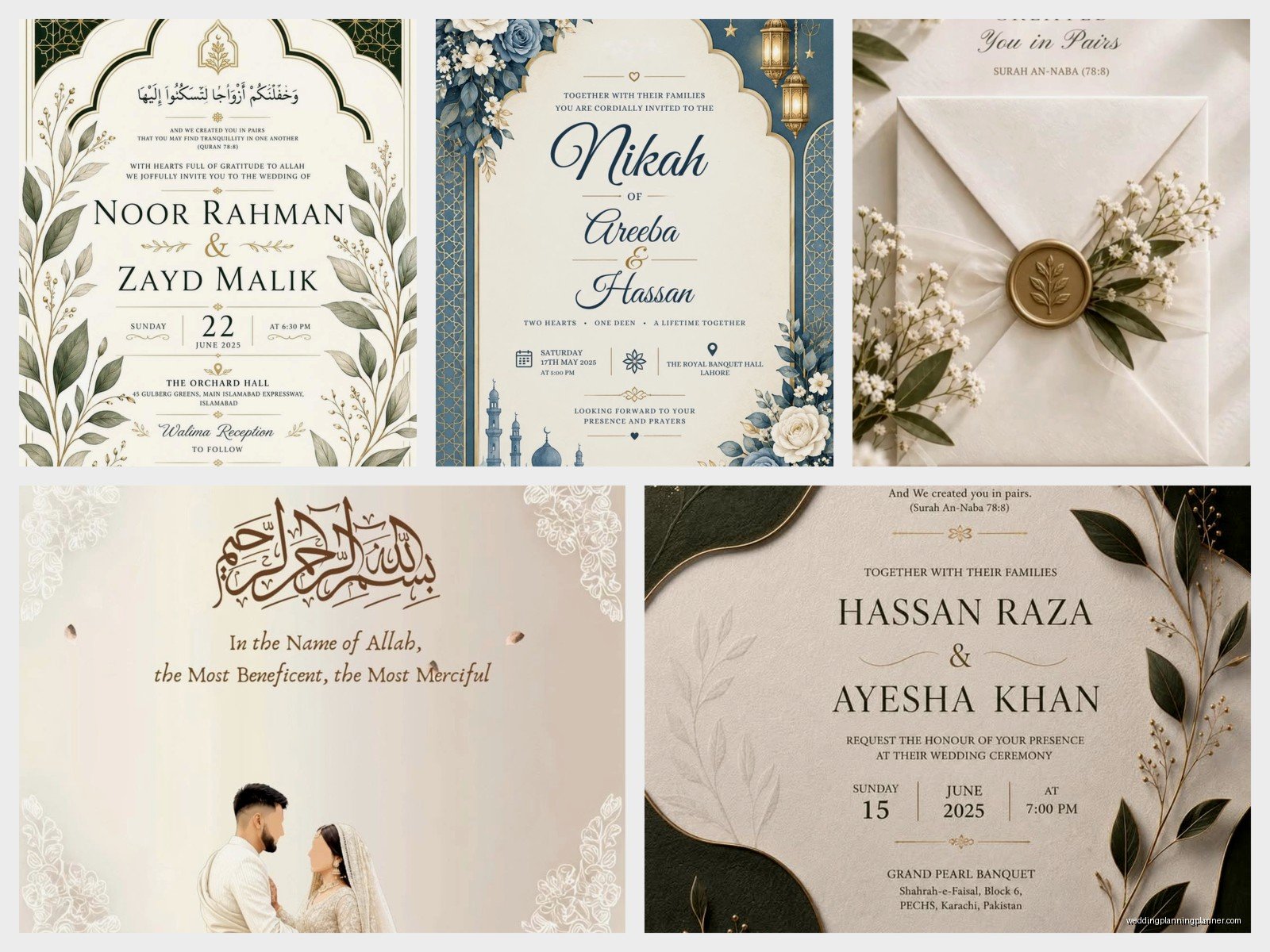
Bilingual invitations are super common. Usually English paired with Arabic, Urdu, or whatever language the family speaks. The layout for bilingual invitations can be challenging – do you do side-by-side, top-and-bottom, separate cards? Arabic reads right to left which adds another layer of complexity to the design layout. I usually recommend separate sections or cards for each language rather than trying to cram both into the same space because it tends to look cluttered.
Important Details To Include
Beyond the standard who/what/when/where, Islamic wedding invitations often need to specify:
- Separate timing or locations for men and women if the wedding is segregated (this is common in more conservative families)
- Dress code – modest dress is usually expected, some invitations specifically mention “Islamic dress code” or “modest attire”
- Whether the event is halal (alcohol-free, halal food)
- Prayer times if the wedding is during a prayer time
- Multiple events with their specific purposes (Nikah vs. Walima vs. Mehndi)
I had this situation once where a family forgot to mention on their invitation that the Nikah ceremony and the Walima reception were on different days, and like half the guests showed up on the wrong day. Always be super clear about timing.
Modern vs. Traditional Approaches
There’s this interesting tension I see with a lot of Muslim couples where they want something that honors their cultural and religious traditions but also feels modern and reflects their personal style. Especially second-generation immigrants who grew up in Western countries – they’re navigating between what their parents expect and what feels authentic to them.
Modern Islamic invitations might strip back some of the ornate elements and go for cleaner lines, minimalist geometric patterns, contemporary fonts paired with traditional calligraphy. You might see marble textures, watercolor effects, or even acrylic invitations with gold Arabic calligraphy. The key is keeping some traditional elements (Bismillah, maybe a Quranic verse, Islamic patterns) while the overall aesthetic feels current.
I’ve also seen couples incorporate their personal story into the design in ways that… okay so my cat just knocked over my coffee which is apparently very important right now, sorry – anyway, couples might include subtle references to how they met, their hobbies, or their profession in the invitation design while keeping it within Islamic aesthetic guidelines.
What Drives Me Crazy
Can I just vent for a second? What really annoys me is when people appropriate Islamic design elements without any cultural connection just because they think it looks exotic or trendy. Or when non-Muslim couples want “Moroccan-themed” weddings with all the Islamic design elements but strip away any actual cultural or religious meaning. Like, these aren’t just pretty patterns – they have significance.
Also, vendors who think one Islamic design fits all situations. I can’t tell you how many times I’ve had vendors send me “Islamic invitation samples” that are clearly just one regional style (usually South Asian) when my client is Arab or Turkish or African. Do your research.
Practical Production Tips
If you’re actually producing these invitations, here’s what you need to know. Foil stamping and letterpress work beautifully with Islamic designs, especially for the geometric patterns and calligraphy. The raised or metallic effect adds that luxury feel that many Muslim families are looking for.
For printing Arabic or Urdu text, you need a printer who knows how to handle right-to-left languages. Not all printers do. I learned this the hard way early in my career when a print shop totally messed up the text flow on a bilingual invitation and we had to rush reprint everything.
Laser cutting is gorgeous for Islamic geometric patterns – you can create these intricate sleeve designs or gate-fold invitations with cut-out patterns that are just stunning. They’re also expensive, so make sure your client’s budget can handle it. A full laser-cut invitation suite can easily run $15-25 per invitation.
If budget is tight, you can get a similar effect with digitally printed geometric patterns and maybe one special element like a wax seal with Arabic calligraphy or a ribbon in the wedding colors. Not everything needs to be custom calligraphy and gold foil.
Digital Invitations
More Muslim couples are considering digital invitations now, especially for destination weddings or when they have guests scattered across different countries. The key is making sure the digital design still feels formal and respectful enough for a wedding. Animated geometric patterns can look really cool, and you can incorporate video elements showing the couple’s story or the wedding venue.
Some older family members might not be thrilled about digital-only invitations though – in many Muslim cultures, the physical invitation is kinda a keepsake and a sign of respect. I usually recommend sending digital save-the-dates but physical formal invitations.
Working With Vendors and Calligraphers
If you’re hiring a calligrapher for Arabic or other Islamic calligraphy, ask to see their portfolio specifically for wedding work. There are different calligraphy styles (Thuluth, Naskh, Diwani, Kufi) and some work better for invitations than others. Thuluth is probably the most popular for wedding invitations because it’s elegant and readable.
Get everything proofread by someone who actually speaks the language fluently. Seriously, this is gonna save you so much trouble. I once had a designer who used a Quranic verse but got the diacritical marks wrong, which completely changed the meaning. The family was not happy.
When working with Muslim clients, be aware of Islamic calendar dates. Some families want both the Gregorian date and the Islamic (Hijri) calendar date on the invitation. The Islamic calendar is lunar, so dates shift each year – make sure you’re using a proper converter to get the right Hijri date.
Envelope and Assembly Considerations
Islamic invitations often come with multiple inserts – ceremony card, reception card, accommodation card, RSVP card, maybe a card explaining Islamic wedding traditions for non-Muslim guests. The assembly order matters for some families – religious elements should be on top.
Envelope addressing can be done in calligraphy (either English or Arabic), but make sure your post office can actually read it. I’ve had invitations returned because the Arabic calligraphy was too decorative for the postal service to scan properly. Sometimes you need to add a printed label with the address in plain text.
Wax seals with custom stamps featuring the couple’s initials in Arabic or a small geometric pattern are a nice touch. Colors like deep red, gold, or emerald green work well.
Oh and timing – send Islamic wedding invitations at least 8-10 weeks before the wedding, maybe even earlier if you have a lot of international guests. Muslim families often travel long distances for weddings, so people need time to arrange travel, and if the wedding falls during Ramadan or Hajj season, that adds another layer of planning
