Planning Guides, Style Guide
Wedding Contract Sample: Sample Ideas & Examples
Apr
Wedding Contract Samples You Actually Need
Okay so wedding contracts are honestly one of those things people completely mess up or skip entirely and then wonder why everything went sideways. I’ve seen it happen so many times that I started keeping a folder of contract disasters just to remind myself why this matters.
The basic wedding contract needs to have like, at minimum, these sections: parties involved, date and time, services provided, payment terms, cancellation policy, and liability stuff. Sounds boring I know but spring 2023 I had this couple who hired a photographer with literally just a handshake agreement and when the photographer showed up two hours late and left early they had zero recourse because nothing was in writing.
The Header Section
Start with the basics at the top. You need the contract title (like “Wedding Planning Services Agreement” or “Venue Rental Contract”), the date the contract is being signed, and then the full legal names and addresses of both parties. Don’t use nicknames even if everyone calls the groom “Bucky” or whatever. Legal names only.
Example header language: “This Wedding Services Agreement is entered into on [DATE] between [YOUR BUSINESS NAME], located at [ADDRESS] (hereinafter referred to as ‘Service Provider’) and [CLIENT NAMES], located at [ADDRESS] (hereinafter referred to as ‘Client’).”
I always put the business info first because it looks more professional, but honestly either order works as long as both parties are clearly identified.
Event Details Section
This is where you spell out exactly what event you’re talking about. Wedding date, ceremony time, reception time, venue names and addresses, expected guest count. Be super specific here because I once had a vendor show up to the wrong venue because the contract just said “The Grand Ballroom” and apparently there are like fourteen Grand Ballrooms in our metro area.
Include backup dates if you’re booking way in advance. Covid taught us that weddings get postponed and your contract should address what happens then. My cat knocked over my coffee while I was writing a postponement clause once and honestly the coffee-stained version made more sense than what I’d originally written, but anyway—
Sample language: “The Event is scheduled for [DAY], [DATE] at [TIME]. Ceremony will take place at [VENUE NAME AND ADDRESS]. Reception will follow at [VENUE NAME AND ADDRESS] from approximately [TIME] to [TIME]. Expected guest count: [NUMBER].”
Services and Deliverables
This section needs to be so detailed it’s almost annoying. List every single thing you’re providing. If you’re a photographer, specify how many hours of coverage, how many edited photos, delivery timeline, whether you’re providing prints or just digital files. If you’re a caterer, break down the menu, service style, staffing numbers, rentals included.
What really bugs me is when vendors write vague stuff like “full wedding planning services” because that means absolutely nothing when there’s a dispute. Full according to who? Does that include day-of coordination? Does it include vendor sourcing? How many planning meetings?
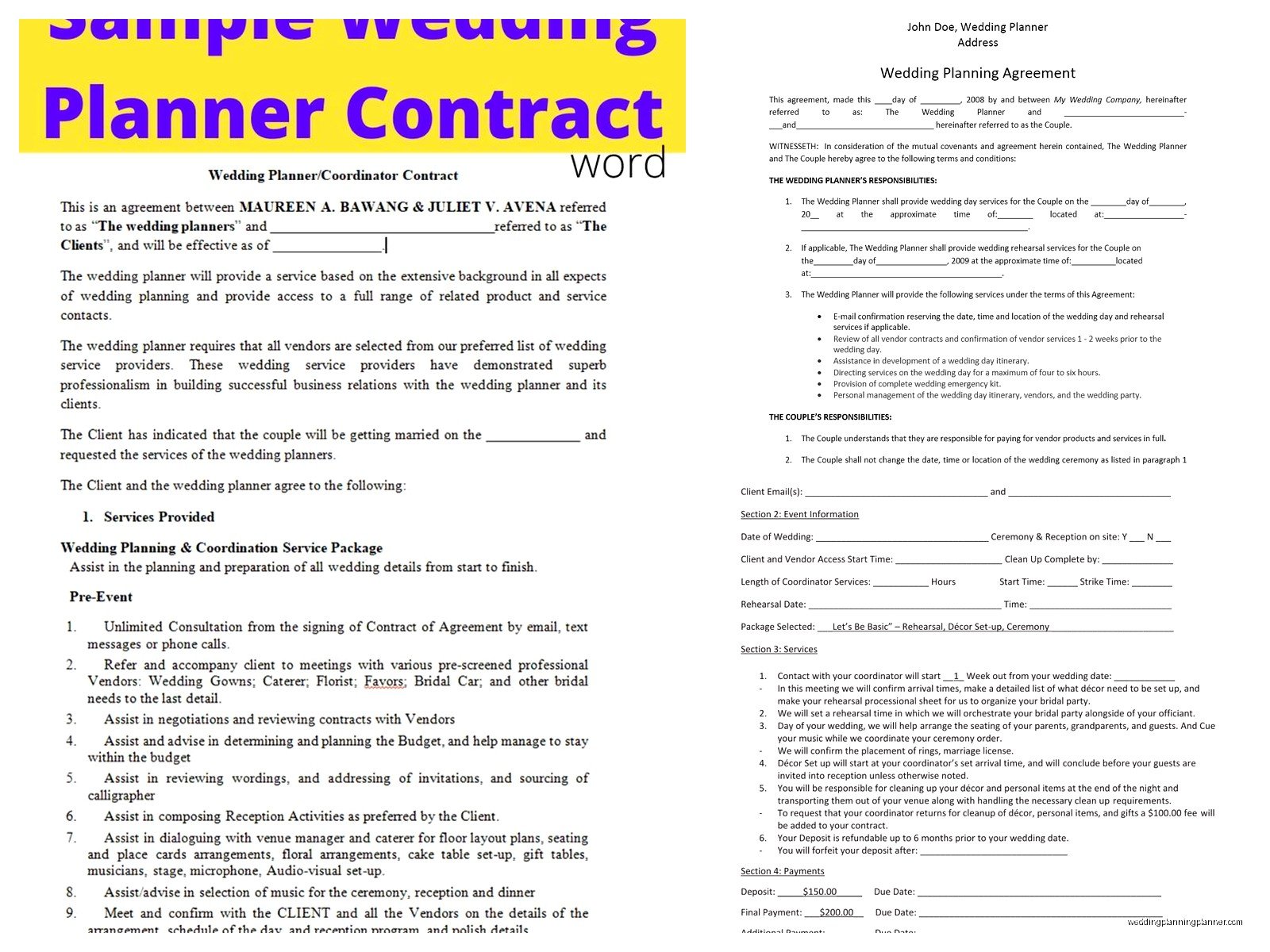
Here’s a sample for wedding planning services:
Service Provider agrees to provide the following services:
- Unlimited email and phone consultation beginning [DATE]
- Assistance with venue selection and vendor recommendations
- Budget development and tracking
- Attendance at up to [NUMBER] vendor meetings
- Creation of wedding day timeline
- Coordination of rehearsal
- Full day-of coordination including [NUMBER] hours of coverage
- Management of vendor setup and breakdown
- Emergency kit and problem-solving throughout event
See how specific that is? That’s what you need. For every service category.
Payment Terms
Money is where things get weird so you gotta be crystal clear. Break down the total cost, deposit amount, payment schedule, accepted payment methods, and late payment penalties.
Standard structure is usually: non-refundable deposit due at signing (typically 25-50% of total), second payment at some milestone (maybe 50% due three months before wedding), and final payment due two weeks before the event. Never let final payment be due after the wedding because good luck collecting that.
Sample payment terms: “Total contract price: $[AMOUNT]. Payment schedule as follows: (1) Non-refundable retainer of $[AMOUNT] due upon signing to secure date; (2) Second payment of $[AMOUNT] due on [DATE]; (3) Final payment of $[AMOUNT] due no later than [DATE]. Payments may be made via check, credit card, or bank transfer. Late payments will incur a fee of [AMOUNT OR PERCENTAGE] per [TIMEFRAME].”
I learned the hard way in summer 2021 to specify that the deposit is non-refundable even if they cancel. Had a couple book me, I turned away three other weddings for that date, then they canceled six months out and wanted their deposit back. Contract didn’t say non-refundable clearly enough and it became this whole thing. Now every contract I write has “non-refundable” in bold like seventeen times.
Cancellation and Postponement Policy
This section saves your butt when things go wrong. You need different terms for cancellation (they’re not having the wedding at all) versus postponement (they’re moving it to a different date).
For cancellation, typically the deposit is kept no matter what, and then there’s a sliding scale for additional fees depending on how close to the wedding date they cancel. If they cancel a year out, maybe they only lose the deposit. Six months out, maybe they owe 50% of total. Three months out, maybe 75%. Less than a month, full amount.
For postponement, you can be more flexible since you’re not totally losing the business. I usually offer one free date change if the new date is within the same calendar year and I’m available, but charge a rebooking fee if it moves to the next year or if I have to turn down another booking to accommodate them.
Example language: “If Client cancels this agreement more than 180 days before the Event, the retainer will be forfeited. Cancellation between 180-90 days before the Event results in forfeiture of 50% of total contract price. Cancellation less than 90 days before the Event results in forfeiture of 100% of contract price. One postponement to an available date within 12 months of original date is permitted without additional fee. Subsequent postponements or date changes beyond 12 months will incur a $[AMOUNT] rebooking fee.”
Vendor Responsibilities and Client Responsibilities
This is sorta like a “you do your part, I’ll do mine” section. As the vendor, you’re promising to show up on time, provide the agreed services, maintain professional standards, carry insurance, whatever. The client is promising to provide accurate information, make timely decisions, give you access to the venue, provide meals if that’s part of the deal, stuff like that.
I always include a clause about the client being responsible for getting necessary permits or permissions. Like if they want sparklers for the exit, they need to check that’s allowed and get any permits. I’m not tracking down fire marshal approvals, you know?
Client Responsibilities sample:
- Provide accurate guest count no later than [NUMBER] days before Event
- Obtain all necessary venue permits and permissions
- Provide vendor meal if services extend beyond [NUMBER] hours
- Ensure venue access for Service Provider beginning [TIME] on Event day
- Respond to Service Provider communications within [NUMBER] business days
- Designate point person for Event day questions
Liability and Indemnification
Okay this is the legal protection stuff that honestly you should probably have a lawyer look at but here’s the basic idea. You’re limiting your liability to the amount they paid you. So if something goes wrong, the most they can sue you for is what they paid, not their entire wedding budget or emotional damages or whatever.
You also want language saying you’re not responsible for stuff outside your control—weather, venue problems, other vendors not showing up, acts of God, pandemics (yeah we all added that after 2020), stuff like that.
And there should be an indemnification clause where they agree not to hold you responsible if someone gets hurt at the wedding due to something that’s not your fault. Like if Aunt Martha trips over her own feet during the reception, that’s not on you.
Sample: “Service Provider’s liability under this agreement is limited to the total contract price paid by Client. Service Provider is not liable for delays, failures, or damages beyond Service Provider’s control including but not limited to acts of God, venue issues, other vendor failures, weather, illness, or pandemic. Client agrees to indemnify and hold harmless Service Provider from any claims arising from the Event unless directly caused by Service Provider’s negligence or willful misconduct.”
Force Majeure Clause
This is basically the “what if something crazy happens” section. Pandemic, natural disaster, venue burns down, zombie apocalypse, whatever. You need to spell out what happens to payments and obligations if the event literally cannot happen due to circumstances beyond anyone’s control.
Usually this means deposits are kept because you’ve already turned away business, but remaining payments might be refunded or applied to a rescheduled date if possible. Really depends on your business model and how much you can afford to absorb.
“If the Event cannot take place due to circumstances beyond either party’s control (including but not limited to natural disasters, pandemic, government restrictions, or venue closure), the retainer will be retained by Service Provider. Remaining payments will be refunded or, if both parties agree, applied to a rescheduled date based on Service Provider’s availability.”
Image and Media Usage Rights
If you’re gonna use photos from their wedding for your marketing—and you should because that’s how you get more clients—you need permission in writing. Specify what you’re allowed to use (photos, videos, testimonials), where you can use them (website, social media, print advertising), and whether you need to credit anyone.
Some clients don’t want their wedding photos plastered all over Instagram and that’s their right, so include an opt-out option. I usually phrase it as they’re granting permission unless they explicitly say no.
“Client grants Service Provider permission to use photographs, videos, and details from the Event for promotional purposes including but not limited to website, social media, portfolio, and advertising. Client may opt out of this permission by notifying Service Provider in writing within [NUMBER] days of contract signing.”
Termination Clause
Sometimes you need to fire a client. I know that sounds harsh but trust me, it happens. If they’re being abusive, not paying, making unreasonable demands, or you just realize you absolutely cannot work with them, you need an out.
Include grounds for termination by either party and what happens financially if that occurs. Usually if you terminate without cause, you refund everything except what you’ve already earned based on work completed. If they terminate without cause, they forfeit more. If either party terminates with cause (breach of contract), different rules apply.
“Either party may terminate this agreement with [NUMBER] days written notice. If Service Provider terminates without cause, Client will receive refund of all payments minus retainer and value of services already provided. If Client terminates without cause, cancellation policy in Section [X] applies. If either party terminates due to material breach by the other party, the breaching party forfeits all payments or, in Service Provider’s case, must refund all payments received.”
Dispute Resolution
Nobody wants to think about this part but you need to say how you’ll handle disputes. Most contracts include a mediation clause where you agree to try mediation before anyone can sue anybody. It’s cheaper and faster than court.
Also specify which state’s laws govern the contract and where any legal proceedings would take place. Usually that’s wherever your business is located.
“Any disputes arising from this agreement will first be submitted to mediation in [COUNTY, STATE]. If mediation is unsuccessful, disputes will be resolved in the courts of [COUNTY, STATE]. This agreement is governed by the laws of [STATE].”
Additional Clauses You Might Need
Depending on your service, you might need specific clauses for things like: overtime rates if the event runs long, travel fees if it’s outside your normal area, equipment damage (if you’re renting stuff out), assistant or subcontractor disclosure (so they know you might not be the only person working), weather contingency plans for outdoor events, or substitution rights if you get sick or have an emergency.
For photographers and videographers, you definitely want something about backup equipment and what happens if your gear fails. For caterers, food safety and allergy disclaimers. For venues, damage deposits and cleanup requirements.
I also always include an entire agreement clause that says this contract is the whole deal and supersedes any previous conversations or emails. Because you don’t want someone saying “but you told me on the phone that you’d include [expensive thing] for free!” when it’s not in the contract.
“This agreement constitutes the entire understanding between the parties and supersedes all prior negotiations, understandings, and agreements. Any modifications must be in writing and signed by both parties.”
Signature Section
End with signature lines for both parties, including printed names, dates, and titles if applicable. If you’re dealing with a company rather than individuals, make sure whoever’s signing has authority to bind the company.
I also include a line for a witness signature on really big contracts, though that’s probably overkill for most wedding services. And make sure both parties get a fully executed copy—that means everyone has signed it before you make copies.
Oh and one more thing that’s kinda random but my lawyer told me this: never have someone sign a contract with blank spaces. If you don’t have all the info yet, put “TBD” or something, but don’t leave blanks because theoretically someone could fill them in later with different terms. Probably nobody would actually do that but better safe than sorry.
Contract Samples by Vendor Type
Wedding Planner contracts need all the stuff above plus specifics about planning meetings, vendor coordination responsibilities, and day-of timeline. Florist contracts should detail specific flowers (with substitution clause for seasonal availability), delivery time, setup requirements, and whether you’re picking up rentals afterward or they are. Photographer contracts need to address shot lists, editing timeline, number of deliverables, and what happens if you get sick—do you send a backup or refund?
DJ contracts should specify music selection process, equipment provided, backup equipment, and whether they’re also MCing or just playing music. Caterer contracts need to be super detailed about menu, service style, staffing ratios, bar service if applicable, rentals, and timing of service. Venue contracts are different because you’re usually the client signing their contract, but if you own a venue, you need stuff about capacity limits, insurance requirements for clients, and what they’re allowed to do to your space.
Baker contracts need delivery details, cake size and servings, design specifics (with visual mockups attached), and setup requirements. Videographer contracts are similar to photographer ones but should address video length, editing style, music licensing, and number of revisions included.
The thing is every wedding vendor is a little different so you really do need to customize your contract to your specific services. Don’t just download a template and call it a day. Actually think through what could go wrong and make sure your contract addresses it. That sounds pessimistic but I promise you’ll thank yourself later when something inevitably does go sideways and you have clear terms to fall back on.