
Planning Guides, Style Guide
Wedding Details Card: Accommodation & Direction Inserts
May
So You Need Accommodation and Direction Inserts
Okay so accommodation and direction cards are those little extra inserts that go inside your wedding invitation suite and honestly they’re more important than people think. I learned this the hard way back in spring 2023 when I had a destination wedding client who decided she didn’t need them because “everyone has GPS now” and then her grandparents literally drove to the wrong venue and missed the ceremony. Like completely different location. It was a whole thing.
The basic idea is you’re creating separate cards that give guests the practical info they need without cluttering up your main invitation. Your invitation should be pretty and focused on the important stuff—who’s getting married, where, when. All the logistical details go on these inserts.
What Actually Goes On These Cards
For accommodation cards, you’re gonna list hotel options where you’ve secured room blocks. Include the hotel name, address, phone number, and your specific booking code or group name. Also put the date by which guests need to book to get your group rate because hotels release those blocks usually 30 days before the wedding.
I always tell couples to list 2-3 hotel options at different price points. Not everyone can afford the fancy boutique hotel, and some guests will want the budget option. You’re not being judgy, you’re being practical. List them in order from closest to venue or from most to least formal, whatever makes sense.
Direction cards are trickier because yeah, everyone does have GPS now, but GPS doesn’t always know about the back entrance that’s easier to access or the fact that the main driveway is gravel and terrible for heels or that parking is actually two blocks away. This is where you add the context that Google Maps won’t give them.
Size and Format Things
Most accommodation and direction inserts are smaller than your main invitation. Standard sizes are 4×6 inches or 5×7 inches, though you can do a slim card that’s like 4×9 inches if you want something different. The key is they need to fit inside your invitation envelope without getting folded or bent.
You can print them on the same cardstock as your invitation or go lighter weight to save on postage (which adds up fast, trust me). I usually recommend at least 80lb cardstock so they don’t feel flimsy. If your invitation is letterpress or foil, your inserts don’t need to match that level of fancy—digital printing is totally fine for these.
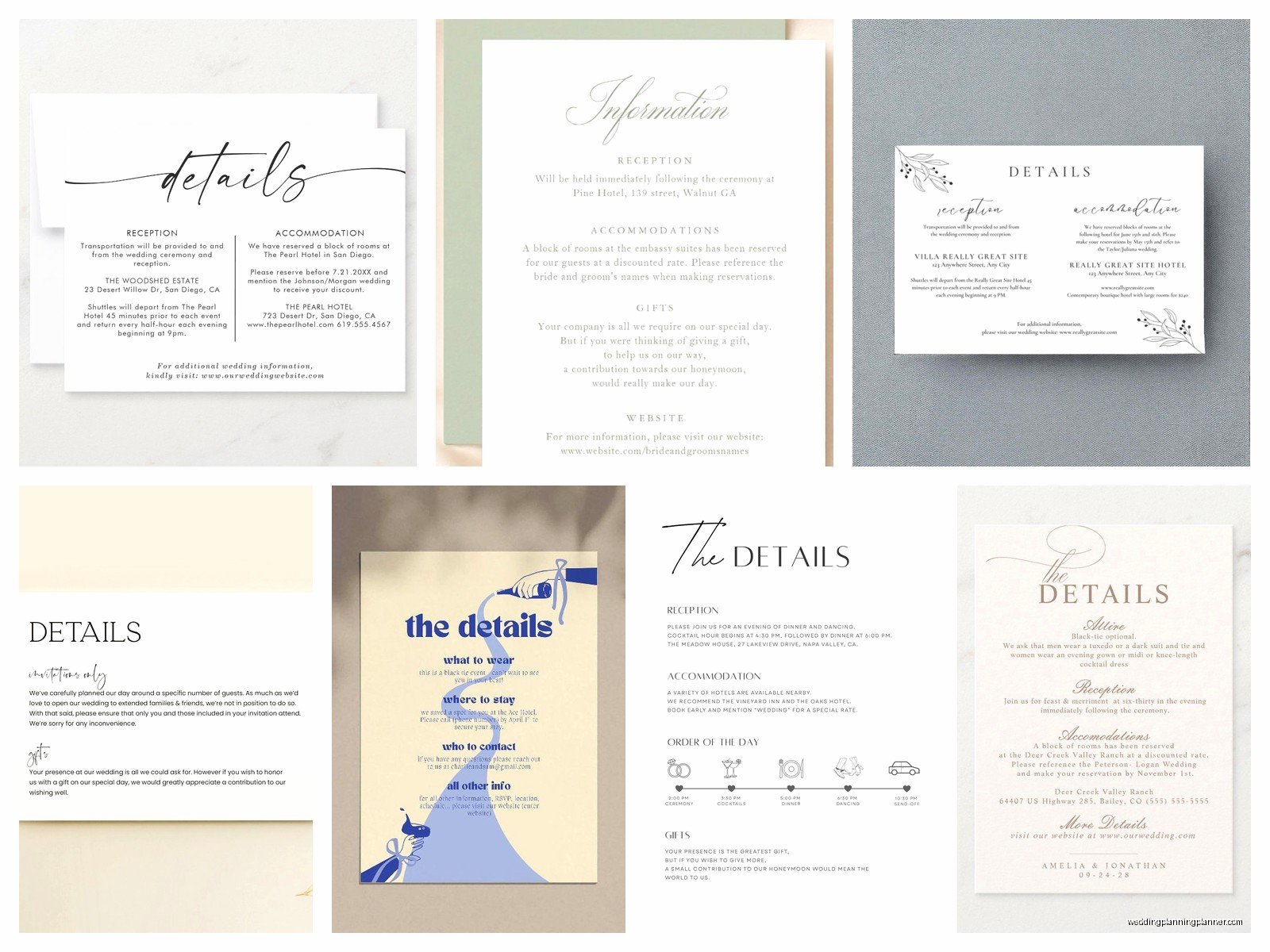
Some couples do a single card with accommodation on one side and directions on the other. That works if you don’t have much info, but if you’ve got multiple hotels and detailed directions… or if your venue is kinda complicated to find, do separate cards. It’s easier to read.
Writing The Accommodation Info
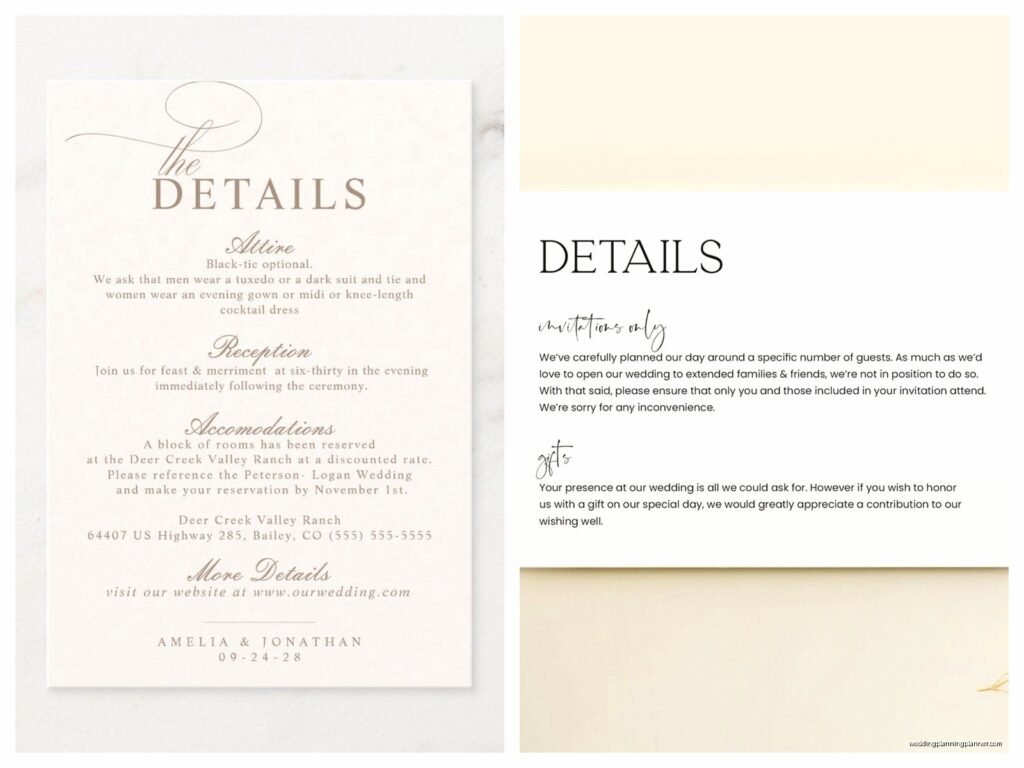
The wording doesn’t need to be formal or matchy with your invitation style. Actually it’s better if it’s just clear and straightforward. Here’s what I usually include:
Header: “Accommodations” or “Where to Stay” or “Lodging Options”
For each hotel:
- Hotel name in bold or slightly larger font
- Full street address (not just city/state)
- Phone number
- Booking details: “A room block has been reserved under [Last Name] Wedding” or “Please mention the [Name]-[Name] wedding when booking”
- Reservation deadline date
- Distance from venue if it’s not obvious
Something that really annoys me is when couples forget to actually set up the room blocks before printing these cards. Like they assume they can just list hotels. Nah, you gotta call the hotels, negotiate the block, get the booking code, THEN print the cards. I’ve had to reprint accommodation cards twice because couples jumped the gun.
You can also add a line about alternative options: “Additional hotels and vacation rentals available in the downtown area” or whatever. Some guests prefer Airbnb and that’s fine, but you don’t need to list specific ones.
The Direction Card Details
For directions, you’ve got options. You can do written turn-by-turn directions (kinda old school but some older guests appreciate it), or you can do more of a “helpful hints” format, or you can include a custom map illustration.
Written directions should start from a major highway or landmark everyone will know. “From I-95 North, take Exit 42…” that kind of thing. Keep it simple. If your venue is in a weird spot that confuses GPS, include the actual physical address plus maybe “Note: GPS may direct you to the old entrance on Maple Street—please use the main entrance on Oak Avenue instead.”
Honestly though, most couples now just do a simple card with:
- Venue name and full address
- Parking information (this is crucial)
- Any special notes about access
The parking thing is huge. Tell people where to park, if there’s valet, if they need to walk from a parking lot, if street parking is impossible, whatever. “Complimentary valet parking available at the main entrance” or “Please park in the north lot—the venue will provide shuttle service to the ceremony site.” That kind of specific info saves so much confusion on the day.
Custom Maps Are Worth It Sometimes
If you’re crafty or working with a stationer who does custom work, illustrated maps are really cute and actually useful. Not like a full detailed map, but more of a stylized one that shows the venue in relation to the hotels, maybe marks the rehearsal dinner location if it’s nearby, shows major roads.
I did this for a wedding in summer 2021 where the venue was at a state park and there were like three different entrances and GPS kept sending people to the wrong one. We created a simple illustrated map that showed which entrance to use, where the parking was, and the walking path to the ceremony site. Saved everyone so much hassle.
You can hire someone on Etsy to do this pretty affordably, or use a service like Minted that has map templates you can customize. Just make sure it’s actually readable—some illustrated maps are so stylized they’re useless for actual navigation.
Digital Alternatives or Additions
Here’s the thing though… you might wanna include your wedding website URL on these cards too, or instead of printing all this info. Lots of couples now do a simple insert that just says “For accommodation options, directions, and more visit [website]” and then they keep all the detailed info online where they can update it if things change.
This is especially smart if you’re finalizing details close to your invitation mailing date. Hotels change policies, room blocks fill up, venues modify their parking situations. It’s way easier to update a website than to reprint 150 direction cards (yes, I’ve had clients need to do this).
But you should still include something physical. A lot of older guests won’t check the website, or they’ll lose the URL, or they’re just not website people. At minimum, print a card with your venue address, basic parking info, and the website for more details.
Formatting and Design Stuff
Keep the text size readable. I see couples try to cram too much info onto a small card with tiny 8-point font and it’s just… no one’s gonna read that. Minimum 10-point font, 11 or 12 is better. Use spacing and line breaks to make it scannable.
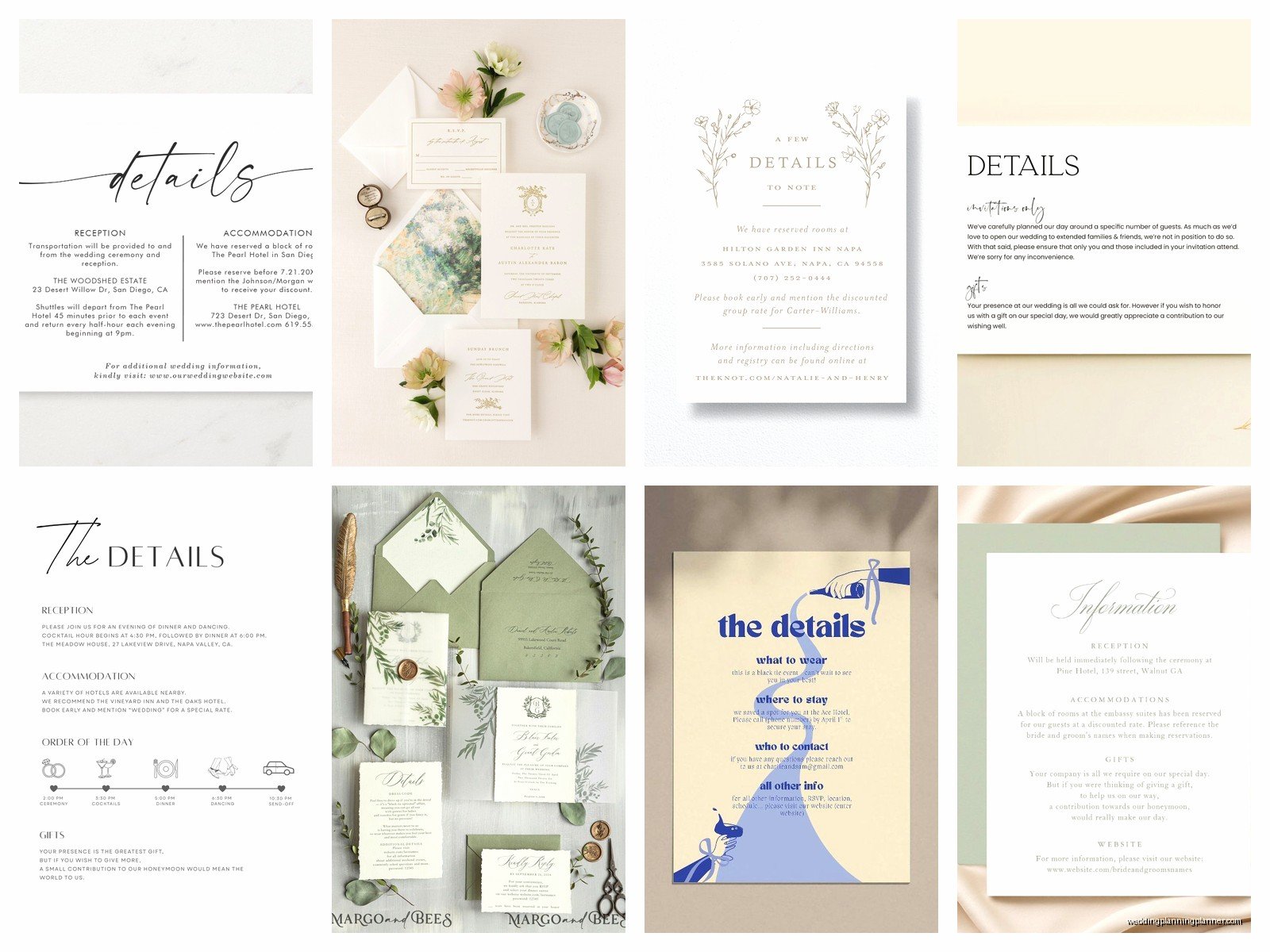
You can match the design to your invitation suite but it doesn’t have to be exact. Same color palette and fonts is usually enough. If your invitation has a floral border, maybe just use a small version of that flower as an accent on the corner of the insert cards.
Think about hierarchy—what’s most important? That should be biggest or boldest. Hotel names and phone numbers should pop. The booking deadline should be obvious. The parking info shouldn’t be buried in a paragraph.
My cat just knocked over my coffee while I’m writing this, so if this section seems disjointed that’s why… anyway, where was I?
How Many Cards Do You Actually Need
Not every invitation needs every insert. If you’re doing separate accommodation and direction cards, you might mail them differently:
- Local guests might not need accommodation cards (though some might want to stay over for convenience)
- Out-of-town guests definitely need both
- If you’re having a cocktail hour at one location and reception at another, everyone needs direction cards for both spots
I usually tell couples to print accommodation cards for about 70% of their guest list and direction cards for 100%. You can always print more accommodation cards later if needed, but you’ll probably have extras.
Stuffing The Envelopes
Order matters when you’re assembling your invitation suite. The general rule is invitation on bottom (text side up), then reception card if you have one, then any other inserts like accommodation and directions, then RSVP card and envelope on top.
But honestly if your insert cards are the same size, guests aren’t gonna care what order they’re in. Just make sure everything is facing the right direction so when they pull the stack out, they can read each piece without flipping things around.
Some people do the whole inner envelope thing where everything is wrapped in tissue paper and perfectly organized, and some people just stack the cards in the envelope. Both are fine. Your guests are gonna separate everything immediately anyway to read it.
What About Shuttle Information
Oh right, if you’re providing shuttle service between hotels and venue, that information goes on these cards too. Be super specific:
- Which hotels have shuttle pickup
- What time shuttles start running
- How frequently they run
- Where exactly guests should wait for pickup
- What time the last shuttle leaves the venue
This might mean you need a third insert card, or you combine it with the accommodation card since it relates to the hotels. Just make sure it’s clear—shuttle logistics are confusing enough without vague instructions.
Accessibility Information
Something I really wish more couples would include is accessibility info. If your venue has wheelchair access, if there’s a lot of walking between ceremony and reception, if the terrain is rough, if there are stairs—this stuff matters to guests who need to plan accordingly.
You can add a simple line: “The venue is wheelchair accessible with accessible parking near the entrance” or “Please note the ceremony site requires walking on grass—we recommend avoiding stiletto heels.” It doesn’t need to be a whole separate card, just a note on your direction insert.
Timeline For Getting These Done
Work backwards from your invitation mailing date (which should be 8 weeks before the wedding, or 12 weeks for destination weddings):
- 12-10 weeks before wedding: Finalize hotel room blocks and get all booking codes
- 10-9 weeks before: Confirm all venue details, parking, accessibility
- 9-8 weeks before: Design and order insert cards
- Allow 2-3 weeks for printing if doing custom or letterpress
- 1 week before mailing: Assemble everything and double-check all info is current
The worst thing is printing incorrect information, so triple-check everything before you send files to the printer. Call the hotels and confirm your blocks are active, test drive the route to your venue, verify parking details with your venue coordinator.
Budget Considerations
Insert cards add to your stationery budget but they don’t have to break the bank. If you’re doing letterpress invitations, you can do digital insert cards to save money. If you’re already doing digital printing for everything, adding insert cards is pretty minimal cost.
Printing at home on nice cardstock is totally an option for insert cards if you’re crafty and have a good printer. Your main invitation should probably be professionally printed, but inserts are more forgiving. Just make sure your printer can handle cardstock and the ink won’t smudge.
You can also skip physical cards entirely and do a really good wedding website with all this info, then include just a small website card in your invitation. This is the cheapest option and honestly works well for tech-savvy guest lists.
Common Mistakes To Avoid
Don’t list hotels where you haven’t actually secured blocks. Guests will call and be confused when the hotel has no record of your wedding.
Don’t assume GPS is enough for complicated venues—it’s not, and you’ll get panicked texts on your wedding day from lost guests.
Don’t forget to include booking deadlines. Room blocks get released and then your guests are stuck paying full price or staying farther away.
Don’t make the font too small or too fancy to read. These are practical cards, readability beats beauty here.
Don’t print these before confirming all your details. I’ve seen couples have to reprint because the hotel changed their block terms or the venue modified parking rules.
And honestly, don’t stress too much about making these perfect. They’re helpful information cards, not works of art. Your guests care way more about knowing where to sleep and how to get there than whether the font matches your invitation exactly. Get the information right, make it readable, and you’re good to go.