
Planning Guides, Style Guide
Wedding Rehearsal Dinner Invitations: Pre-Ceremony Party Cards
May
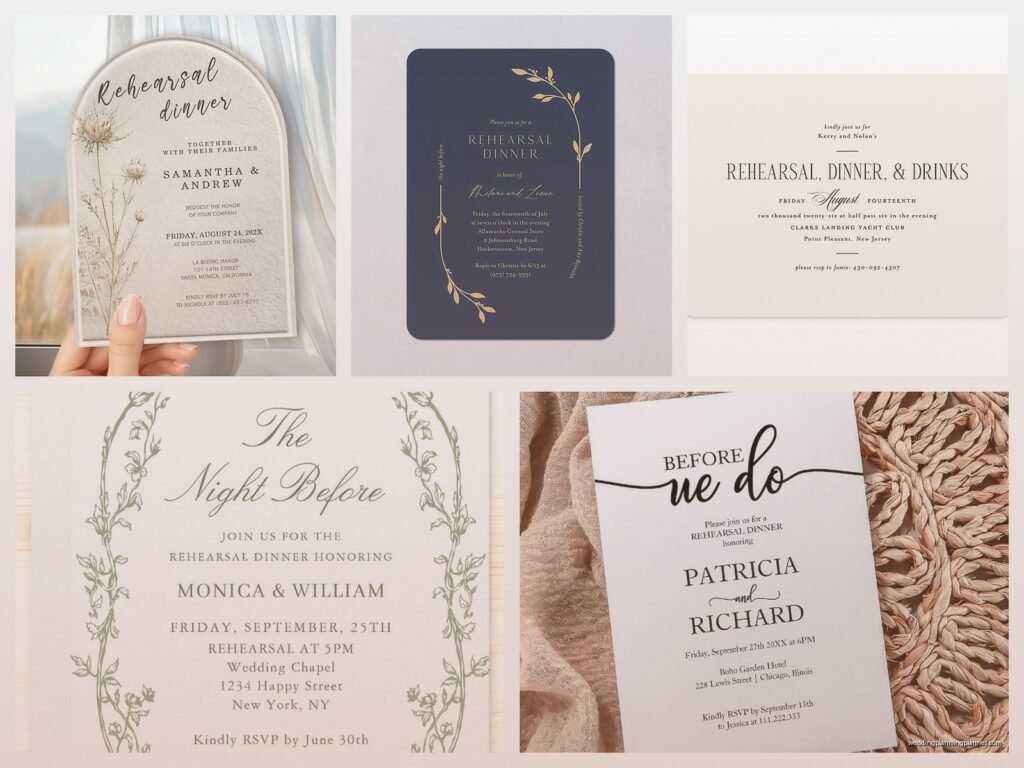
Okay So Rehearsal Dinner Invitations Are Actually Important
You know what drives me absolutely nuts? When couples assume rehearsal dinner invitations are just like… optional or something you can handle with a group text. I had this wedding in spring 2023 where the groom literally sent out a mass text to 45 people two days before the rehearsal dinner and then acted shocked when half the guests didn’t show up because they thought it was just a casual “maybe stop by” thing. Anyway, let’s talk about how to actually do these properly because they’re way more than just a formality.
Who Even Gets Invited To This Thing
So traditionally the rehearsal dinner is just for the wedding party and immediate family, right? But honestly that’s kinda outdated. Most couples now invite the wedding party plus their significant others, both sets of parents, grandparents if they’re around, officiant, and sometimes out-of-town guests who traveled far. I’ve seen rehearsal dinners with 20 people and I’ve seen them with 80 people. There’s no perfect number.
The general rule I tell clients is: if someone is participating in the ceremony rehearsal itself, they absolutely need to be at the dinner. Then you build out from there based on your budget and venue capacity. Your reader did the ceremony run-through? They’re invited. Your cousin who’s just attending as a guest? Probably not, unless you’re doing a massive rehearsal dinner which some people do now as like a welcome party situation.
Out of Town Guests Are The Grey Area
Here’s where it gets tricky and where you’ll probably stress about this the most. If you’ve got 15 out-of-town guests, do you invite all of them? Some couples do a separate welcome drinks thing instead, which takes the pressure off. Or you invite out-of-towners to join after dinner for drinks and dessert. I had a couple do this beautifully where the formal dinner was 6-8pm for wedding party and family, then at 8:30pm they opened it up to anyone who wanted to stop by for the after-party portion. Super casual, people could come and go.
Timing Is Everything And Also Confusing
You wanna send these out like 3-4 weeks before the wedding. Not earlier because people lose track of things, not later because you’ll stress yourself out waiting for RSVPs. The invitations should go out after your actual wedding invitations have gone out, obviously, but with enough time that people can actually plan.
I usually tell couples to mail them about 4 weeks out if it’s a destination wedding or lots of travel involved, 3 weeks if it’s mostly local people. And yes, you need actual RSVPs for this. Don’t just assume everyone’s coming. I learned this the hard way during a disaster in summer 2021 when a couple didn’t collect RSVPs and the restaurant prepared for 40 people but 62 showed up and it was just… chaos. The bride’s dad ended up having to negotiate with the restaurant manager in the middle of dinner to add tables.
What Information Actually Needs To Be On These Cards
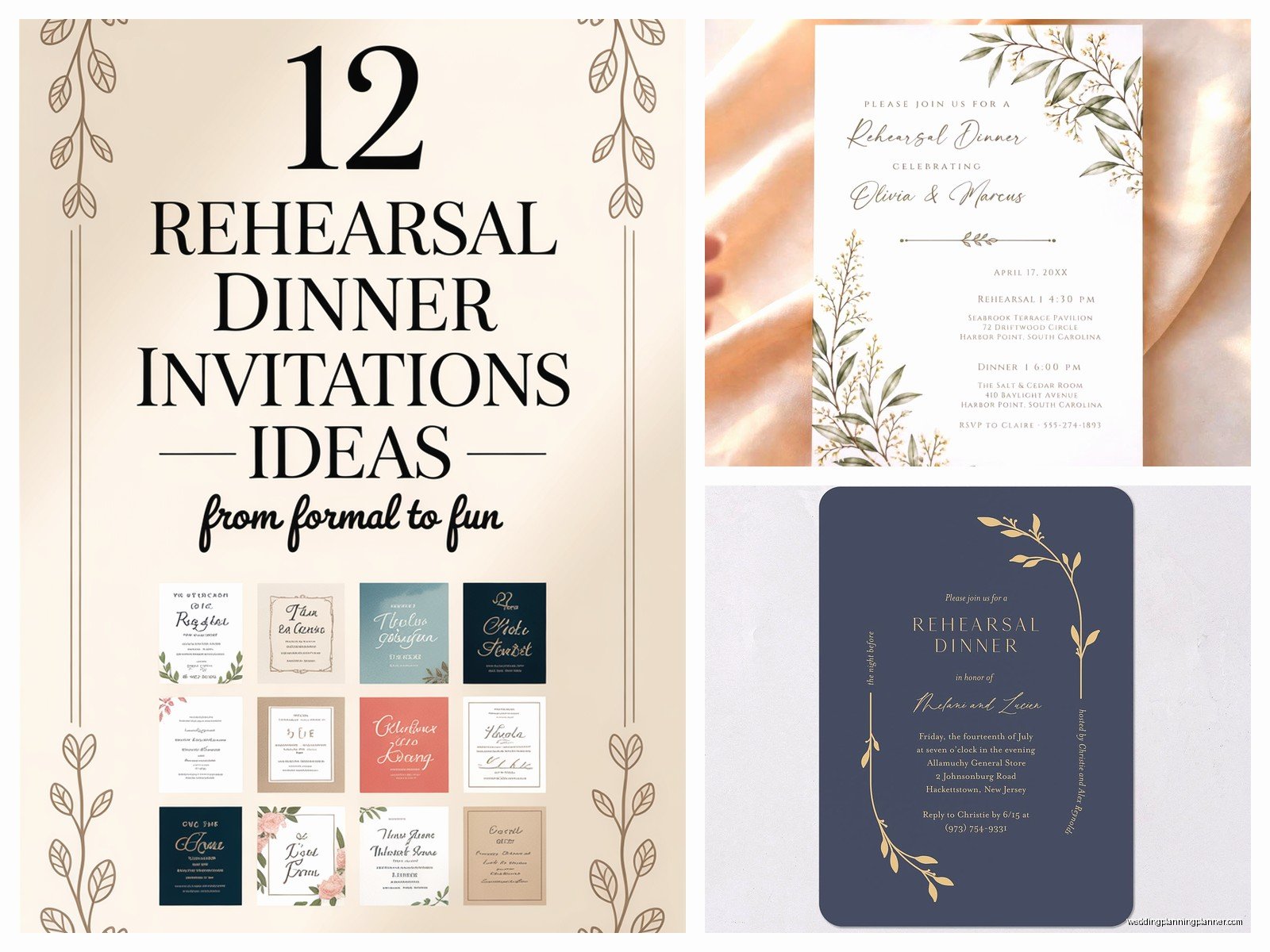
Alright so here’s what you gotta include, and I’m gonna be specific because I’ve seen people forget the weirdest things:
- The obvious: date, time, location with full address
- Who’s hosting (usually the groom’s parents traditionally but like, whatever, it can be anyone)
- Dress code because people will ask you 500 times if you don’t include it
- RSVP deadline and method (phone, email, text, whatever)
- If it’s adults only or if kids are welcome
- Parking information if the venue is tricky
The wording can be super casual for these. You don’t need the formal “Mr. and Mrs. Jonathan Richardson request the pleasure of your company” nonsense. I mean you can if you want, but most rehearsal dinner invites I design are way more relaxed. Something like “Join us the night before the big day” or “Let’s eat, drink, and practice getting married.”
The Actual Format Options You Have
You’ve got a few routes here and honestly it depends on your wedding style and budget. Physical cards are traditional and they’re what I usually recommend because they feel more official and people are less likely to forget about them. But I’ve also done digital invites that worked perfectly fine.
Printed cards: These can match your wedding invitation suite or be completely different. I’ve designed rehearsal dinner invites that coordinate with the wedding colors but have a more casual vibe. Like if your wedding invites are formal letterpress, maybe the rehearsal dinner ones are flat printed on textured cardstock. They don’t have to match exactly but they should feel cohesive.
Postcards: These are actually my favorite for rehearsal dinners because they’re casual and practical. No envelope needed, easier to stick on a fridge, and they just feel more approachable. Plus they’re cheaper to mail which is nice.
Digital invitations: Paperless Post, Greenvelope, even Canva has templates now. These work great for younger couples or super casual dinners. They’re also good if you’re short on time. Just make sure you’re not sending these to grandparents who don’t really check email regularly. My cat walked across my keyboard while I was designing a digital invite once and somehow saved this weird version with paw print smudges and the couple actually loved it and wanted to keep it but like… that was a lucky accident.
Design Stuff That Actually Matters
I’m gonna be real with you, the design doesn’t have to be Pinterest-perfect. But it should be clear and readable. I’ve seen couples get so caught up in fancy fonts and elaborate designs that you literally can’t read the address or time. That’s not cute, that’s just poor planning.
Keep the font size readable. I usually go with nothing smaller than 10pt for the main information. Use a clear hierarchy so people’s eyes go to the important stuff first. The date and time should jump out at you. The location should be immediately obvious.
Color-wise, you can coordinate with your wedding colors or go completely different. I had a couple once who did formal navy and gold wedding invites but their rehearsal dinner invites were bright coral and yellow because the dinner was at this beachy restaurant and they wanted that vibe to come through. It worked perfectly.
Paper Quality And Printing Methods
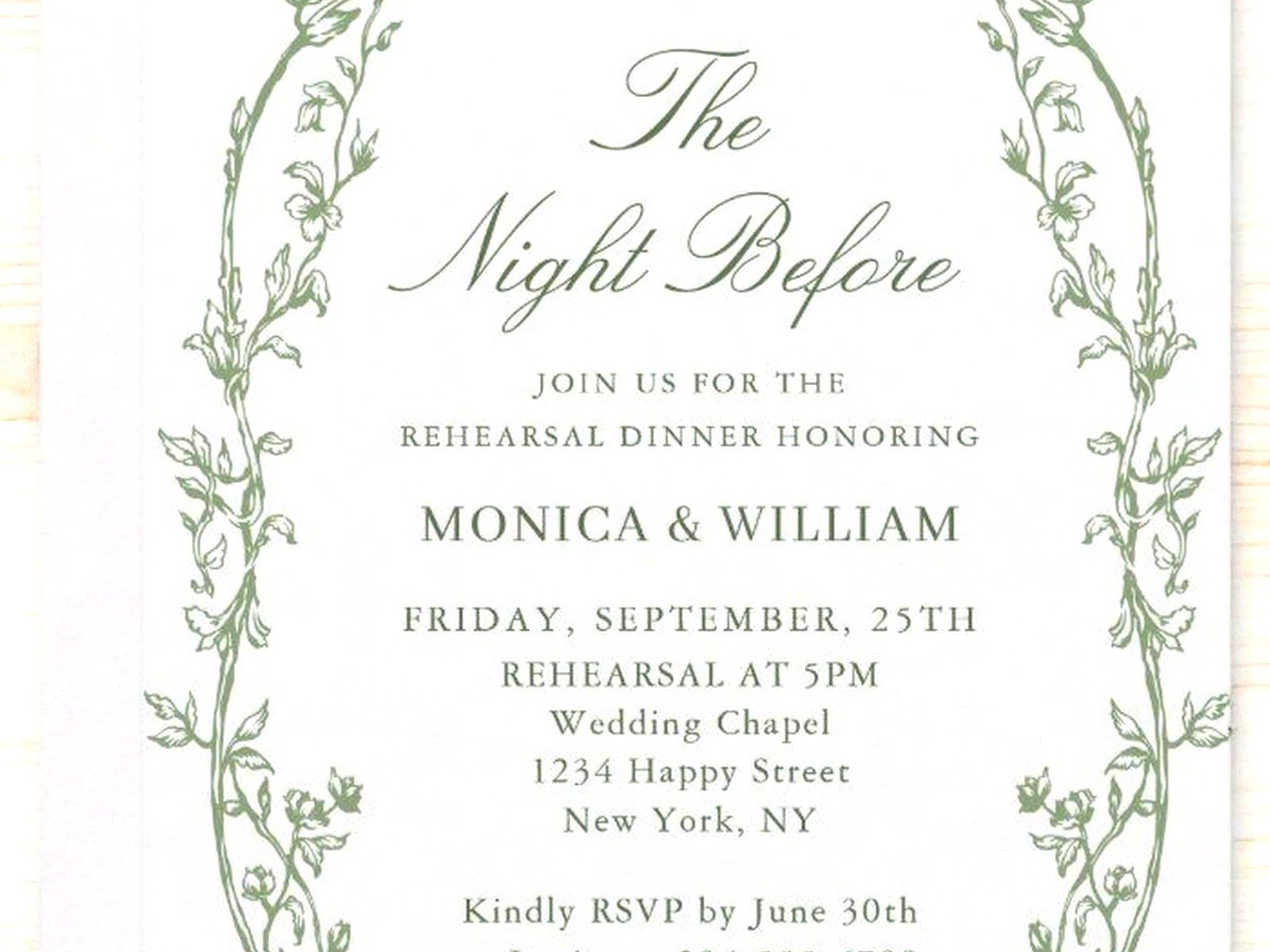
If you’re doing printed invites, don’t cheap out on the paper too much. I mean you don’t need 220lb cotton paper or anything, but standard copy paper is gonna look sad. A nice 80-100lb cardstock works great. Matte or eggshell finish looks more sophisticated than glossy for this kind of thing.
Printing methods: digital printing is totally fine and cost-effective. Letterpress is gorgeous but expensive and probably overkill for a rehearsal dinner unless you’re really into stationery. Thermography gives you that raised print look without the letterpress price tag, which is a nice middle ground.
Wording Examples Because Everyone Asks For These
Here’s some actual wording I’ve used that worked well:
Casual option:
“Before we say ‘I do’
Let’s have a drink or two!
Join us for dinner the night before the wedding
Friday, June 15th at 7:00pm
The Garden Bistro
123 Main Street
Cocktail attire
Hosted by the Reynolds family”
More traditional:
“The families of Sarah Chen and Michael Torres
invite you to join them
for a rehearsal dinner
the evening before their wedding
Friday, the fifteenth of June
Seven o’clock in the evening
Riverside Restaurant
456 River Road”
Super casual:
“Rehearsal Dinner!
Because we need to practice this whole marriage thing
Friday night, 7pm
Tony’s Steakhouse
Come hungry, leave happy
RSVP to Jenny: 555-0123″
The RSVP Situation That Everyone Handles Differently
You need RSVPs for this. I know I already said that but I’m saying it again because it’s important. The restaurant or venue needs a headcount. Your budget needs a headcount. You need to know who’s actually coming.
Include a clear RSVP method. I usually recommend having someone other than the couple collect these – maybe the maid of honor or one of the parents hosting. The couple has enough to deal with in those final weeks. Give a deadline that’s about 2 weeks before the dinner so you have time to finalize numbers with the venue.
You can do RSVP cards that mail back, but honestly for rehearsal dinners that feels like overkill. Most people just put “RSVP by June 1st to Maria at maria@email.com or 555-0123” and that works fine. Text RSVPs are totally acceptable for this level of formality unless you’re doing like a super formal rehearsal dinner which… why would you do that to yourself, but okay.
Stuff People Forget To Include And Then Panic About
Map or directions if the venue is hard to find. I cannot tell you how many times I’ve had wedding party members calling me the night of because they can’t find the restaurant. Just include it.
Start time AND end time if there’s a hard stop. Some venues have time limits or maybe you’ve planned something else after. Just tell people.
Dietary restriction information. Either include a line asking about restrictions on the RSVP or mention that the menu will accommodate various needs. This saves so many headaches.
What happens after dinner. Are you going to a bar after? Is there an after-party? Are people free to leave whenever? Set expectations.
The Insert Card Debate
Some people include rehearsal dinner info as an insert card with the actual wedding invitation, especially if the rehearsal dinner is big enough that most wedding guests are invited. I’m honestly not a huge fan of this because it gets confusing – people think the rehearsal dinner is part of the wedding weekend that everyone attends, and then you get random guests showing up who weren’t actually invited.
If you’re gonna do this, make it VERY clear who’s invited. “For members of the wedding party and their guests” or whatever applies. Be specific. Vague wording leads to awkward conversations.
Budget Reality Check
You can spend $2 per invitation or $20 per invitation. Both are fine. I’ve designed gorgeous rehearsal dinner invites that cost almost nothing because we did digital printing on nice cardstock and the couple assembled them themselves. I’ve also done fancy letterpress ones with envelope liners and custom stamps that cost a fortune.
For a typical rehearsal dinner with like 30-40 invitations, I usually see couples spend anywhere from $75 to $300 on the invitations themselves. That includes printing, envelopes, and postage. You can definitely DIY these more easily than wedding invitations because there’s less pressure for them to be perfect.
DIY Tips If You’re Going That Route
Templates are your friend. Etsy has thousands of them, Canva has free options, even Microsoft Word has decent templates now. Download one, customize it with your info, and print at home or through a print shop.
If you’re printing at home, do a test print first. And then do another test print. Check your margins, make sure nothing’s getting cut off. Use the actual cardstock you’ll use for the final version because different paper weights feed through printers differently and you might need to adjust settings.
Envelope addressing: you can handwrite these and it looks perfectly fine for a rehearsal dinner. Or use printed labels. Or print directly on the envelopes if your printer can handle it. Don’t stress about calligraphy for these unless you really want to or you’re already doing calligraphy for your wedding invites and you’re on a roll.
Common Mistakes I See All The Time
Waiting too long to send them out. Three weeks minimum, people. Four is better.
Not including enough information. I had a couple once who literally just wrote “Rehearsal dinner Friday at 7” with no location because they assumed everyone knew which restaurant they meant. Nobody knew. Chaos ensued.
Making them too matchy-matchy with the wedding invites to the point where guests get confused about which event is which. Differentiate them enough that it’s clear.
Forgetting to include plus-ones for the wedding party. Your bridesmaid’s boyfriend should be invited even if he’s not in the wedding. This is standard etiquette and people get weirdly offended if you mess this up, trust me.
Not confirming the final headcount with the venue. You collected RSVPs, great! Now actually tell the restaurant how many people are coming. I’ve seen couples forget this step and then show up and the venue is set for the original estimate from weeks ago which is completely wrong.
The Etiquette Questions That Come Up
Do kids come to the rehearsal dinner? Up to you entirely. If it’s at a nice restaurant at 8pm, probably not. If it’s a backyard BBQ at 6pm, maybe yes. Just be clear on the invitation.
What if someone RSVPs yes then can’t come? Not a huge deal for a rehearsal dinner honestly. Let the venue know the final count a day or two before, expect maybe one or two no-shows.
Can you do online RSVPs through your wedding website? Yes totally. Just make sure the rehearsal dinner has its own section that’s password protected or clearly marked as “by invitation only” so random wedding guests don’t see it and think they’re invited.
I think the biggest thing is just… don’t overthink these as much as your wedding invitations but also don’t completely phone it in with a group text, you know? Find that middle ground where they’re nice enough to show you put in effort but casual enough that nobody’s stressing about them. And for the love of everything, include the actual address of the venue. Please. I’m begging you. The amount of times I’ve had to text people directions the night of the rehearsal dinner because the invitation just said “Mario’s Restaurant” with no other identifying information and there are three Mario’s Restaurants in the area and nobody knows which one… anyway yeah. Include the full address. Also the zip code for people’s GPS.
