
Planning Guides, Style Guide
Christian Wedding Invitation Card: Design & Ordering Guide
Jun
Getting Your Christian Wedding Invitations Right
Okay so Christian wedding invitations are basically their own category and if you don’t get the wording right or miss certain elements, you’re gonna have relatives calling your mom asking questions. I learned this the hard way back in spring 2023 when a client’s grandmother literally called me directly (how she got my number I still don’t know) to ask why there was no mention of God’s blessing in the invitation text.
First thing you need to figure out is whether you want traditional scripture-based invitations or something more subtle with Christian symbolism. There’s like a whole spectrum here and it really depends on your church community and family expectations.
The Scripture Thing
So here’s what nobody tells you until you’re already knee-deep in invitation samples – you gotta pick your scripture verse carefully. Not every beautiful Bible verse works on an invitation. I usually tell couples to stick with shorter verses or even just partial verses because you don’t want your invitation looking like a Bible study handout.
Popular ones that actually fit well:
- “Love is patient, love is kind” (1 Corinthians 13:4)
- “And now these three remain: faith, hope and love” (1 Corinthians 13:13)
- “Two are better than one” (Ecclesiastes 4:9)
- “I have found the one whom my soul loves” (Song of Solomon 3:4)
- “Love one another as I have loved you” (John 15:12)
The thing that annoyed me so much about Christian invitation design for years was that every template seemed to use the exact same three verses. Like, there are literally thousands of verses about love and commitment and unity in the Bible, but we all just keep using the Corinthians ones over and over. Not that there’s anything wrong with those verses obviously, they’re beautiful, but sometimes it’s nice to see something different.
Design Elements That Actually Matter
Christian wedding invitations typically incorporate certain symbols and you should know what they mean before you just slap them on there. Crosses are obvious but there’s also doves (representing the Holy Spirit and peace), interlocking rings (unity in Christ), olive branches, crowns, anchors (hope), and even specific flowers like lilies.
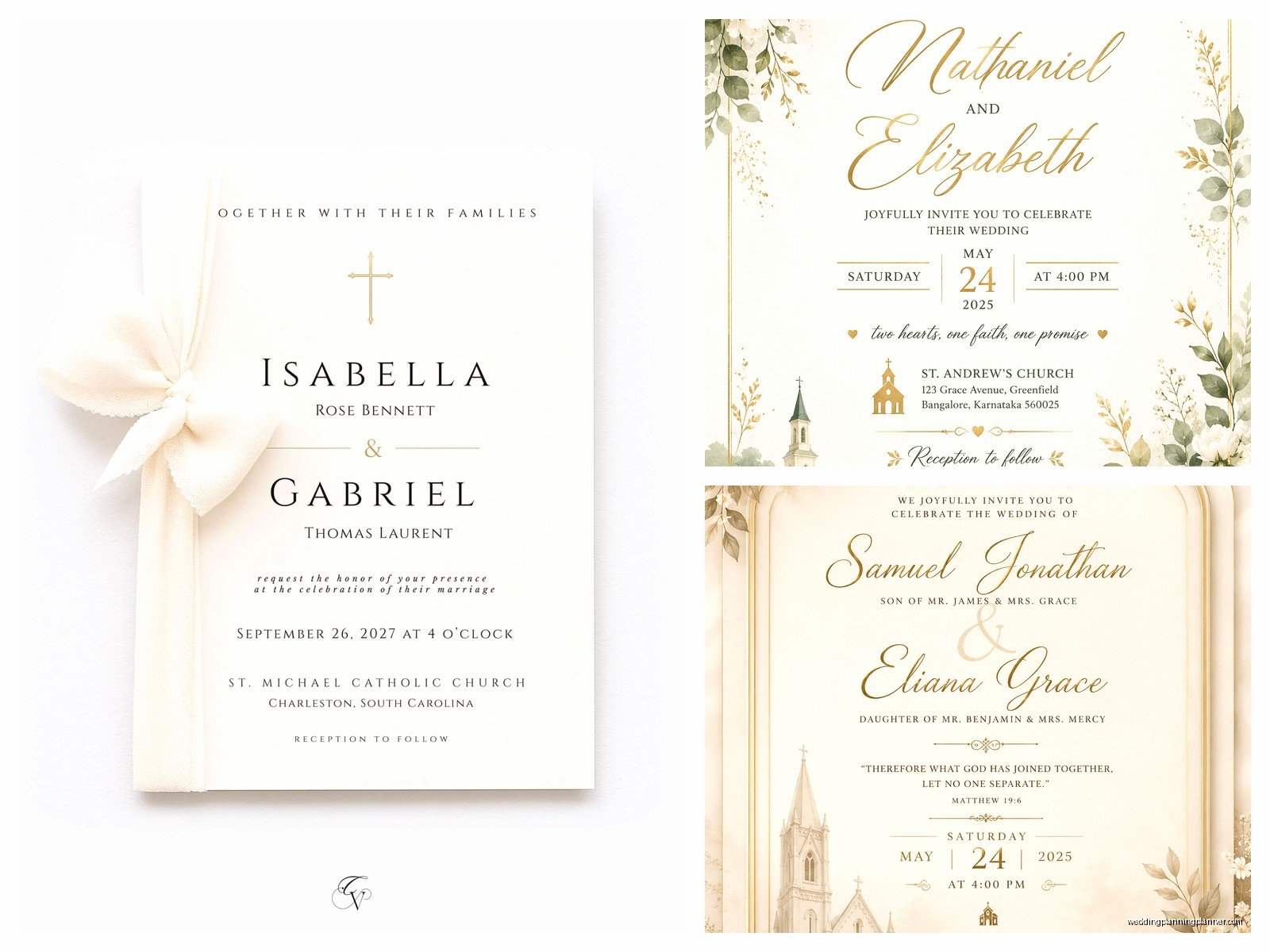
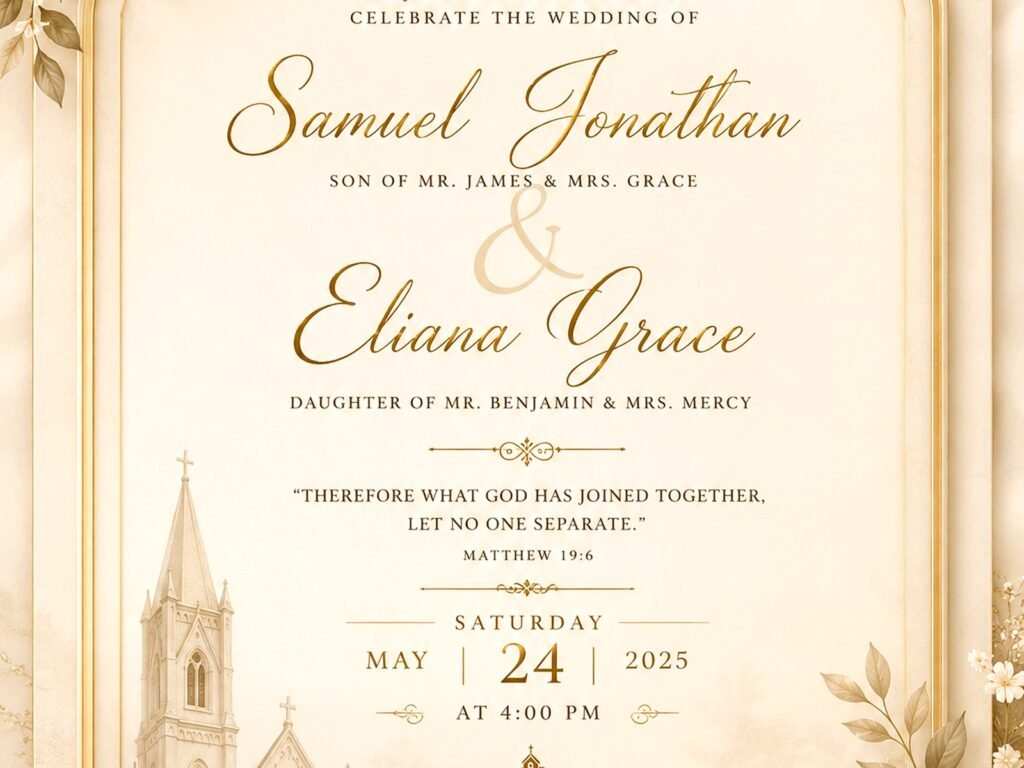
When you’re looking at design options you’ll see everything from super ornate with gold crosses and formal calligraphy to really minimalist modern designs with just a small cross icon. Both are completely valid. I’ve noticed that younger couples tend to go more minimal while traditional families push for the ornate style, and honestly this becomes a whole negotiation sometimes.
Color choices matter too but not as much as people think. Yes, white and gold are traditional, but I’ve done beautiful Christian invitations in navy blue, burgundy, sage green… My cat knocked over my coffee on a set of dusty rose invitations once and honestly the stain kinda looked intentional so we just… ordered one less than planned and nobody knew.
Wording Structure
Alright so the wording part trips people up constantly. Christian wedding invitation wording is different from secular invitations in a few key ways. You’ll often see phrases like:
- “Together with their families”
- “Request the honor of your presence at the marriage of”
- “As they unite in Christian marriage”
- “To witness their union in Christ”
- “Invite you to celebrate as they join in holy matrimony”
The phrase “honor of your presence” is specifically used for religious ceremonies (versus “pleasure of your company” for secular ones). Small detail but church people notice.
If your ceremony is in a church, you definitely want to include the full church name and address. Like don’t just say “St. Mary’s Church” – use “Saint Mary’s Catholic Church” or “First Baptist Church of Whatever Town” because there might be multiple St. Mary’s churches in your area and you don’t want guests ending up at the wrong one.
The Parents’ Names Situation
This gets complicated fast. Traditional Christian invitations often include parents’ names because it reflects the families coming together under God’s blessing. But modern families are… complicated. Divorced parents, remarried parents, deceased parents, parents who aren’t involved, parents who are involved but don’t get along.
Standard traditional format:
Mr. and Mrs. John David Smith
request the honor of your presence
at the marriage of their daughter
Catherine Marie
to
Mr. James Robert Anderson
son of
Mr. and Mrs. Robert Lee Anderson
But you can absolutely do “Together with their families” at the top if the parents situation is messy. Nobody’s gonna judge you for that, and if they do, well, they’re not very Christian about it are they?
Timeline For Ordering
Okay so here’s where I get really specific because timing matters SO much and people always underestimate this. Order your invitations at least 4-5 months before your wedding date. That gives you time for design, proofs, printing, assembly, addressing, and mailing with enough buffer for mistakes.
The actual timeline looks like:
- 5 months before: Start looking at designs and wording
- 4 months before: Order invitations
- 3 months before: Receive invitations, do assembly
- 8 weeks before: Mail invitations
- 1 month before wedding: RSVP deadline
And listen, I know online templates say you can do this faster but those timelines are assuming literally nothing goes wrong and… something always goes wrong. Someone’s name gets misspelled, the paper color looks different in person, the church changes their service time, whatever.
Printing Methods
You’ve got options here and they’re all at different price points. Digital printing is cheapest and honestly looks great for most designs. Thermography gives you that raised letter effect that feels fancy. Letterpress is gorgeous but expensive and takes longer. Engraving is the most traditional and formal but also the most expensive.
For Christian weddings specifically, I usually recommend at least thermography if your budget allows because there’s something about that raised text that feels appropriate for religious invitations. It’s not required though, digital printing has come so far that most guests won’t even notice the difference unless they’re specifically looking for it.
Where To Order
You can order from big online retailers like Minted, Shutterfly, Zazzle, or specialty Christian wedding sites. You can also work with local print shops or independent designers. Each has pros and cons.
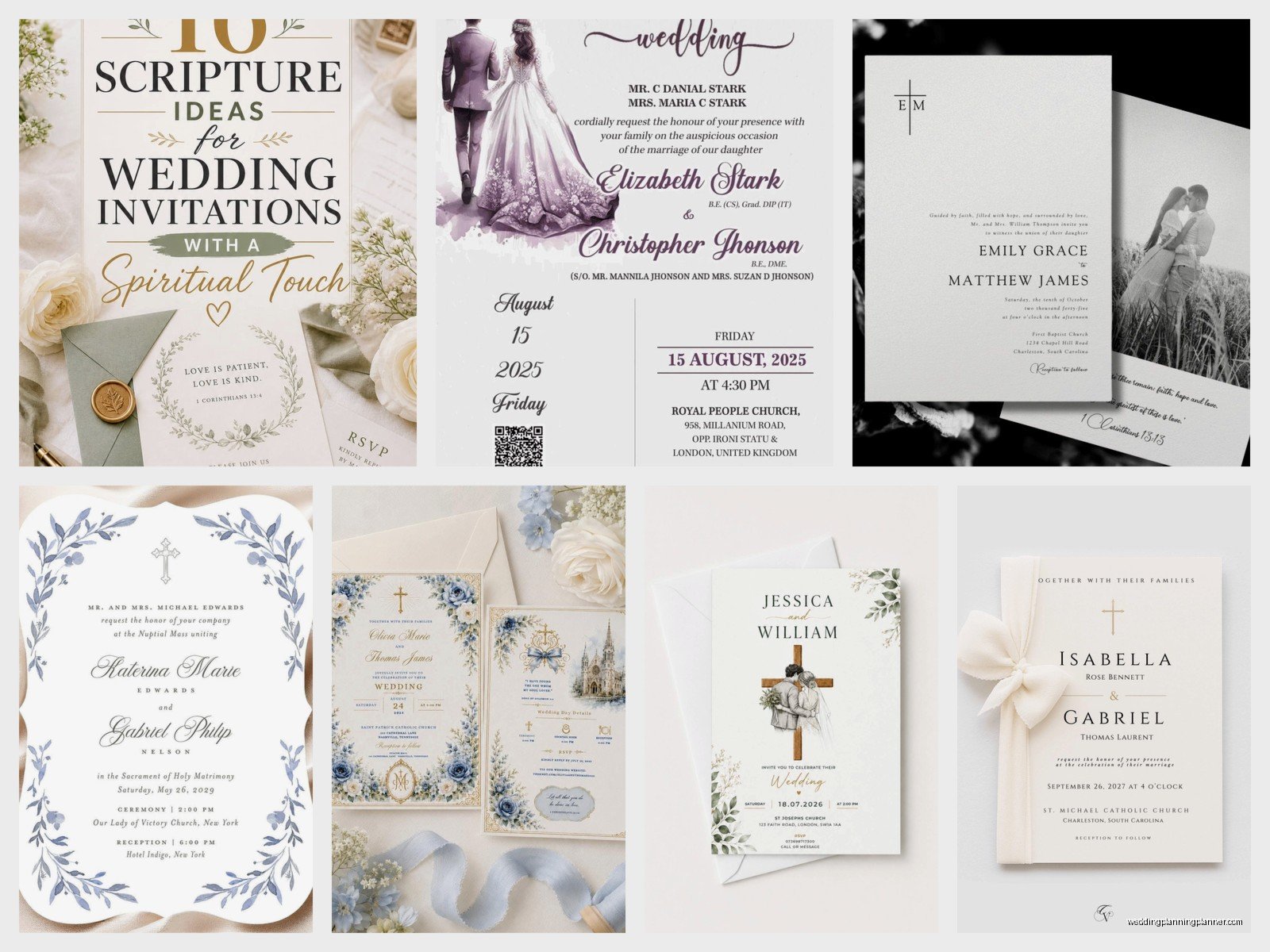
Big online retailers are convenient and often have good deals, plus easy templates. But their Christian-specific options can be kinda limited or cheesy-looking. I’ve seen some really terrible clip art crosses on major retailer sites that just… no.
Local print shops can work with you on custom designs and you can see paper samples in person which is huge. But they’re usually more expensive and have longer timelines.
Independent designers on Etsy or through wedding directories can create something totally unique. This is great if you have specific vision or want to incorporate your church’s architectural elements or specific imagery. Just make sure you’re checking their reviews and asking about revision policies.
The Insert Cards Nobody Tells You About
Christian weddings often need more insert cards than secular weddings because there’s more info to communicate. You might need:
- Reception card (if reception is at different location)
- Accommodation card
- RSVP card with envelope
- Direction/map card
- Website card
- Dress code card (especially if you have modesty expectations)
That last one is something I didn’t even think about until summer 2021 when a couple had a really conservative church community and needed to communicate that shoulders should be covered and skirts below knee. You can’t just spring that on guests when they show up, so we added a small card that said something like “We celebrate in a traditional church setting. Please dress modestly out of respect for our worship space” or something less preachy than that, I’m forgetting the exact wording.
Addressing The Envelopes
Formal Christian wedding invitations traditionally use full titles and formal addressing. So “Mr. and Mrs. John David Smith” not “John and Sarah Smith.” I know this feels old-fashioned and some people hate it, but for traditional Christian ceremonies it’s kinda expected.
You can do calligraphy (expensive but beautiful), printed addresses (easier), or even handwrite them yourself if you have decent handwriting. Whatever you choose, be consistent.
Inner envelopes are less common now but some traditional Christian families still expect them. The inner envelope would have just the names without titles or addresses, and it goes inside the outer mailing envelope. It’s an extra layer of formality that honestly most people under 50 don’t care about anymore.
Proofreading Is Everything
I cannot stress this enough – get like five different people to proofread your invitation before you order. Check the date, day of week, time, all addresses, all names spelled correctly, and make sure your Bible verse is quoted correctly with proper attribution.
Nothing is worse than getting 150 invitations delivered and realizing you put Saturday June 15th when June 15th is actually a Sunday. Or misspelling someone’s name. Or getting the scripture reference wrong (book, chapter, verse).
Also double-check with your church about ceremony time because some churches have specific service times they do weddings and won’t budge on it. You don’t wanna print “2:00 PM” on all your invitations and then find out the church only does weddings at 1:00 or 3:00.
Budget Real Talk
Christian wedding invitations can run anywhere from $1.50 per invitation suite to like $15+ for super fancy letterpress with multiple inserts. Most couples spend around $3-5 per invitation which includes the main invitation, one or two inserts, and envelopes.
You’ll also need to budget for postage which is more than you think because wedding invitations are usually heavier than regular mail. Those little RSVP envelope stamps add up too. And if you’re doing any wax seals or belly bands or ribbon, factor that in.
Ways to save money: skip the inner envelope, do digital RSVP instead of mailed cards, print your own envelope addresses, order from discount retailers during sales, or simplify your design to need less ink/fewer colors.
Assembly Tips
Once your invitations arrive you gotta assemble them which sounds easy but takes forever. The traditional order from back to front is: invitation card (largest, on bottom), reception card, any other insert cards, RSVP card with envelope tucked under (not inside) it, all facing up so guests can read everything without flipping anything around.
Some people do assembly parties with bridesmaids and wine which sounds fun until you’re three hours in and still have 80 more to go and everyone’s tired and someone definitely smudged ink on something.
If you’re adding any embellishments like ribbon or wax seals, do those before stuffing envelopes. And be gentle with wax seals because they can crack in the mail if you’re not careful – or just skip them honestly, they’re pretty but not necessary.
Mailing Them Out
Take one fully assembled invitation to the post office and have them weigh it before you buy all your stamps. Wedding invitations often need extra postage and you don’t want them all returned to you.
Mail them 8 weeks before your wedding date, not earlier because people forget, not later because people need time to plan. And maybe keep like 5 extra complete invitation suites for last-minute additions or keepsakes.
Also just… hand-cancel them at the post office if you can, meaning ask them not to run them through the machine. It prevents damage and keeps everything looking nice. Some postal workers will do this if you ask nicely, some won’t, depends on the day and who’s working.
The Digital Question
Some couples ask about doing digital invitations for Christian weddings and honestly it depends on your community. More traditional or older congregations might find it too casual for a sacred ceremony. Younger, more casual church communities might be totally fine with it. When in doubt, ask your pastor or some key family members what they think because you’ll hear about it if people are offended.
You can always do a hybrid – send digital save-the-dates but paper invitations, or paper invitations to older relatives and digital to young friends. Whatever works for your situation and budget, just make sure the important info is communicated clearly either way.