Planning Guides, Style Guide
Red And White Wedding Invitations: Design & Ordering Guide
Jun
Getting Started With Red and White Color Schemes
So red and white invitations are actually way more versatile than people think. I had this bride back in spring 2023 who was absolutely convinced red and white would look “too Valentine’s Day” and I had to literally pull out like fifteen different samples to show her the range. You can go classic formal with deep crimson and crisp white, or soft and romantic with blush-adjacent reds and cream, or even modern minimalist with bright red geometric patterns on stark white cardstock.
The first thing you gotta figure out is which red you’re actually talking about. Burgundy? True red? Scarlet? Cherry? Because I’m telling you, when you send a design file to a printer and just say “red” you’re gonna get whatever their default red is, and it might not match your wedding colors at all. I learned this the hard way with a client whose invitations came back fire-engine red when she wanted wine red and we had to rush reorder everything.
Choosing Your Actual Red Shade
Get yourself some Pantone swatches or at least look at your printer’s color options before you commit. Most professional printers will have:
- Classic red (Pantone 186 or similar) – this is your true Christmas/Coca-Cola red
- Burgundy/wine reds (Pantone 505, 1815) – super elegant for fall/winter weddings
- Scarlet or bright red – more energetic and modern
- Brick red – earthy and vintage feeling
- Cherry or pink-reds – softer and more romantic
And then your whites aren’t all the same either. Bright white vs cream vs ivory vs eggshell makes a huge difference. If you’re doing outdoor summer wedding, bright white looks amazing. Fall or winter wedding? I usually push people toward cream or ivory because it feels warmer and more… I dunno, it just works better with the deeper reds.
Design Styles That Actually Work
Okay so there are basically a few directions you can go with red and white invites and they all give completely different vibes.
Traditional Formal
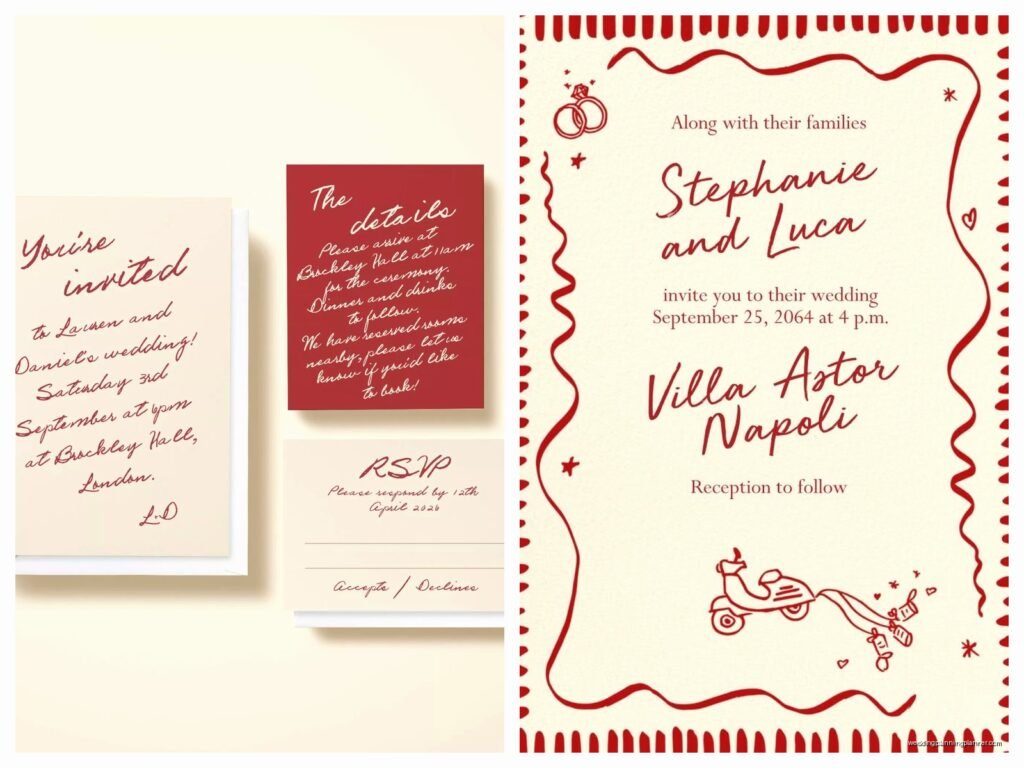
This is your classic engraved or letterpress look. Deep red ink on heavy white or ecru cardstock, maybe with a burgundy envelope liner. Script fonts, formal wording, the whole thing. This works really well for church weddings, ballroom receptions, black-tie events. You’d pair it with things like wax seals, silk ribbon, maybe a vellum overlay.
The annoying thing about formal invitations though is that everyone assumes they have to be boring? Like no, you can still have personality. I had a couple who did formal layout and wording but added a tiny red heart watermark behind the text and it was perfect.
Modern Minimalist
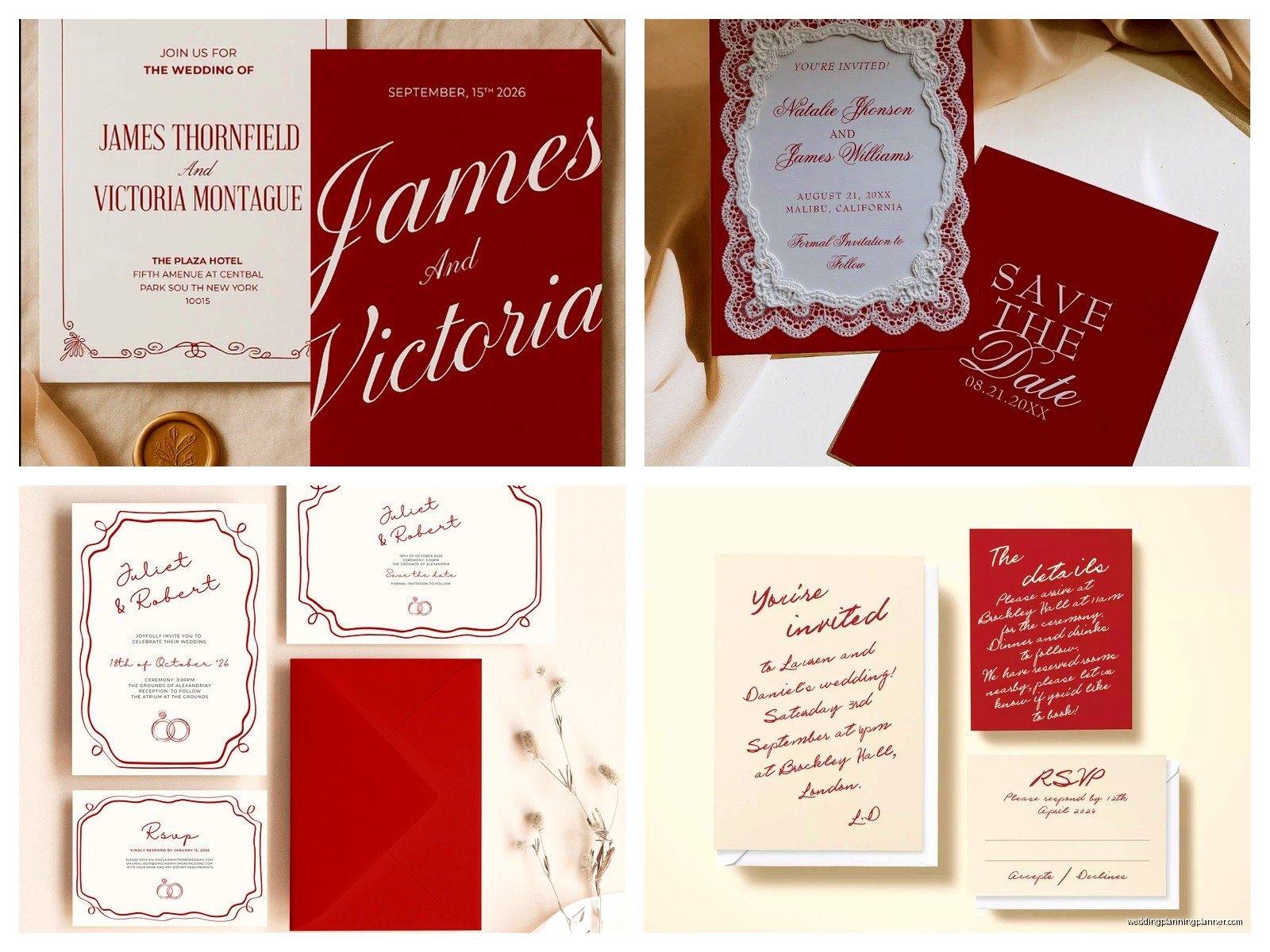
Clean lines, lots of white space, maybe one bold red element. Think sans-serif fonts, geometric shapes, or even just a thick red border around simple black text on white. This style is having a huge moment right now and it’s also usually the most budget-friendly because you’re not doing tons of fancy printing techniques.
You can do stuff like a bright red envelope with a simple white card inside, or white card with just your names in red at the top. Less is more here.
Romantic Floral
Red roses, peonies, or other flowers with green leaves on white background. This can go watercolor style, vintage botanical illustration style, or even pressed flower style. Super popular for spring and summer weddings. The key is making sure your florals don’t look too Valentine’s-y unless that’s what you’re going for.
I always tell people to include some greenery or other accent colors in the floral designs even if your main palette is red and white, because otherwise yeah, it does kinda read Valentine’s Day cards from the drugstore.
Vintage or Retro
Think 1950s diner vibes, or vintage circus posters, or art deco patterns. Red and white is actually perfect for retro designs. You can play with polka dots, stripes, vintage fonts, old-school illustrations. This works great if your wedding has a theme or if you’re getting married at a unique venue.
Paper and Printing Options
Alright so this is where it gets technical but also where you can save or spend a lot of money.
Cardstock Weight and Texture
Standard invitation cardstock is usually 80lb to 100lb cover weight. Anything less feels flimsy. I personally like 110lb for invitations because it feels substantial without being impossible to fit in an envelope. You can go heavier but then you’re paying more for postage potentially.
Textures matter too:
- Smooth – clean and modern, best for digital printing
- Linen – has a subtle texture, feels traditional and fancy
- Laid – shows horizontal lines in the paper, very classic
- Cotton – super luxe feeling, takes ink beautifully
Printing Methods
Digital printing is your most affordable option and honestly looks great for most designs. The color is printed directly onto the paper. Perfect for full-color designs, photos, or if you need a quick turnaround. Most online invitation companies use digital printing.
Letterpress is where they press the design into the paper so you get this amazing texture. It’s gorgeous and very tactile but also expensive and you’re limited to simpler designs usually. The red ink pressed into white paper looks incredible though – I had a summer 2021 wedding where the bride splurged on letterpress for just the main invitation and did digital for all the enclosures and it was the perfect compromise.
Thermography is like raised printing – the ink is raised off the paper. It’s cheaper than letterpress but still gives you that fancy dimensional look. Works great for red on white because the contrast really shows off the raised effect.
Foil stamping uses actual metallic foil. You can get red foil on white paper which is super striking and modern. More expensive than digital but less than letterpress usually.
Envelope Situations
Your envelope color matters just as much as the invitation itself. You’ve got options:
White envelopes with red invitations inside – classic and clean. You can add a red liner to make it more interesting when people open them. Red envelopes with white invitations – bold and eye-catching in the mail, though sometimes the post office machinery doesn’t love dark envelopes as much. White envelopes with red addressing – elegant and pulls the whole look together.
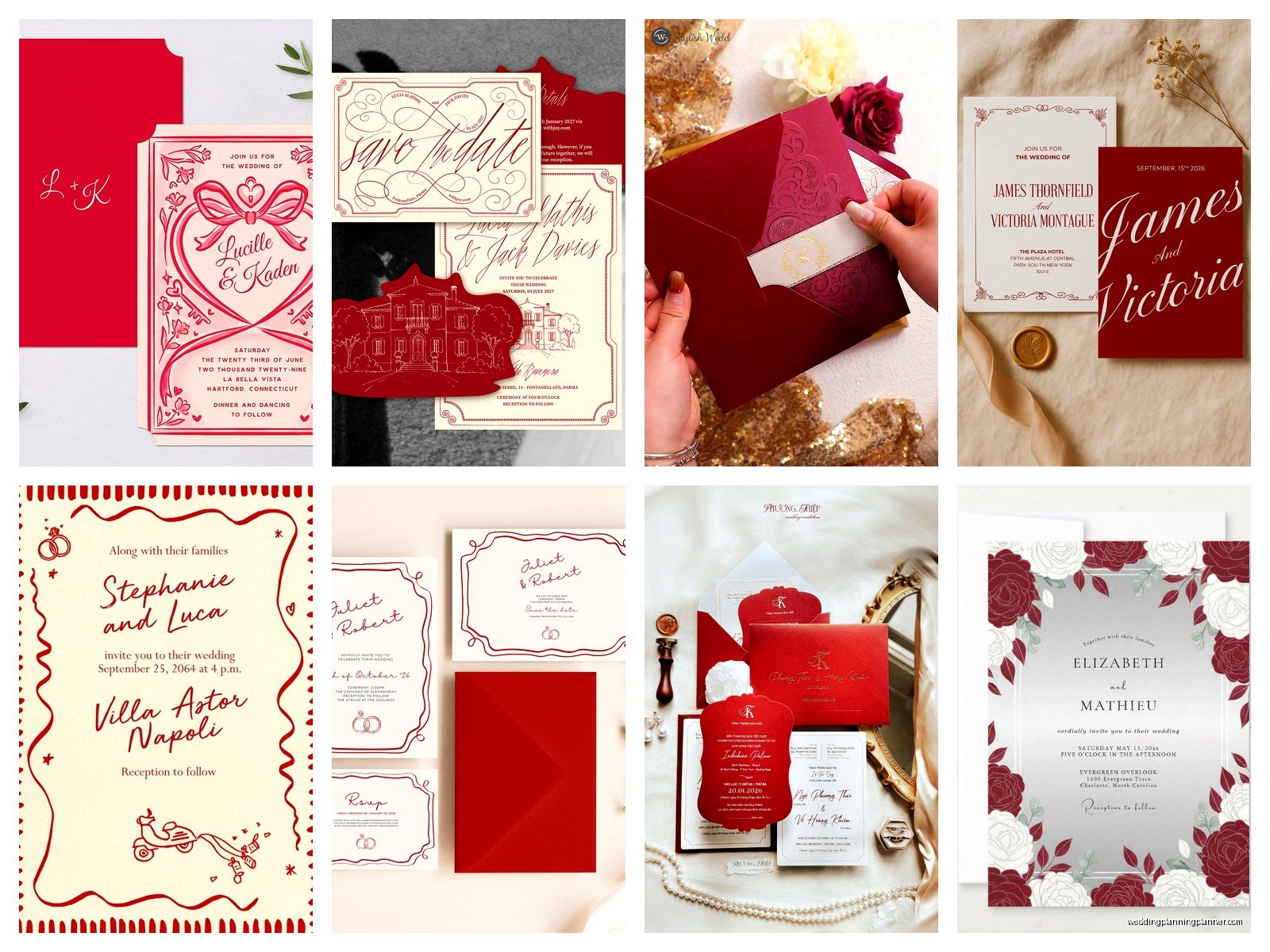
Here’s something that annoys me SO much – when people design beautiful invitations and then just… use whatever basic envelope came with them and address them with their home printer in default font. Like, your envelope is the first impression! At minimum, do nice addressing. You can hand-letter them, use calligraphy, print nice labels, or hire a calligrapher.
For red and white invites, I usually suggest either red ink calligraphy on white envelopes or white ink on red envelopes. Both look amazing. Or if you’re doing modern minimalist, even just clean black addressing can work.
Budget Breakdown and Where to Order
Online Print Shops
Places like Minted, Zazzle, Shutterfly, Vistaprint – these are gonna be your most budget-friendly options. You can get 100 invitations for anywhere from $100 to $400 depending on what you choose. They have templates you can customize, which is perfect if you’re not doing anything super unique.
Minted is my favorite of these because their designs are actually created by independent artists so they’re more interesting, and their paper quality is really good. They also do free guest addressing if you use their service which saves tons of time.
Independent Designers on Etsy
You can find customizable templates for like $15-40 and then print them yourself locally or through an online printer. This is the budget option if you’re crafty. Just make sure you know what you’re doing with the file formats and printing specs because I’ve seen people mess this up and waste money on bad prints.
Some Etsy designers also offer full custom design services which range from like $200-800 depending on how complex you want to get.
Professional Stationery Studios
This is the high-end option. You’re working with a designer who creates something completely custom for you. Expect to pay $800-2000+ for invitation suites for 100 guests. But you’re getting exactly what you want, premium printing methods, and someone who handles all the details.
I work with several local stationers and honestly for couples who have the budget, it’s worth it because you get something nobody else has and the quality is just… chef’s kiss.
What to Include in Your Suite
At minimum you need the actual invitation. But most people also include:
- RSVP card and envelope (can be white with red accents or vice versa)
- Details card with hotel info, website, dress code
- Reception card if ceremony and reception are different locations
- Outer envelope and possibly inner envelope
You can also add things like weekend itinerary cards, map cards, rehearsal dinner invites if you’re inviting people that way. Just remember every additional card is more printing cost and more postage weight.
Oh and speaking of postage – you’re probably gonna need extra stamps if your suite is heavy or oversized. Square envelopes also cost more to mail, which is something nobody tells you until you get to the post office. My cat knocked over my coffee onto a stack of square envelopes once and I had to reorder them and I was so annoyed because they were already more expensive to mail anyway.
Timing and Quantities
Order your invitations like 4-6 months before your wedding. You want to mail them 6-8 weeks before the wedding date. That means you need to have your guest list finalized, addresses collected, and design approved way earlier than you think.
For quantities, count your households not individual guests. So a couple living together gets one invitation. Order like 10-15 extras beyond what you need for keepsakes and mistakes. You’ll want extras for your parents, yourself, maybe to frame one.
Proofreading is Critical
Read everything seventeen times. Then have someone else read it. Then read it again. Check the date, the time, the venue name and address, the spelling of everyone’s names, the website URL if you included one. I once had a client approve invitations with their venue address wrong and didn’t realize until they were printed and we had to order sticker labels to cover the mistake because there wasn’t time to reprint.
Matching Your Other Stationery
Once you’ve got your invitations sorted, you’ll probably want matching pieces for the actual wedding day. Programs, menus, place cards, table numbers, signage – you can carry the red and white theme through all of it.
You don’t have to order everything from the same place as your invitations though. A lot of people do invites from Minted or a designer, then DIY their programs and menus using the same fonts and colors. Canva has templates that make this pretty easy.
For red and white weddings specifically, I love when people do white programs with red ribbon binding, or red table numbers on white cardstock in simple frames. Keep it consistent but you don’t have to match everything exactly – like your invitations can be burgundy and cream, and your day-of stuff can be brighter red and white, and it’ll still feel cohesive as long as you’re in the same color family.
Common Mistakes to Avoid
Don’t use too many fonts. Two fonts maximum, maybe three if one is just for a small detail. I see people mixing like script font for names, serif for body text, sans-serif for dates, decorative font for some random element and it looks chaotic.
Don’t make your text too small. People over 50 especially will struggle to read tiny font and then they’ll call you asking for details, which defeats the purpose of sending information in the first place.
Don’t forget to include your wedding website if you have one. So much easier to put all the extra info there than trying to cram everything onto cards.
Don’t wait until the last minute to order. Rush fees are real and they’re expensive. Plus you need time to assemble everything, address envelopes, add postage, and actually mail them.
And don’t stress too much about making them perfect because honestly, most guests look at the invitation for like thirty seconds to get the important info and then… they either come to your wedding or they don’t, and the invitation design doesn’t really factor into that decision as much as you think it does while you’re agonizing over which shade of red to choose at 11pm on a Tuesday.