
Planning Guides, Style Guide
Wedding And Reception Invitation: Design & Ordering Guide
Jun
Okay so invitation design and ordering is honestly where most couples either nail it or totally stress themselves out
The biggest thing you gotta know upfront is that your invitation suite isn’t just one card anymore. Like, it used to be simple but now you’re looking at the main invitation, RSVP cards, details cards, maybe a weekend events card if you’re doing multiple days, reception cards if ceremony and reception are separate… it adds up fast. And printers charge by the piece so that “affordable” invitation suddenly costs $8 per guest when you add everything up.
I had this couple in spring 2023 who ordered their invitations without checking what was included in the “suite” and they thought they were getting everything for $3.50 per invite. Turned out that was JUST the main card and they needed like four additional inserts. Their budget went from $450 to almost $1,100 and they were so stressed because they’d already spent that money elsewhere in their heads, you know?
Timeline is everything and everyone gets this wrong
You want to mail invitations 8 weeks before your wedding. That’s standard. Destination weddings or holiday weekends need 12 weeks. So work backwards from there. Most custom or semi-custom invitations take 3-4 weeks to produce once you approve the proof. Then you need time to assemble them, address them, and get them to the post office. I always tell couples to order 4-5 months before the wedding date.
Save-the-dates go out 6-8 months before (or earlier for destination weddings). You can be more casual with these—postcards work great and they’re cheaper to mail.
Design decisions you need to make before you even start shopping
Formality level matters SO much. A black-tie ballroom wedding needs different invitation vibes than a backyard barbecue reception. The invitation sets expectations for your guests about what kind of event this is. I’ve seen guests show up underdressed because the invitation looked super casual but the wedding was actually formal.
Here’s what affects your design:
- Venue style (rustic barn vs. fancy hotel vs. beach vs. garden)
- Wedding colors—you don’t have to match exactly but it should coordinate
- Season—fall weddings can go deeper and richer, spring can be lighter
- Your personal style as a couple
- Formality level of the actual event
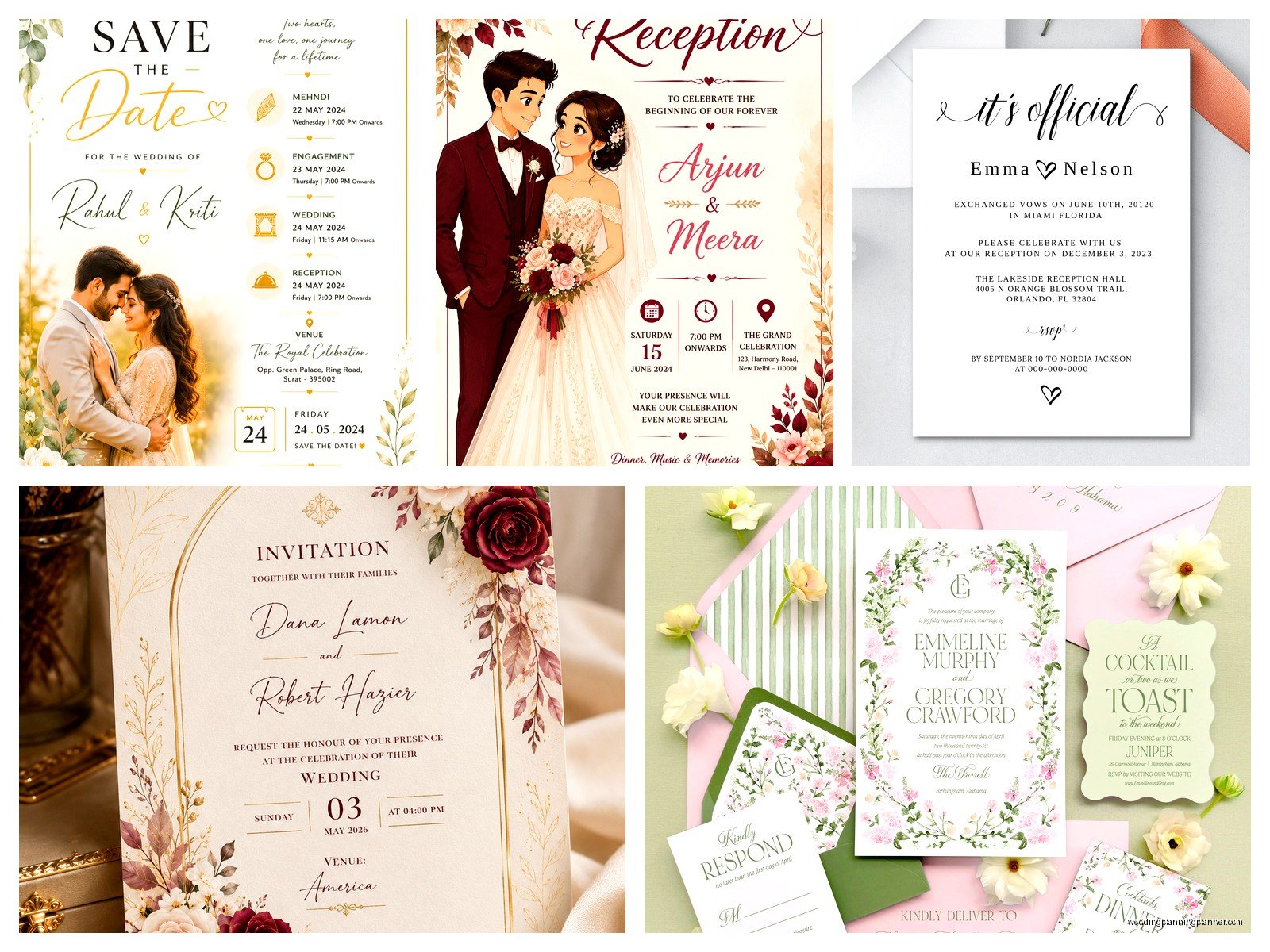
One thing that annoyed me for YEARS is when couples pick a design they love that has absolutely nothing to do with their wedding style. Like, they’re having an elegant ballroom wedding but they fell in love with wildflower invitations because they’re pretty. Then the whole aesthetic is disjointed and guests are confused about what to expect. Your invitation is the first impression of your wedding.
Printing methods and why this affects your budget big time
Digital printing is the most affordable. It’s what most online companies use (Minted, Zazzle, Shutterfly). Quality has gotten really good. You can get beautiful invitations this way for $2-5 per suite usually. Turnaround is quick too.
Letterpress is where they press the design into thick cotton paper so you get that gorgeous texture and indentation. It’s stunning but expensive—think $8-15+ per invitation. And you’re limited on colors usually. It’s very classic and elegant looking though.
Thermography raises the text so it’s shiny and lifted. It’s cheaper than letterpress but gives you that dimensional effect. Maybe $4-8 per invite typically.
Foil stamping adds metallic foil details (gold, silver, rose gold, copper). This has gotten super popular. Costs vary wildly but expect to add $2-4 per invitation for foil details.
Engraving is the most expensive and traditional—they actually carve the design into a metal plate. It’s what old-money families use for their formal events. Beautiful but gonna cost you $12-20+ per invite easily.
What should actually be included in your invitation suite
The main invitation card has the who, what, when, where. Traditional wording is formal (“Mr. and Mrs. John Smith request the honour of your presence…”) but honestly most couples do something more personal now. Just make sure you include:
- Your names (however you want them listed)
- Date and time
- Venue name and city/state
- Reception information if it’s at the same location OR…
Reception card if your ceremony and reception are different locations or if there’s a gap between them. This card tells guests where to go next and what time.
RSVP card and return envelope. Pre-address and stamp these return envelopes. Yes it costs more upfront but your return rate will be SO much better. I can’t tell you how many couples skip the stamp to save money and then they’re chasing down RSVPs because people didn’t bother… or they actually expect guests to respond online when half of them are older relatives who don’t want to deal with a wedding website.
Details card covers dress code, hotel blocks, transportation info, wedding website URL. Don’t cram too much info on here though or it gets overwhelming.
Weekend events card if you’re doing welcome drinks, day-after brunch, etc. Only include people who are invited to those events obviously.
Ordering the right quantity
You need one invitation per household, not per guest. So a family of four gets ONE invitation. Couples living together get one. Your college roommate who’s bringing a plus-one gets one.
Order 10-15 extra invitations beyond your household count. You’ll want them for keepsakes, last-minute additions, mistakes in addressing, or damaged ones. They’re cheaper to order upfront than trying to reorder later.
For RSVP cards and envelopes, order the same quantity as your invitations since it’s one per household.
Where to actually order from
Online companies like Minted, Zola, Paperless Post (they do paper now too), Greenvelope, Shutterfly are convenient and affordable. You can see tons of designs, customize online, order samples. Minted’s quality is really good and I recommend them a lot. Their foil options are nice.
Etsy has thousands of designers doing custom and semi-custom work. You can find unique stuff here. Just read reviews carefully and make sure the seller has good communication and clear turnaround times. I’ve seen some disasters with Etsy orders that arrived late or looked nothing like the listing.
Local print shops and stationery boutiques cost more but you get personalized service. They’ll help you with wording, coordinate everything, sometimes even do calligraphy addressing. Worth it if you want hand-holding through the process or if you’re doing letterpress or engraving.
Independent designers (like me sometimes ha) create fully custom suites. Most expensive option but you get exactly what you want and it’s one-of-a-kind. Expect to invest $1,500-3,000+ for custom design work plus printing for 100 invitations.
Samples are non-negotiable
Always order samples before you commit to the full order. Paper weight, color accuracy, printing quality—it all looks different in person than on a screen. Most companies charge $5-10 per sample which is nothing compared to hating your $800 invitation order.
When I was planning my own wedding (summer 2021, small backyard thing), I ordered samples from like six different companies because I’m ridiculous and also it’s literally my job to know this stuff. The paper quality varied SO much and some colors that looked navy online were actually purple in person.
Addressing your invitations
You’ve got options here. Hand calligraphy is gorgeous but costs $3-8 per envelope typically. There are calligraphers who do modern styles, traditional styles, whatever you want.
Digital calligraphy or printing directly on envelopes is way more affordable—sometimes free, sometimes $0.50-1 per envelope. It looks good and saves time.
DIY if you have nice handwriting or want to print labels at home. Just… make sure it looks intentional and neat, not like a last-minute scramble.
Guest addressing needs to be formal-ish. “Mr. and Mrs. John Smith” or “Sarah Johnson and Guest” or “The Martinez Family.” Don’t use abbreviations for Street, Avenue, etc. on the envelope even if you’re being casual inside.
Postage is more complicated than you think
Square envelopes cost extra to mail. Non-standard sizes cost extra. Anything thick or heavy costs extra. Go to the post office with a fully assembled invitation (all inserts, sealed, addressed) and have them weigh it BEFORE you buy stamps. I cannot stress this enough.
A standard invitation usually needs $0.73-1.00 in postage depending on weight. Oversized or square needs $1.20+. If your suite is chunky with multiple cards and a ribbon, you might need $2+ in postage.
Buy pretty stamps that coordinate with your wedding. The post office has nice options or you can order custom stamps online with your engagement photo or whatever. Makes the envelope prettier.
Don’t just drop them in a mailbox—hand them to a postal worker and ask them to hand-cancel if possible. This means they stamp them by hand instead of running them through the machine that can tear or bend them.
Assembly takes longer than you expect
Set aside an evening (or two) to assemble everything. Get your bridesmaids or family to help, order pizza, make it a party. You need to:
- Stuff all inserts in order (invitation on bottom, then other cards, RSVP card and envelope on top)
- Make sure RSVP envelopes are pre-addressed and stamped
- Add any belly bands, ribbons, wax seals, or other decorative elements
- Seal the outer envelopes
- Apply postage
- Add return address labels or stamps
For 100 invitations, this usually takes 2-3 hours with help. My cat knocked over a stack of RSVP cards once during assembly and I almost lost it… they scattered everywhere and we had to re-match them to the right envelopes.
Proofreading because typos are forever
Read everything out loud. Multiple times. Have other people read it. Check:
- Date and day of week match (September 15, 2024 should be a Sunday if you say Sunday)
- Venue name and address are exactly correct
- Names are spelled correctly
- Times are correct and include AM/PM
- Your wedding website URL works
- Phone numbers for RSVP (if using) are correct
I had a couple once who printed “Saturday, June 12th” when June 12th was actually a Friday. They didn’t catch it until after they mailed them and had to send correction cards to everyone. So embarrassing and expensive.
Digital invitations are actually kinda great for some situations
Nah, hear me out—for casual weddings, eco-conscious couples, or super tight budgets, digital invitations work. Paperless Post, Greenvelope, and even Evite (for very casual) have nice designs. They track RSVPs automatically which is convenient. You lose the tangible keepsake aspect but you save hundreds of dollars and tons of time.
Some couples do digital save-the-dates and paper invitations as a compromise. That works too.
Little extras that make invitations special
Wax seals on the back flap look fancy. You can get custom stamps with your initials or monogram. Takes practice though and they add weight so… more postage.
Vellum overlays are those translucent sheets over the main invitation. Pretty but they shift around in the envelope which sorta bugs me.
Ribbon belly bands hold everything together and add color or texture. Just remember they add bulk.
Envelope liners in a pattern or color make the invitation feel more special when guests open it. Most companies offer these as an add-on.
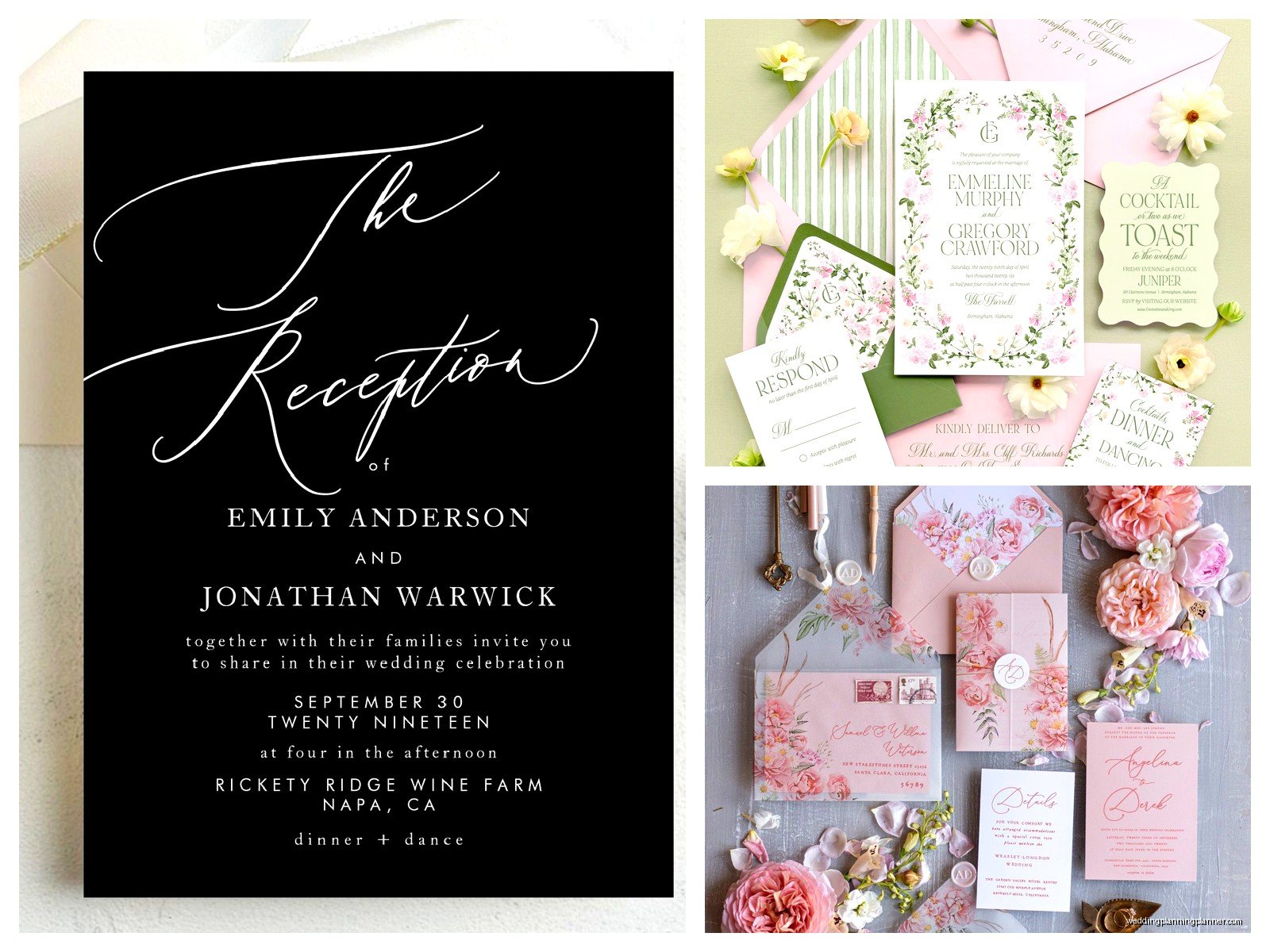
Custom envelope colors instead of standard white or ivory. Metallics, navy, burgundy, blush—these are popular and look elevated.
I usually tell couples to pick one or two special touches rather than doing everything. It keeps costs reasonable and honestly too many elements starts looking cluttered anyway.
Common mistakes I see all the time
Ordering too late and then rushing and making mistakes. Waiting until the last minute to address envelopes. Not ordering enough. Forgetting to include an RSVP deadline (should be 3-4 weeks before wedding). Making the font too small or hard to read—your grandma needs to be able to read this without a magnifying glass. Including too much information on the invitation itself instead of using a details card. Not matching formality level to the actual event. Skipping the postage check and then having invitations returned for insufficient postage.
Oh and using super trendy design elements that’ll look dated in five years. Like I’m already seeing invitations from 2019 with that specific dusty blue and rose gold combo that screams “2019 wedding” you know? Not that it matters really since they’re just keepsakes but still.
Budget breakdown so you know what you’re getting into
For 100 invitations (full suites), you’re looking at:
- Budget option: $200-400 (digital printing, simple design, online company)
- Mid-range: $500-900 (better paper quality, maybe one special printing technique, some customization)
- High-end: $1,000-2,000+ (letterpress, foil stamping, custom design, premium paper)
- Luxury: $2,500+ (fully custom with designer, engraving, hand calligraphy, all the bells and whistles)
Add postage ($75-200 depending on weight), envelope addressing if you’re hiring someone ($300-800), and any assembly help if you’re outsourcing that.
The average couple spends about $600 on invitations total for 125 guests according to most surveys, which sounds about right from what I see. But I’ve worked with couples who spent $150 and couples who spent $4,000. It’s really about priorities and… honestly there’s no right answer as long as you’re communicating the necessary information clearly and it represents your wedding appropriately