Planning Guides, Style Guide
Intimate Wedding Invitation: Design & Ordering Guide
Jun
Okay so intimate wedding invitations are actually way different than regular wedding invites
First thing you gotta understand is that when you’re planning an intimate wedding—like under 50 people, sometimes even just 20 or 30—your invitation strategy changes completely. I learned this the hard way back in spring 2023 when a client came to me with a guest list of 18 people and wanted to order invitations from one of those big online printers that had a minimum order of 100. We ended up with so many leftover invites that she literally used them as scrap paper for her grocery lists for like six months.
The whole vibe of an intimate wedding invitation should feel more personal, more intentional. You’re not mass-producing announcements here, you’re creating something special for a very select group of people who actually matter to you.
Timing is totally different than you think
So everyone says send wedding invitations 6-8 weeks before the wedding, right? For intimate weddings, I actually recommend longer—like 10-12 weeks. Here’s why: your guests are probably your absolute closest people, which means they’re gonna want to be there no matter what, which means they need more time to actually arrange their schedules, book travel if needed, and make it happen. When you only have 25 guests, each person really counts.
Also you can kinda get away with doing save-the-dates more casually for intimate weddings? Like I’ve seen couples just text or call their small guest list, or send a cute email. But if you want to do physical save-the-dates, send those 6-8 months out, especially if there’s travel involved.
Design choices that actually work for small weddings
This is where it gets fun. With a smaller guest list, you can afford to do things you absolutely couldn’t do for 150 people:
- Hand-lettering each guest’s name (I did this for a backyard wedding of 22 people in summer 2021 and my hand cramped but it looked gorgeous)
- Wax seals on every single envelope
- Custom illustrations that include personal details
- Actual vintage stamps instead of those printed meter marks
- Handmade paper or really unique textures that would blow your budget on a large order
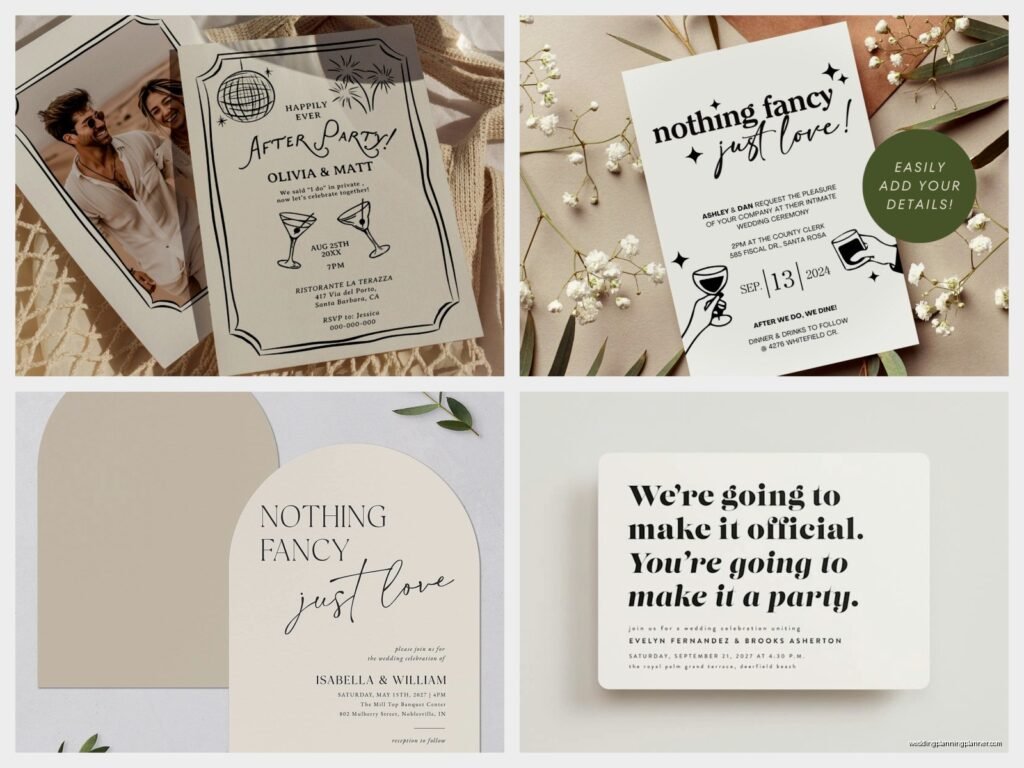
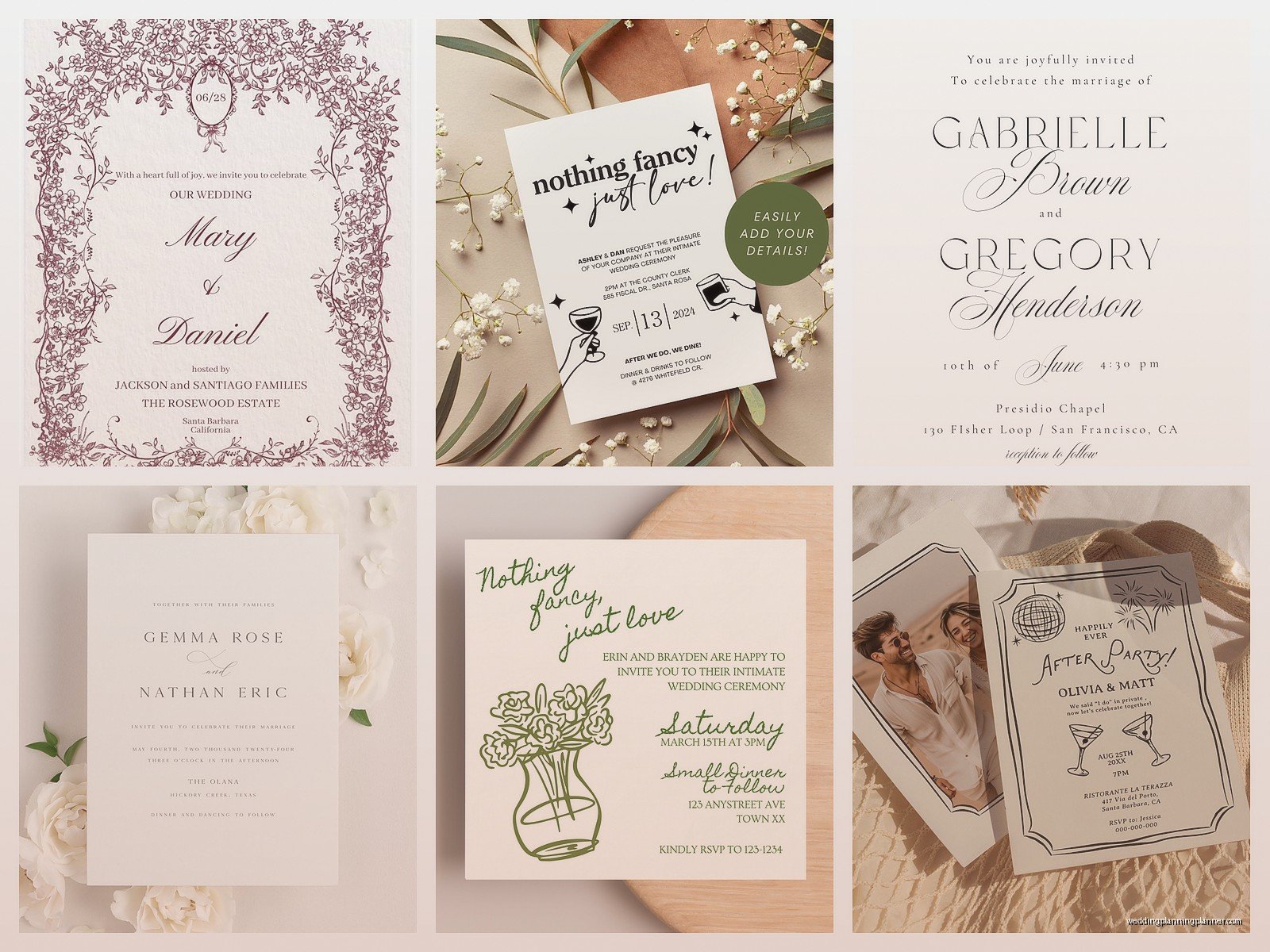
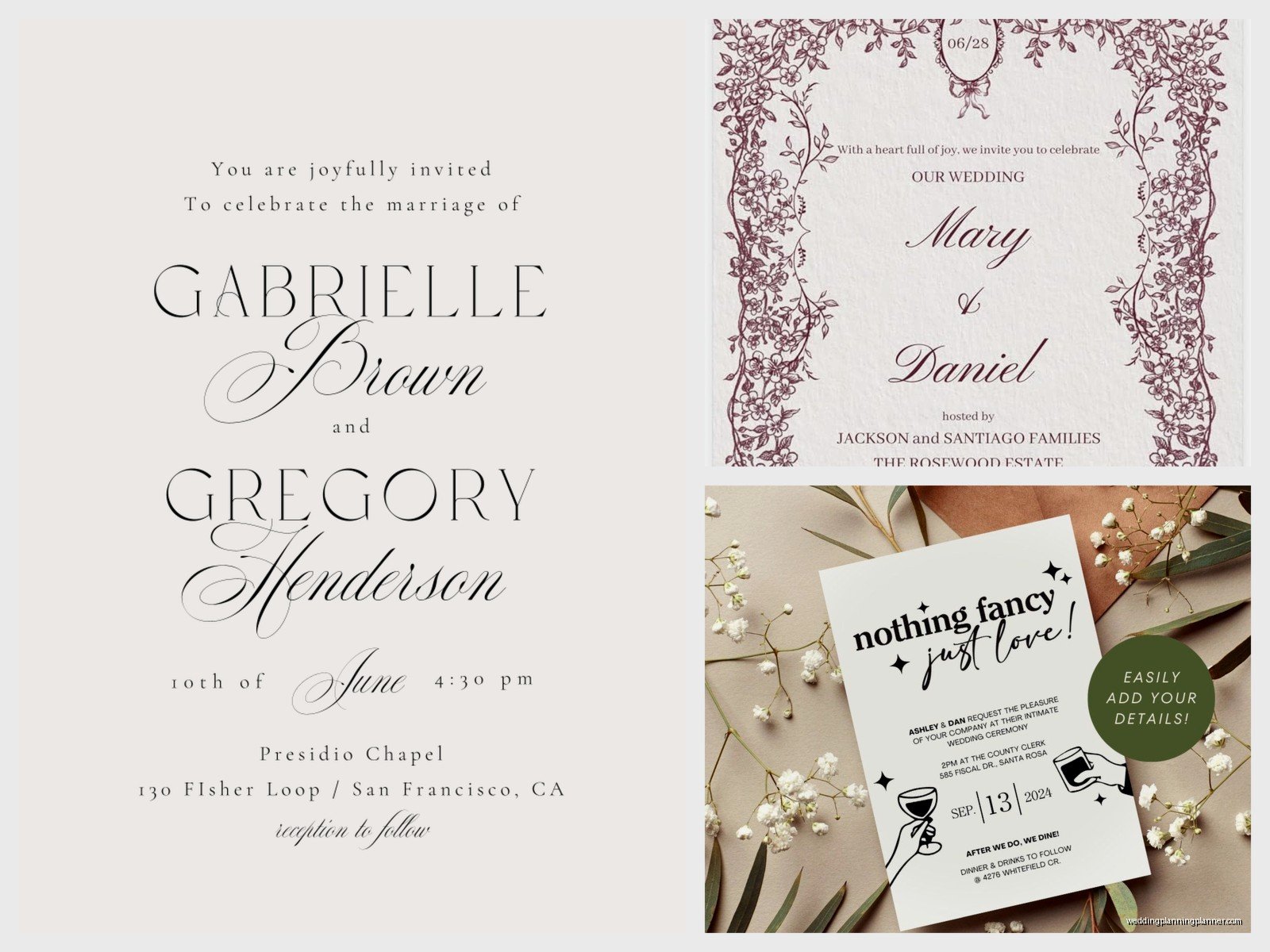
The design itself should feel less formal unless that’s specifically your vibe. I see a lot of couples doing more conversational wording, dropping some of the traditional “request the honor of your presence” language in favor of something like “We’re getting married! Join us for an intimate celebration…”
One thing that annoys me SO much is when couples planning 30-person weddings still use those super formal, traditional invitation suites with the reception card and the response card and the accommodations card and the directions card. Like… you’re having 30 people. You can include everything on one card, or maybe two if you really need to. You’re gonna talk to most of these people before the wedding anyway, right?
Where to actually order from
Okay so this is important because minimum order quantities will destroy your budget if you’re not careful.
Etsy sellers are honestly your best bet for intimate weddings. Most of them don’t have minimums, or their minimums are like 10-20 invitations. You can find people who do custom work, semi-custom templates, or printable files you can print yourself. I always check reviews and make sure they’ve done wedding invitations before, not just birthday party invites.
Local print shops can be amazing for small runs. I worked with this print shop in my area that did letterpress for a client’s 35-person wedding and because it was a small order, they actually gave us more attention and let us do a test print to see the colors in person. Try calling around, especially to shops that do business cards and corporate printing—they’re set up for small quantities.
Minted and Paperless Post both let you order small quantities, though Minted’s prices don’t really drop until you hit higher numbers. Paperless Post is great if you want to do digital invitations, which… okay hear me out on this because I know people have feelings about digital wedding invites.
The digital invitation question
For intimate weddings? Digital invitations are actually kinda perfect in some situations. If your 25 guests are scattered across the country and you’re already doing a destination-style wedding, or if your wedding is more casual and modern, a really well-designed digital invitation through Paperless Post or Greenvelope can be gorgeous and functional. Plus you get instant RSVPs, which is… honestly the dream.
But I only recommend this if it matches your overall wedding vibe. If you’re doing an intimate garden ceremony with a sit-down dinner, maybe stick with paper. If you’re doing a casual restaurant buyout with your favorite people, digital could totally work.
The RSVP situation gets weird with small weddings
Here’s something nobody tells you: when you have 30 guests, the RSVP process is awkward. Like, you probably already know if they’re coming because you’ve talked to them about the date before you even sent invitations. I had a bride in 2022 who had 24 guests and literally every single one of them texted her their RSVP instead of sending back the card. She had these beautiful letterpress RSVP cards that nobody used.
So you have options. You can skip RSVP cards entirely and just include your wedding website or phone number for responses. You can do a postcard-style RSVP that feels less formal. Or you can include them knowing they might not get used but they complete the suite and look pretty.
I usually tell couples to include an RSVP deadline that’s about 4-5 weeks before the wedding for intimate celebrations, which gives you time to follow up with the one or two people who inevitably forget to respond even though they’re your closest friends.
Information you actually need to include
Okay so beyond the obvious stuff—who, what, when, where—intimate wedding invitations should probably include:
- Really specific location details since you might be using a non-traditional venue (someone’s backyard, a small restaurant, a rental house)
- Parking information because small venues often have limited parking
- The vibe/dress code, and you can be way more specific here than “cocktail attire”—like “garden party chic” or “wear your favorite vintage dress”
- Whether kids are invited (this matters more when you have a small count because each kid takes up a bigger percentage of your guest list)
- Your wedding website if you have one, though honestly for 25 people you might not even need… wait no, you probably still want one for photos and registry
My cat just knocked over my coffee while I’m writing this, so if there’s a weird transition here, that’s why.
Suite components you actually need
For an intimate wedding, here’s what I typically recommend:
Main invitation: Obviously. This can be a single card or a folded card. For small quantities, folded cards often don’t cost much more and they feel more substantial.
Envelope: Get the nice ones. With a small quantity, you can afford better quality envelopes. Consider lined envelopes or colored envelopes that match your wedding colors.
RSVP card and envelope (maybe): As I mentioned, these might not get used, but they complete the traditional suite. For 30 invitations, we’re talking like $40 extra for RSVP cards and envelopes, so it’s not gonna break the bank.
Details card (if needed): Only if you have a lot of weekend activities or complicated logistics. Otherwise just put everything on the main invite.
What you don’t need: Reception cards if your ceremony and reception are in the same place (which they usually are for intimate weddings). Separate accommodation cards—just put that on your website or include it on a details card. Those weird little tissue papers that go over the invitation, nobody knows what those are for anyway.
Printing methods and what they cost for small runs
Digital printing is gonna be your most affordable option and honestly it looks really good now. For 30 invitations, you’re probably looking at $100-200 for nice digital printing depending on the design and paper quality.
Letterpress is beautiful and for small quantities it’s actually more achievable than you’d think. I’ve seen letterpress suites for 25 invitations come in around $400-600 depending on the design complexity. It’s a splurge but it might be worth it when you’re not printing 150 of them.
Foil printing is another option that looks really elegant. Similar price range to letterpress for small quantities.
Thermography is that raised printing technique and it’s fallen out of favor but it’s still less expensive than letterpress if you want that dimensional effect.
DIY or semi-DIY options
With a small guest list, DIY becomes way more manageable. You could:
- Buy a template from Etsy, customize it in Canva or Word, and print at home on nice cardstock
- Order printed invitations but hand-letter the envelopes yourself
- Print the invitations professionally but assemble and embellish them yourself with ribbons, wax seals, or pressed flowers
- Create a simple design and have it printed at a local print shop on beautiful paper
I did a semi-DIY project for a client who had 28 guests—we ordered simple printed cards and then she spent like three evenings adding watercolor details to each one. They were stunning and so personal, but she definitely couldn’t have done that for 100+ invitations.
Wording that feels right for intimate celebrations
You can be so much more personal and less formal with intimate wedding invitation wording. Instead of the traditional third-person format, lots of couples use first person:
“We’re getting married! Please join us for an intimate celebration of our wedding…”
Or you can acknowledge the small size directly:
“We’re keeping our wedding small and intimate, surrounded by our closest family and friends. We’d be honored if you’d join us…”
You can also be more specific about what the day will look like: “Join us for a ceremony in our backyard followed by a long dinner under the stars” tells your guests exactly what to expect in a way that feels warm and personal.
Addressing and mailing
Okay so with 30 invitations, you can absolutely hand-address every envelope. Even if your handwriting isn’t perfect, it adds that personal touch that matters for an intimate wedding. I recommend practicing on some extra envelopes first (order like 10-15 extra because you will mess some up, trust me).
If you really don’t want to hand-address, look into digital calligraphy where someone creates a font from your handwriting, or hire a calligrapher for just 30 envelopes—it’s way more affordable than you’d think for such a small quantity.
For postage, get the nice stamps. Go to the post office and look at their special issue stamps. With 30 invitations, you’re spending like $20-25 on postage anyway, might as well make it pretty. Also weigh your assembled invitation at the post office before you buy stamps because if it’s over 1 oz you’ll need extra postage and it’s better to know upfront than have them all returned to you.
Timeline for ordering
Here’s a realistic timeline that I give my clients:
12-14 weeks before wedding: Start looking at designs, reach out to potential printers or Etsy sellers, nail down your wording
10-12 weeks before: Place your order (small print runs often have shorter turnaround times, sometimes just 2-3 weeks instead of 4-6)
8-10 weeks before: Invitations arrive, you assemble them if needed, address envelopes
8 weeks before: Mail invitations
4 weeks before: RSVP deadline
This gives you buffer time because something always takes longer than expected or you need to reorder because your dog ate an envelope or… life happens.
Budget real talk
For 30 intimate wedding invitations, here’s what you should actually budget:
Basic/budget: $75-150 (digital printing, simple design, DIY elements)
Mid-range: $200-400 (nicer printing method, semi-custom design, professional printing)
Splurge: $500-800+ (letterpress, foil, custom illustration, all the fancy extras)
Remember that per-invitation costs are often higher for small quantities because you don’t get volume discounts, but your total spend is lower because you’re ordering fewer. So yeah, you might pay $8 per invitation instead of $4, but you’re only buying 30 instead of 150, so your total is $240 instead of $600.
Common mistakes I see all the time
Ordering way too many “just in case”—you don’t need 50 invitations for 28 guests, I promise.
Forgetting to order extra envelopes for addressing mistakes.
Not checking the weight before mailing and being surprised when they need extra postage.
Making the design too complicated with too many insert cards when everything could fit on one card.
Not proofreading carefully—with small quantities, one typo means you might need to reorder everything, and it’s frustrating and expensive.
Assuming you need all the traditional elements when you really don’t.
Some final practical bits
Order at least 5-10 extra invitations beyond your guest count for keepsakes, last-minute additions, or mistakes. They’re not expensive when you’re only ordering 30 anyway.
Consider doing day-of stationery that matches your invitations—with a small wedding, you probably only need like 8-10 menus, maybe 4-5 table numbers if you even have multiple tables, and one welcome sign. This is all super affordable to match your invitation suite.
Keep one invitation completely unassembled as a keepsake before you put them all together. I forgot to do this for my own wedding and I only have the assembled version which bothers me more than it should.
Take photos of your finished invitations in natural light before you mail them. You spent time and money on these, document them properly because once they’re mailed you’ll never see most of them again and people definitely don’t bring their invitations to the wedding despite what Pinterest suggests.