
Planning Guides, Style Guide
50th Wedding Anniversary Invitation Card: Golden Celebration
Jun
Okay so 50th anniversary invitations are actually way more complicated than people think
So you’re planning a golden anniversary celebration and need invitations that don’t look like every other generic card from the drugstore. I get it. Last spring I had this couple, the Hendersons, who came to me literally three months before their party and wanted “something special but not too fancy” which is basically code for “we have no idea what we want but we’ll know it when we see it.” That project taught me SO much about what actually works for these milestone celebrations.
First thing – the timeline matters more than you think. You’re gonna want to send these invitations 6-8 weeks before the event. I know everyone says that for weddings, but for anniversary parties it’s even more important because you’re dealing with an older crowd who might need to arrange travel, and also their kids who are probably helping coordinate everything are busy with their own lives. I’ve seen people send them out 3 weeks before and then act shocked when half the guest list can’t make it.
The whole “who sends the invitation” thing that nobody talks about
This is where it gets kinda tricky. Traditionally the couple sends their own anniversary invitations, but for a 50th, it’s usually the kids who are hosting and organizing everything. So you’ve gotta figure out the wording. If the children are hosting, the invitation should come from them. If the couple is hosting their own party (which honestly I don’t see as much anymore), then it comes from them. There’s also this weird middle ground where the couple wants to be involved but the kids are doing all the actual work, and that’s when you get into awkward wording territory.
What really annoyed me last year was this family who couldn’t decide among themselves who was “hosting” and kept changing the invitation wording back and forth. We went through FOUR different proofs because the siblings couldn’t agree, and meanwhile we’re eating into the printing timeline. Just… have that conversation before you contact the stationer, okay?
Color schemes and that golden theme everyone does
Look, gold is the traditional color for 50th anniversaries, everyone knows that. But here’s the thing – you don’t have to go full Vegas gold explosion on everything. I’ve seen some really elegant invitations that just had gold foil accents on ivory cardstock, or even a soft champagne color with metallic gold lettering. The all-gold shiny cards can look kinda cheap if you’re not careful about the paper quality.
You can also incorporate the couple’s wedding colors if you want to make it more personal. I had this couple in summer 2021 who had gotten married in navy and blush, so we did ivory invitations with gold and navy accents and tiny blush flowers in the corners. It referenced their original wedding without being too matchy-matchy, and people loved it because it felt unique to them.
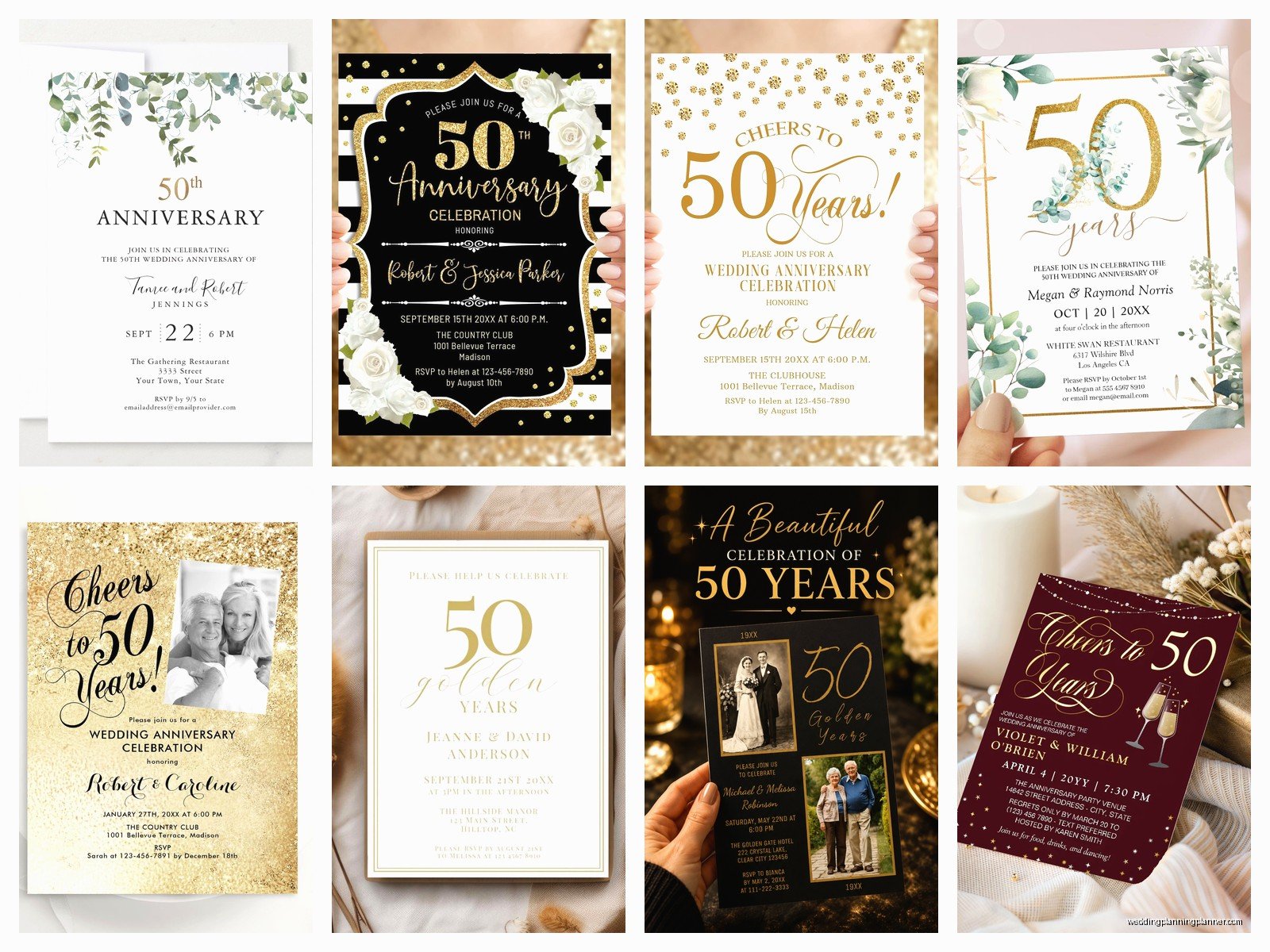
Other color combos that work: gold with deep burgundy, gold with forest green, gold with black (surprisingly elegant), cream with rose gold (softer look), white with champagne gold. Just test the readability – I’ve seen gold text on gold background and it’s basically unreadable for anyone over 60, which is probably most of your guest list.
What information you actually need to include
Okay so beyond the obvious stuff like date, time, and location, here’s what you should think about:
- The couple’s names – use their full names, and if the wife changed her name at marriage, use her married name
- The actual anniversary date (even if your party isn’t on that exact date)
- Whether it’s hosted by the couple or their children
- Dress code – older crowds especially appreciate knowing this
- RSVP information with a deadline that’s at least 2 weeks before the event
- Registry information if they’re doing that (some couples request donations to charity instead of gifts)
- Hotel recommendations if people are traveling
- Whether it’s adults-only or family-friendly
One thing people forget is meal information. If you’re serving dinner, say so. If it’s just cake and punch, definitely say that so people can eat beforehand. I learned this the hard way when… actually my cat interrupted me three times while I was trying to finish a proof last month and I accidentally left the meal info off a different client’s invitations and we had to do an email follow-up to everyone. Embarrassing.
Wording examples that don’t sound stuffy
The formal traditional wording is fine but sometimes it feels too stiff for what’s essentially a big party. Here’s some options:
If children are hosting:
“Join us in celebrating the 50th Wedding Anniversary of [Names]. Hosted by their children [names if you want]. Saturday, the fifteenth of June, two thousand twenty-five, at six o’clock in the evening. [Venue name and address].”
If the couple is hosting:
“[Names] request the pleasure of your company as we celebrate fifty years of marriage. [Date, time, location].”
More casual version:
“Fifty years together! Please join [Names] and their family for a Golden Anniversary celebration. [Details].”
You can also include a line like “Your presence is the only gift we need” if they really don’t want gifts, though in my experience people bring something anyway.
Photo invitations vs traditional cards
So there’s this trend now where people use a photo from the couple’s wedding day on the invitation, sometimes with a current photo too. It’s sweet and personal, but you gotta make sure the photo quality is good enough. Those old wedding photos from 1975 or whenever don’t always scan well, and if the photo is too busy it can make the text hard to read.
I usually recommend putting the photo on the back or inside of the invitation rather than competing with the text on the front. Or you can do a photo card as a separate insert – like the invitation is traditional and formal, but there’s a photo card tucked inside with a timeline of the couple’s life together. People love that stuff.
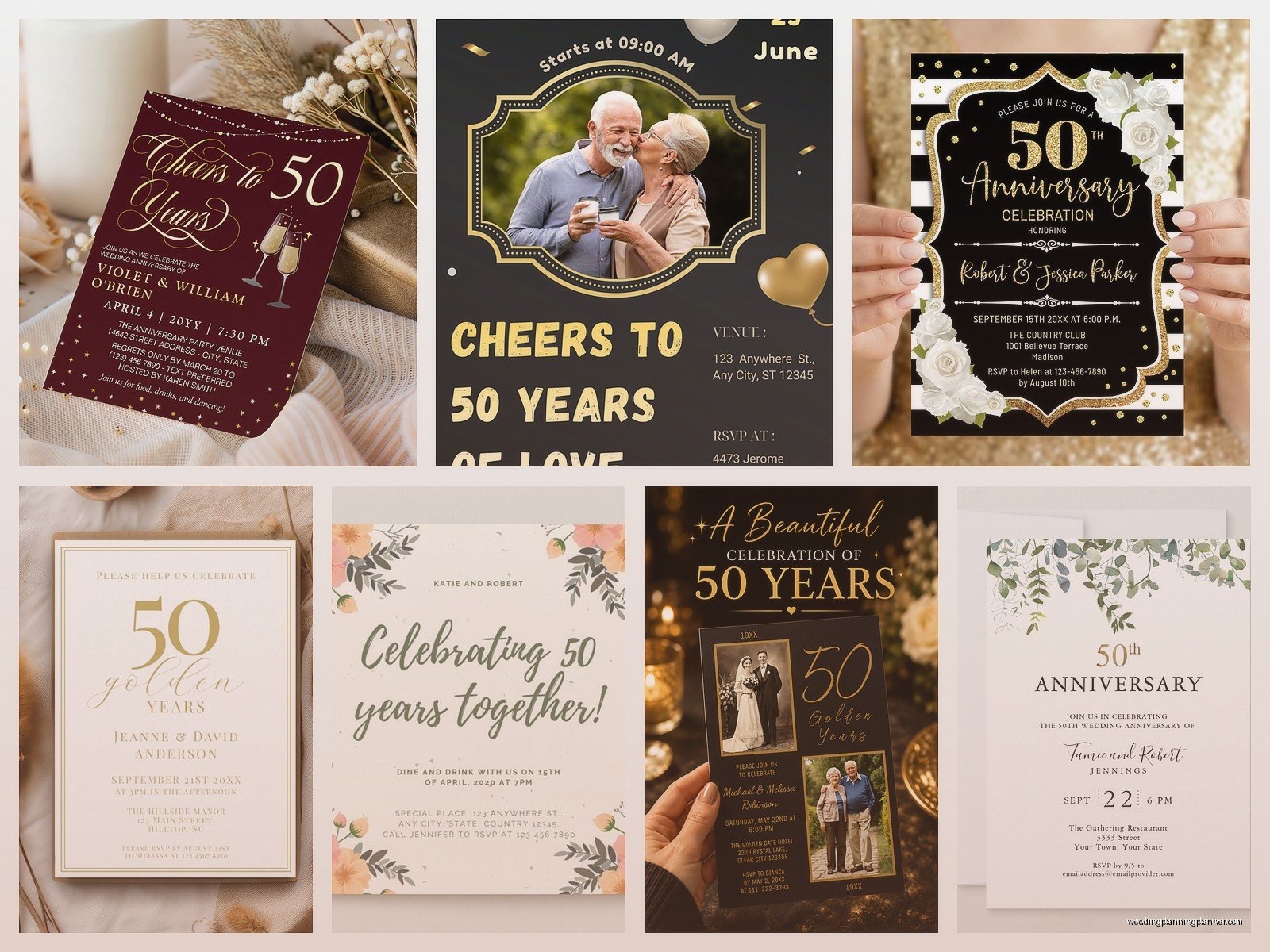
Just don’t use a blurry photo or one where you can barely see their faces. I’ve seen people try to use group wedding photos where the couple is tiny in the background and it just doesn’t work for an invitation. Get the photo professionally scanned and cleaned up if needed.
Paper stock and printing methods matter more than you think
Okay this is where I get a bit technical but it actually affects your budget and timeline. You’ve got options:
Digital printing: Most affordable, quick turnaround, works for most designs. Good for photo invitations. The quality is pretty great these days, honestly.
Thermography: That raised printing that looks kinda like engraving but isn’t. Nice traditional look, medium price point. Takes longer than digital.
Letterpress: Gorgeous, makes an impression (literally) in the paper, expensive, long lead time. If you want to splurge, this is where to do it.
Foil stamping: Metallic foil pressed into the paper. Perfect for gold accents on anniversary invitations. Can be pricey depending on how much coverage you want.
Engraving: The fanciest option, actual engraved printing plate, you can feel the impression on the back of the paper. Traditional and elegant but also the most expensive and longest timeline.
For paper weight, go with at least 110lb cardstock. Anything lighter feels flimsy for a milestone event like this. I personally like a subtle texture – linen or felt finishes photograph really well if people are gonna post them on social media, which let’s be honest, they probably will.
The invitation suite components
You don’t need all of these, but here’s what’s possible:
- Main invitation card
- RSVP card with envelope
- Details card (directions, hotel info, website)
- Photo insert or timeline card
- Envelope liner (adds a nice touch, totally optional)
- Belly band or ribbon to hold everything together
- Custom postage stamps if you’re feeling extra
Most people do the main invitation plus an RSVP card at minimum. The details card is helpful if you have a lot of logistical info that would clutter up the main invitation. For a 50th anniversary, I usually recommend at least three pieces – invitation, RSVP, and either a photo card or details card.
Digital invitations – are they okay for this?
Honestly? It depends on the couple and the crowd. I’ve definitely seen more digital invitations for anniversary parties post-2020, and for some groups it works fine. If the couple is tech-savvy and most guests are too, a really well-designed digital invitation can be elegant and save money and trees.
But for a 50th anniversary, you’re typically dealing with an older generation who appreciates traditional paper invitations. Also, there’s something about receiving a beautiful printed invitation in the mail that signals “this is a special event worth attending.” Digital can sometimes feel too casual for a golden anniversary milestone.
My compromise suggestion: send printed invitations to the older generation and close family, use digital for the younger crowd or people who you know prefer it. Or send printed invitations to everyone but also create a wedding website (or anniversary website I guess?) with all the details, RSVP portal, photos, etc.
Addressing and postage
Use full formal names and addresses. This isn’t the time for “The Smith Family” – write out everyone’s names properly. If you’re inviting a couple, it’s “Mr. and Mrs. John Smith” or “John and Mary Smith” depending on how formal you’re going. For unmarried couples living together, both names on separate lines.
Get the invitations weighed at the post office before you buy stamps. If your invitation suite is thick or has a square envelope or anything non-standard, it’ll need extra postage. I cannot tell you how many times I’ve seen people use regular stamps and then have invitations returned for insufficient postage. It’s gonna delay everything and you’ll have to remail them.
Consider hand-canceling if you have nice stamps or vintage stamps. You can request this at the post office – they’ll hand-stamp each envelope instead of running it through the machine, which prevents the envelopes from getting bent or the stamps from getting those ugly black lines through them.
Timing and ordering quantities
Order invitations at least 3 months before you need to mail them. That gives time for design, proofing, printing, and addressing. If you’re doing fancy printing methods like letterpress or foil, add another few weeks.
For quantities, count your guest list and add about 10-15% extra. You’ll want extras for the couple to keep, for last-minute additions to the guest list, for mistakes in addressing, and just in case. Trust me on this – running out of invitations and having to do a second smaller print run is way more expensive than ordering extras upfront.
Also keep a few blank ones aside before you address everything. People always want to see them, and it’s nice to have a pristine one for photos or for the couple’s memory book.
Common mistakes I see all the time
People forget to include the year on the invitation. Like they’ll put “June 15th” but not “2025” and then guests aren’t totally sure if it’s this year or next year, especially if you’re sending them way in advance.
Wrong RSVP deadline – make sure it’s actually before you need final headcount for catering. I usually do 2-3 weeks before the event.
No response mechanism – you need either RSVP cards with stamped return envelopes, or an email address, or a phone number, or a website. Don’t just put “RSVP by June 1st” with no way to actually respond.
Forgetting to tell people what kind of event it is – is this a formal dinner? A backyard barbecue? A cocktail reception? A church service followed by a party? Your guests need to know.
Using fonts that are too small or too decorative. Your guest list probably includes people in their 70s and 80s. Make sure the text is readable. I had a bride… wait sorry, a daughter of an anniversary couple… who insisted on this super swirly script font and we got so many calls from confused guests who couldn’t read the address. Just use something classic and legible for the important information, save the fancy fonts for accents.
Budget considerations because this stuff adds up
You can spend anywhere from like $2 per invitation to $20+ per invitation depending on what you choose. For a guest list of 100 people, that’s $200-$2000 just for invitations. Here’s where costs come from:
- Printing method (digital cheapest, engraving most expensive)
- Paper quality and weight
- Number of pieces in the suite
- Special finishes like foil or letterpress
- Custom design vs. template
- Envelope liners, ribbons, belly bands
- Professional addressing or calligraphy
Ways to save money without looking cheap: use a template design and customize it, stick with digital printing, skip the envelope liners, print your own details cards at home on nice paper, use online RSVP instead of printed cards, address envelopes yourself or use a nice computer font instead of calligraphy.
Places to splurge if you have budget: the main invitation printing quality, one special element like gold foil on the names, professional design if you want something totally custom, nice thick paper stock.
Working with a stationer vs DIY
Full disclosure, I’m obviously biased here, but there are times when DIY makes sense and times when you really should hire someone. If you’ve got design skills and the time to figure out printing specs and proofing and all that, DIY can save you money. There are good template sites out there.
But for a 50th anniversary, which is a pretty significant milestone, I usually think it’s worth having professional help. A good stationer will guide you through all these decisions, handle the technical printing stuff, make sure everything is worded correctly, and honestly just save you a ton of stress. During that Henderson project I mentioned earlier, the daughter initially tried to DIY and ended up coming to me after she’d already wasted money on a batch of invitations that had the wrong date printed on them. We got it sorted out but it would’ve been easier to start with a professional.
If you’re somewhere in between, you can do a hybrid – hire a designer for the layout but print yourself, or use a template but have a stationer handle the printing and assembly.
The other thing is that stationers have connections with printers and can often get better pricing than you’d get going directly to an online print shop. We also know which vendors are reliable and which ones are gonna mess up your order or miss your deadline.
Random practical stuff I just remembered
Oh, if you’re doing a surprise party, make sure the invitation clearly says that. Like “SURPRISE 50th Anniversary Celebration for [Names]” in big letters so nobody accidentally ruins it.
Include a rain date or rain plan if you’re doing an outdoor event. Or at least note on the details card what happens if weather is bad.
If the couple has dietary restrictions or you know many guests do, you can include a line on the RSVP card asking about dietary needs. Makes catering easier later.
Some people do a “no gifts please” thing but then also include registry info which is… contradictory? Either say no gifts and mean it, or don’t say anything and let people bring gifts if they want. The registry info can go on a details card or website, it shouldn’t be on the actual invitation anyway.
Envelope size matters for postage – square envelopes cost more to mail. Standard rectangular envelopes are cheapest. Just something to keep in mind if you’re watching budget closely or ordering a lot of invitations.